“Daily Financial Time”: “Uzbekistan 2030” Strategy is aligned with the UN Sustainable Development Goals
November 26, 2026. 20:00 • 2 min
• 43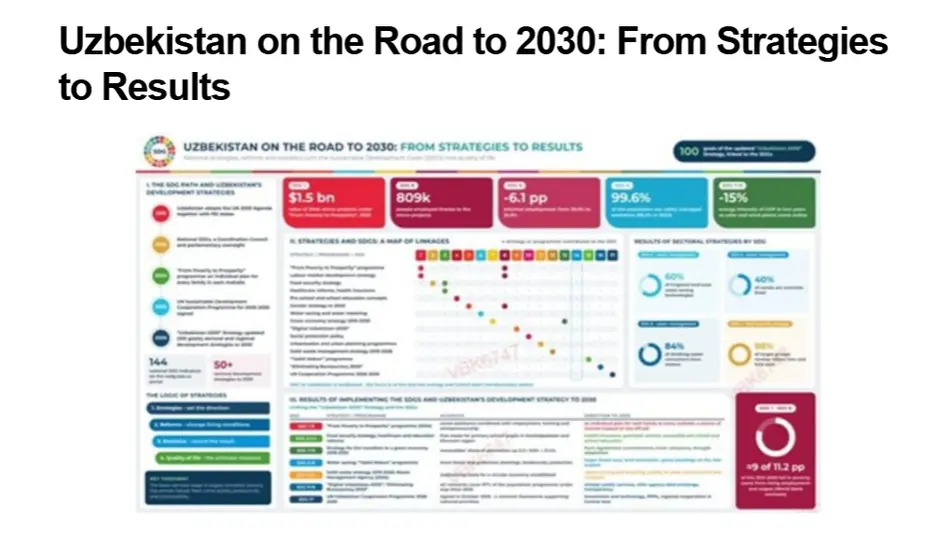
ISLAMABAD, November 26. /Dunyo IA/. Pakistani “Daily Financial Time” has published an article entitled “Uzbekistan on the Road to 2030: From Strategies to Results”, reports Dunyo IA correspondent.
Article recalls that Uzbekistan adopted the UN 2030 Agenda together with 192 other countries and provides a detailed analysis of how global goals are being translated into practical action.
Authors note that the National Statistics Committee maintains a framework of 144 national Sustainable Development Goal (SDG) indicators, with data available on the open portal nsdg.stat.uz. Uzbekistan presented two Voluntary National Reviews to the United Nations in 2020 and 2023; and preparations for the third are currently underway.
The SDGs have been integrated into the Uzbekistan 2030 Strategy and more than 50 sectoral development strategies through 2030. These strategies cover social protection, digitalization, gender equality and the green economy. In October 2025, Uzbekistan and the United Nations signed the Sustainable Development Cooperation Framework for 2026–2030.
Authors note that the priorities of the Uzbekistan 2030 Strategy and the national SDGs largely overlap. At the same time, specific mechanisms have been introduced in several areas that directly influence sustainable development indicators and the implementation of national strategies.
Article also examines the institutional dimension, including strengthening the rule of law, increasing transparency in public administration and combating corruption. These objectives are reflected in the priorities of the Strategy and in reforms aimed at digitalizing public services and reducing administrative barriers. Since 2026, “Eliminating Bureaucracy 2030” program has been underway. It provides for cutting excessive administrative procedures, simplifying public services, developing interagency data exchange and making government bodies more transparent.
In conclusion, authors emphasize that the stage of establishing the institutional framework for the SDGs and expanding access to basic services has largely been completed. Poverty has been reduced by almost half, access to electricity and drinking water, as well as school readiness, has become virtually universal, while the energy mix is undergoing rapid transformation.

Latest News





See all
Read also
Diplomacy Journal: New Constitution defines the Strategic Foundations of the Foreign Policy of Uzbekistan
Egyptian Media: New Constitution Strengthens the Legal Foundations of the Foreign Policy of Uzbekistan