«The National Interest»: Uzbekistan is increasingly a driving force for development and cooperation in Central Asia
September 04, 2026. 09:00 • 4 min
• 150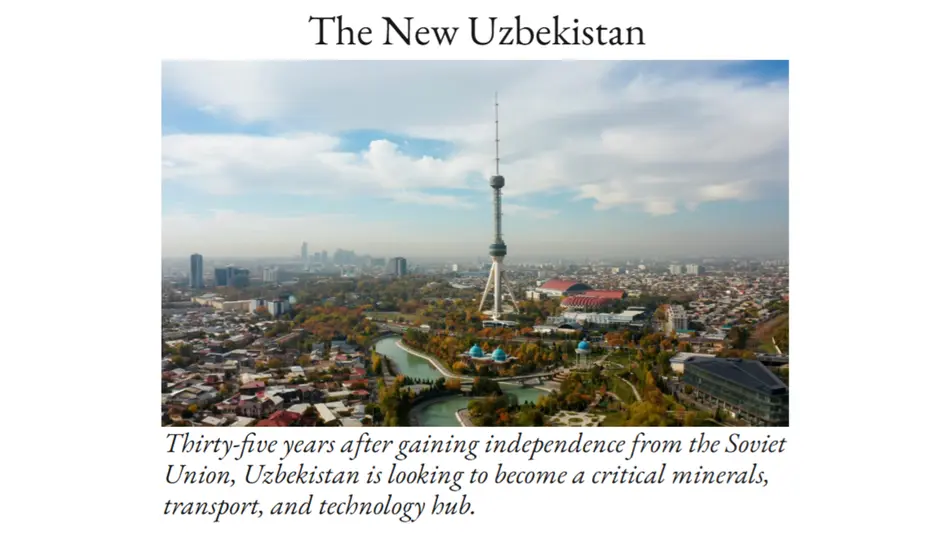
WASHINGTON, September 4. /Dunyo IA/. The influential American analytical publication The National Interest has published an interview with Ambassador of Uzbekistan Furqat Sidikov devoted to the 35th anniversary of the country’s independence, the transformation of the New Uzbekistan, and prospects for further deepening the Uzbek-American strategic partnership, reports Dunyo IA correspondent.
The publication was prepared by Andrew C.Kuchins, a senior fellow at the Center for the National Interest. The interview focuses particular attention on reforms in Uzbekistan, the development of the private sector, investment and technology cooperation with the United States, critical minerals, regional security, and prospects for cooperation in Central Asia.
The publication notes that over 35 years of independence, Uzbekistan has made significant progress in its development, while in recent years the country has entered a qualitatively new stage.
According to the ambassador, the concept of the New Uzbekistan today reflects the country’s profound transformation - its greater openness to the world, expanding opportunities for entrepreneurship, improved public services, development of education, and the active participation of young people in economic and public life.
A substantial part of the publication is devoted to the dynamics of Uzbek-American relations, which have now reached the level of an enhanced strategic partnership.
As noted in the interview, an important factor behind the current positive momentum is the political dialogue between President of Uzbekistan Shavkat Mirziyoyev and President of the United States Donald Trump. Agreements reached at the highest level have acquired concrete economic substance.
The publication highlights the establishment of the US-Uzbekistan Business and Investment Council, as well as the joint investment platform involving the U.S. International Development Finance Corporation (DFC), the U.S. Export-Import Bank (EXIM), and Uzbekistan’s Fund for Reconstruction and Development.
Particular attention in the interview is devoted to the development of the private sector and the improvement of Uzbekistan’s investment climate.
The reforms being implemented are aimed at reducing state ownership in the economy, expanding opportunities for private investment, and strengthening investor protection. An important element of these transformations will be the Tashkent International Financial Centre, whose legal framework will be based on English common law.
A separate section of the interview addresses cooperation in critical minerals, which is becoming increasingly important amid the formation of new global supply chains.
As Ambassador Furqat Sidikov emphasized, the interests of the two countries in this area are largely complementary: the United States is seeking to diversify sources of critical materials, while Uzbekistan is interested in attracting advanced technologies and investment, expanding processing capacity, and accessing new markets.
Workforce development is an important component of this cooperation. Together with the Colorado School of Mines, Uzbekistan is working to establish a Center of Excellence in geology, mining, and critical minerals at the University of Geological Sciences in Tashkent.
The interview also highlights Uzbekistan’s growing role in advancing regional connectivity.
The upcoming C5+1 Foreign Ministerial meeting in Samarkand is viewed as an opportunity to expand practical cooperation in trade, transport, energy, and regional security.
The publication also devotes attention to the historic qualification of Uzbekistan’s national football team for the 2026 FIFA World Cup.
According to the Uzbek ambassador, this sporting achievement has been not only a source of national pride but also an important factor in raising the country’s international visibility. According to the Tourism Committee, Google search interest related to Uzbekistan’s participation in the World Cup increased by 450 percent, while the tourism campaign accompanying the tournament generated more than 1.07 billion media impressions.
“For us, the World Cup was more than a sporting milestone. It brought people together and opened the door to new friendships,” Ambassador Furqat Sidikov said.
At the same time, the interview outlines Uzbekistan’s approach to Afghanistan, which emphasizes preventing the country’s isolation, providing humanitarian assistance, and involving Afghanistan in regional transport, energy, and infrastructure projects.
Overall, the publication of the interview provided a broad American expert and policy audience with an opportunity to learn more about the achievements of the New Uzbekistan and the key priorities of its ongoing reforms. It also highlighted the high level of the Uzbek-American strategic partnership and presented Uzbekistan’s position on pressing issues of the regional and international agenda.

Latest News
See all
Read also
Al Diplomasy: New initiatives aim to put Uzbekistan-Serbia cultural cooperation on a more systematic footing
Narendra Modi’s State Visit to Uzbekistan and SCO Summit in Focus of Indian Media