Amir Khan Muttaqi: Afghanistan extends a hand of cooperation to Central Asia
June 18, 2026. 14:30 • 5 min
• 2166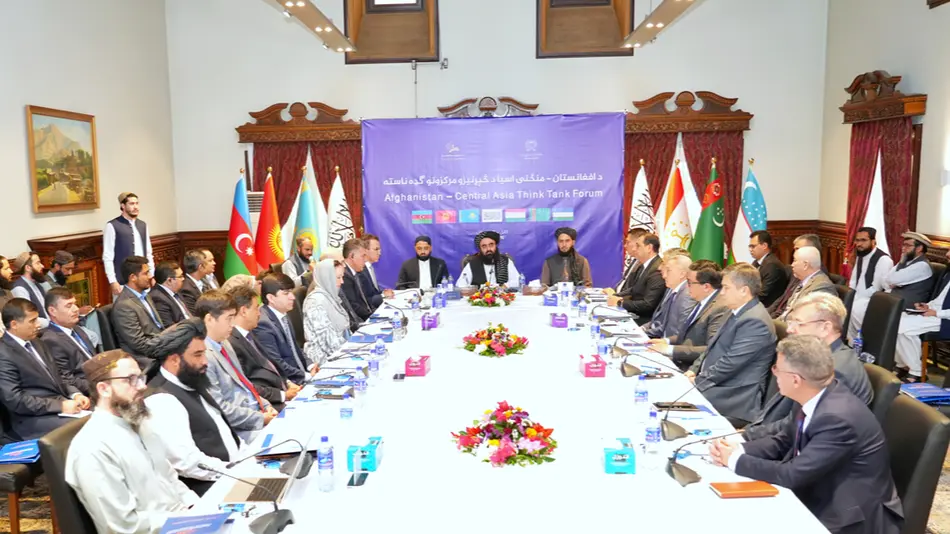
KABUL, June 18. /Dunyo IA/. On June 16, Kabul hosted the First Forum of Think Tanks from Afghanistan, Central Asian countries, and Azerbaijan, reports Dunyo IA correspondent.
According to the Institute for Strategic and Regional Studies under the President of Uzbekistan, the event was organized by the Center for Strategic Studies of the Ministry of Foreign Affairs of Afghanistan. The forum brought together representatives of the academic community, research institutions, and analytical centers of Uzbekistan, Kazakhstan, Kyrgyzstan, Tajikistan, Turkmenistan, Azerbaijan, and Afghanistan.
Discussions focused on trade and economic cooperation, the development of transport and transit connectivity, investment cooperation, climate challenges, regional security, and strengthening expert support for interstate dialogue.
Opening the forum, Afghanistan’s Foreign Minister Amir Khan Muttaqi outlined Kabul’s vision for the future of regional cooperation. In his assessment, the current international order is undergoing a “sensitive historical juncture,” in which, alongside contradictions and competing approaches, there is a growing drive among states toward collective cooperation and multilateral engagement. Against this backdrop, Afghanistan’s relations with the countries of Central Asia and Azerbaijan have “strengthened and expanded more than ever before,” the foreign minister noted, thanks to a pragmatic approach grounded in the pursuit of opportunities and mutual benefit.
“Today, we have gathered here not merely as representatives of our respective countries, but as thinkers and intellectual leaders of a shared geographical space,” Amir Khan Muttaqi stated. According to him, Afghanistan views Central Asia as a key partner and is interested in further expanding cooperation across all areas. “We need to develop a practical and comprehensive roadmap for our future partnership in various fields,” the minister stressed.
The speech clearly reflected Kabul’s openness to deeper engagement with regional countries and its readiness to act as a responsible participant in regional affairs. Amir Khan Muttaqi noted that the successful convening of the First Afghanistan–Central Asia Consultative Dialogue had established an important political foundation for further rapprochement. The next step, he suggested, could be the creation of sustainable expert mechanisms capable of translating political agreements into practical projects and solutions.
Economic connectivity featured prominently in the minister’s remarks. The Afghan foreign minister described Afghanistan as a “natural bridge linking Central and South Asia” and reaffirmed Kabul’s commitment to advancing the CASA-1000 project, the TAPI gas pipeline, the TAP project, the Lapis Lazuli Corridor, and the Trans-Afghan Railway. He emphasized that research institutions could play an important role in highlighting the economic benefits of these initiatives and strengthening mutual trust among regional countries.
The minister also focused on shared challenges. He noted that climate change, water scarcity, environmental degradation, and the consequences of conflicts affect economic development, transport links, food security, and energy security. “These threats do not recognize political borders,” Amir Khan Muttaqi stressed, advocating collective solutions based on scientific analysis and expert assessments.
A key theme of the speech was the development of an independent regional agenda. According to Afghanistan’s foreign minister, the countries of the region possess sufficient intellectual, economic, and political potential to define their own development priorities. “Our opportunities, challenges, and shared future require our own internal vision,” he noted, emphasizing the ability of researchers from Afghanistan, Central Asia, and Azerbaijan to independently assess regional developments and propose solutions that serve the interests of regional states.
“Today, more than ever, it is important that researchers from our region speak for themselves about its realities, opportunities, and challenges,” the minister stated, calling for expanded knowledge-sharing, joint research, and sustained expert dialogue.
Amir Khan Muttaqi expressed confidence that think tanks can become an important instrument of regional diplomacy. “Research centers are not merely academic institutions; they can serve as intellectual partners and driving forces of regional diplomacy,” he stated. In this regard, he proposed establishing a sustainable network of cooperation among the region’s research institutions, developing joint research programs, and facilitating regular exchanges of expert assessments.
Concluding his remarks, Afghanistan’s foreign minister stressed that the region’s future depends on stronger cooperation, mutual trust, and regional connectivity. “A stable, prosperous, and secure future for all countries of the region can only be achieved through cooperation, mutual trust, regional connectivity, and an understanding of our shared interests,” he stated. He also emphasized that “Afghanistan’s researchers and thinkers are extending a hand of academic partnership to researchers in other countries,” reaffirming Kabul’s commitment to long-term and mutually beneficial ties with the countries of Central Asia and Azerbaijan.
Earlier, Tashkent hosted the international Termez Dialogue on Connectivity between Central and South Asia, which likewise brought together representatives of the expert community, think tanks, and government institutions from across the region. On the sidelines of the event, experts from Central Asia and Afghanistan held a separate meeting to discuss prospects for expanding regional cooperation, enhancing transport and transit connectivity, and advancing security and economic partnerships. Among other issues, participants considered the substantive agenda for the upcoming Forum of Think Tanks in Kabul, viewing it as an important step toward institutionalizing expert dialogue among Afghanistan, the countries of Central Asia, and Azerbaijan.
It is worth noting that earlier, from June 4 to 6, Tashkent hosted the International Termez Dialogue on Connectivity between Central and South Asia, which also brought together representatives of the expert community, think tanks, and government institutions of regional countries. Within the framework of the event, a separate meeting of experts from Central Asia and Afghanistan was held, during which participants discussed prospects for expanding regional cooperation, developing transport and transit connectivity, as well as issues of security and economic partnership. Among other topics, the participants also considered the formation of a substantive agenda for the upcoming Think Tank Forum in Kabul, which was viewed as an important step towards institutionalizing expert dialogue between Afghanistan, Central Asian countries, and Azerbaijan.

Latest News


See all
Read also

Natasha Azzopardi-Muscat: Access to Medicines and Early Diagnosis to become key pillars in developing pediatric oncology in Uzbekistan