“Gulf Times” Newspaper: Human Rights and Dignity at the Heart of the Reform Agenda of Uzbekistan
November 09, 2026. 17:30 • 3 min
• 5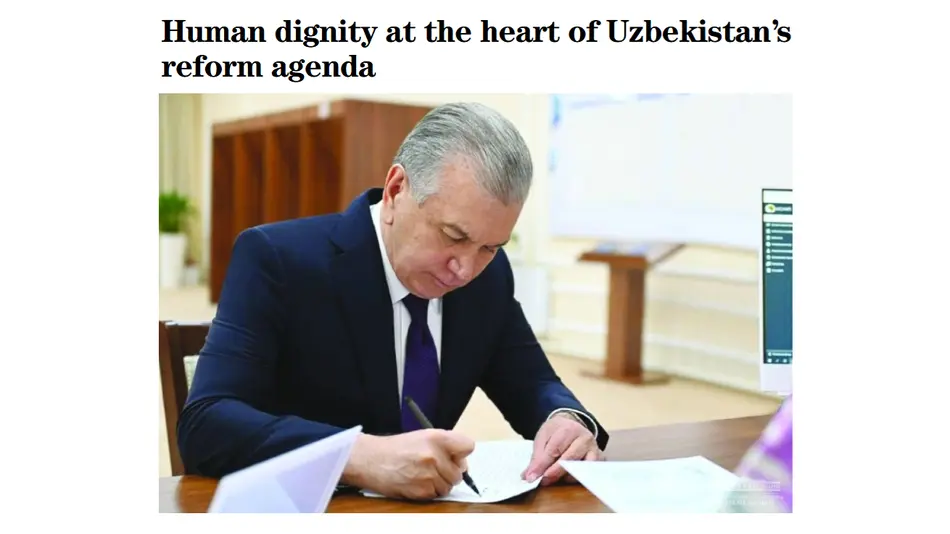
DOHA, November 9. /Dunyo IA/. Qatar’s leading newspaper “Gulf Times” has published an article by Feruza Eshmatova, Commissioner of Oliy Majlis of Uzbekistan for Human Rights (Ombudsman), entitled “Human Dignity at the Heart of Uzbekistan’s Reform Agenda”, reports Dunyo IA correspondent.
Author notes that, for President Shavkat Mirziyoyev, the country’s progress is measured not only by macroeconomic indicators and the facilities constructed, but also by qualitative changes in people’s everyday lives. The current course of development is based on the Constitution of Uzbekistan, adopted in 2023, which proclaims Uzbekistan a social state where the human being, their life, freedom, honour and dignity are the supreme value. Human rights are directly applicable, while contradictions and ambiguities in legislation are interpreted in favour of the individual.
According to the author, over the past decade, schools with a capacity of 1.5 million students, kindergartens for 342,000 children and hospitals with 62,000 beds have been built in the country. Residential buildings housing more than 8 million people have also been connected to district water supply networks. Article also describes a new model of interaction between people and the state. The mahalla is identified as one of its practical embodiments: the “Mahalla Seven” system identifies problems at the family level, while more than 100 types of social services are made available to residents through “Inson” centers on a one-stop-shop basis.
Feruza Eshmatova also writes about poverty reduction, which combines vocational training, job creation, preferential loans, subsidies and the allocation of land plots. In the field of gender equality, liability for domestic violence and sexual harassment has been strengthened. According to the author, the Law “On the Rights of Persons with Disabilities”, adopted in 2020, and the ratification of the UN Convention on the Rights of Persons with Disabilities in 2021 marked a change in approach: persons with disabilities are recognized as independent rights holders. This approach also extends to places of detention. Under a “roadmap” developed at the initiative of the Ombudsman, ramps have been installed in a number of penal institutions, Braille books have been supplied, and sanitary facilities have been adapted.
A significant part of the article is devoted to civil society. NGOs, human rights defenders, journalists and bloggers participate in public oversight, while the Ombudsman serves as a link between the individual and the state: examining appeals, recommending measures to address shortcomings and conducting monitoring visits to closed institutions together with public groups.
In conclusion, author recalls the seven national programs announced by the President on the occasion of the 35th anniversary of independence. They focus on knowledge and skills, healthy lives, a high-tech economy, a new approach to water resources and the environment, judicial independence and the rule of law, expanding the role of mahallas and strengthening the image of Uzbekistan as a peaceful and hospitable country. In Feruza Eshmatova’s view, respect for human dignity strengthens confidence in justice and sets in motion a “virtuous cycle” of self-sustaining democracy and progress.

Latest News




See all
Read also

Experience of Uzbekistan in Tourism Development is also Valuable for Pakistan
“Perspektywy”: Central Asia holds Enormous Potential for the Development of International Educational Cooperation

Germany Trade & Invest: Uzbekistan Focuses on Renewable Energy and Attracting Leading Global Investors