Uzbekistan’s approaches to strengthening the partnership between Central Asia and Europe presented at the Berlin Conference
November 27, 2026. 17:50 • 3 min
• 202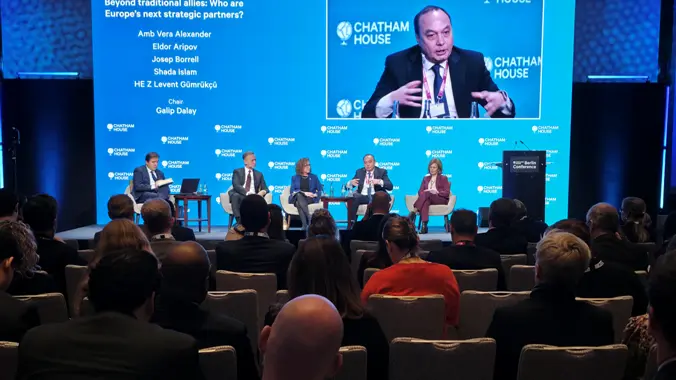
BERLIN, November 27. /Dunyo IA/. On November 25-26th, Eldor Aripov, Director of the Institute for Strategic and Regional Studies under the President of Uzbekistan (ISRS), participated in the Chatham House Berlin Conference 2026, held under the theme “Securing Europe’s strategic autonomy in a volatile world”, reports Dunyo IA correspondent.
Chatham House Berlin Conference is an International Forum established in 2014. It brings together representatives of government institutions, business, and academia to examine issues of European security, economic development and Europe’s role in a shifting global order.
Organised by the Royal Institute of International Affairs (Chatham House), the event brought together government officials, parliamentarians, diplomats, business representatives and academics from more than 20 countries across Europe, Asia and North America.
Discussions focused on European security, economic resilience and the expansion of international partnerships.
Eldor Aripov spoke at the session “Beyond traditional allies: Who are Europe’s next strategic partners?”, presenting approaches to advancing cooperation between Central Asia and European countries.
ISRS Director emphasised that the open and constructive policies pursued by President of Uzbekistan Shavkat Mirziyoyev have strengthened the atmosphere of trust and good neighbourliness in Central Asia. More active regional dialogue, expanding trade and economic ties; and the implementation of joint infrastructure projects are creating new opportunities for sustainable development and cooperation with external partners.
He paid particular attention to the significance of the first “Central Asia–European Union” Summit, held in Samarkand in April 2025. He noted that the elevation of relations to a strategic partnership marked a new phase in engagement between the two regions and laid the groundwork for deeper, long-term, mutually beneficial cooperation.
Turning to promising areas of partnership, Eldor Aripov highlighted industrial cooperation and the development of joint value chains, including in critical mineral resources, alongside stronger transport connectivity. He underscored the importance of European investment and technology in modernising Central Asian economies and improving access to European markets for the region’s products.
Eldor Aripov noted that Europe’s resilience and prosperity depend to a considerable extent on the stability of its partners. For Central Asian countries, economic independence and diversified external ties underpin their development as sovereign states. Cooperation with the European Union is viewed as an important additional source of support for modernization, without replacing relations with traditional and longstanding partners with whom the region maintains close, good-neighbourly ties.
In this context, he emphasized that, by opening up new opportunities for investment, technology and transit in Central Asia, Europe contributes to greater resilience and predictability in the region, thereby supporting its own long-term development.
In conclusion, ISRS Director stressed the importance of regular dialogue among experts to develop concrete proposals for further strengthening the partnership between Central Asia and Europe.

Latest News
See all
Read also

Uzbekistan Delegation in London, United Kingdom, studies British Experience in Financing Education and Healthcare