Tashkent is building a New Model of Partnership in which Distance is Offset by a Convergence of Interests
November 20, 2026. 09:30 • 3 min
• 140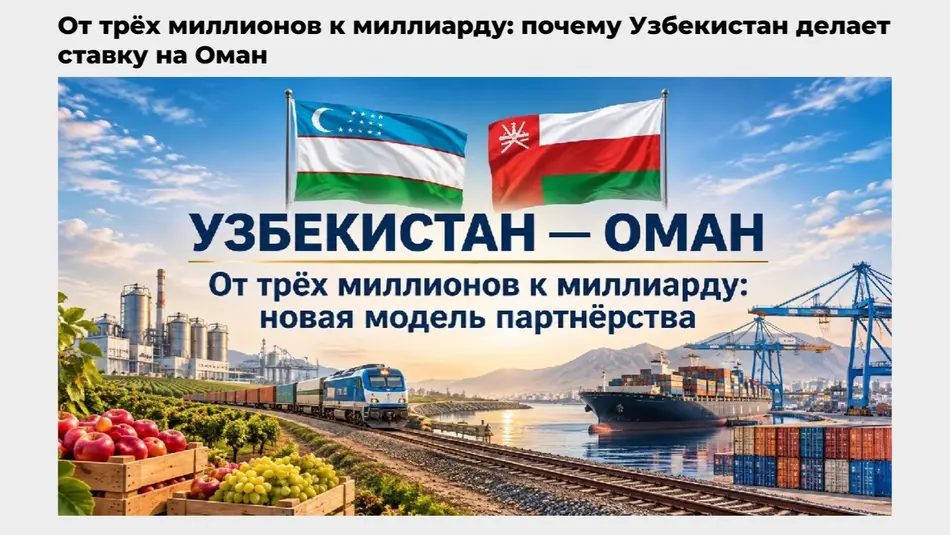
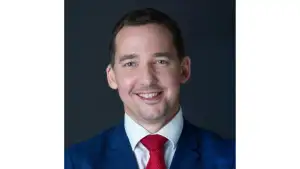
TEL AVIV, November 20. /Dunyo IA/. Israeli portal “Isiwis” has published an article by political analyst and PhD Yuri Bocharov entitled “From Three Million to One Billion: Why Uzbekistan Is Betting on Oman”, reports Dunyo IA correspondent.
Author recalls that, following the state visit of President Shavkat Mirziyoyev to Oman, relations between the two countries were elevated to the level of a strategic partnership. The sides exchanged more than 30 documents, while a portfolio of joint projects worth $5 billion was presented at the Uzbekistan–Oman Business Forum, along with the goal of increasing bilateral trade turnover to $1 billion. At the same time, bilateral trade turnover amounted to approximately $3.2 million in the first nine months of 2026. In the author's view, geographical distance and complex logistics make traditional trade in finished products, such as fruit and vegetables, less viable due to high transportation costs, even though Oman's self-sufficiency in fruit, excluding dates, stands at only around 24 percent.
Political analyst argues that the way forward lies in moving beyond conventional trade towards joint economic activity involving investment, the establishment of enterprises and transport chains, and access to third-country markets. He notes that in June 2026, the Omani group “Asyad” acquired controlling stakes in two Uzbek logistics companies, while discussions in Muscat covered the development of logistics infrastructure at Sohar Port, an integrated trade and logistics platform, and air cargo services. The President of Uzbekistan announced plans for joint production of cable and transformer products, as well as projects in the chemical industry, geological exploration and energy. The sides agreed to increase the charter capital of the Uzbek-Omani Investment Company to $500 million and consider the establishment of a commercial bank.
Author acknowledges that the announced project portfolio has yet to be translated into operational enterprises and actual contracts, but considers it inappropriate to assess the prospects for cooperation solely on the basis of current bilateral trade turnover. In his view, joint production and transport infrastructure can generate trade flows that did not previously exist.
In conclusion, Yuri Bocharov observes that the key outcome of the visit is that Tashkent is building a new model of partnership in which shared interests bridge geographical distance, and that this approach deserves support.

Latest News


See all
Read also
View from Dushanbe: Uzbek-Omani Strategic Partnership acquires a Broader Regional Dimension

View from Moscow: Agreements reached in Muscat can ensure an inflow of stable long-term investments to Uzbekistan and expand access to Oman’s Port Infrastructure