
Major Automotive and Air Transport Projects implemented in Uzbekistan
June 09, 2026. 10:25 • 3 min
• 73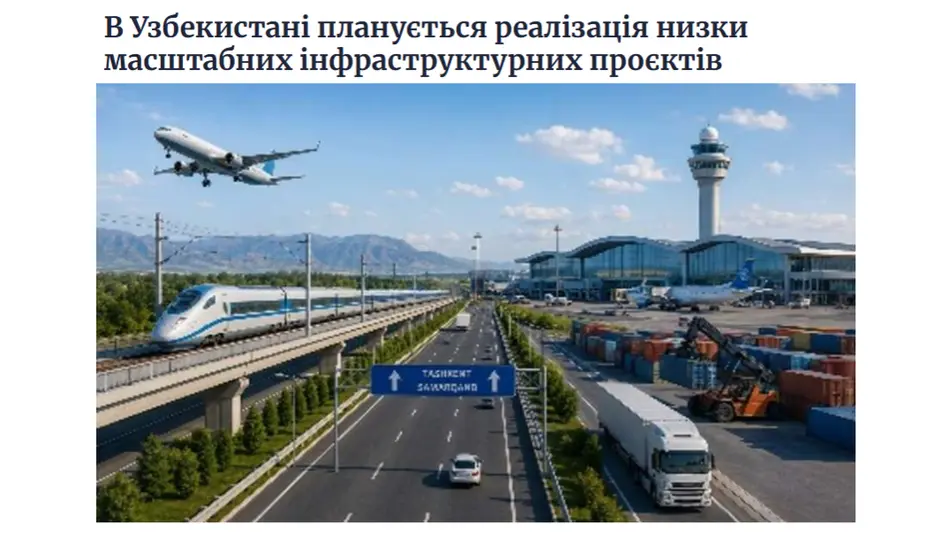
KYIV, June 9. /Dunyo IA/. A series of large-scale infrastructure projects aimed at developing regional transport connectivity, logistics, and the country's transit potential are planned for implementation in Uzbekistan, reports Dunyo IA correspondent, citing with Ukrainian information portals “Open4business” and “Fixygen”.
One of the key projects will be the construction of the “Tashkent – Samarkand” alternative highway. The new 282-kilometer route will pass through the Tashkent, Syrdarya, Jizzakh and Samarkand regions. The category-one road, featuring a cement-concrete surface and six traffic lanes, will allow for speeds of up to 150 km/h.
The project provides for the construction of 12 interchanges, 91 bridges, 16 overpasses, 60 tunnel crossings, and more than 250 drainage structures. It also plans the implementation of an intelligent transport system, as well as the construction of terminals, roadside service facilities, and weigh stations.
In parallel, the modernization of aviation infrastructure continues. Currently, seven international airports are being reconstructed. In recent years, new air harbors have emerged in Muynak, Kokand, Zaamin, Shahrisabz, Sariasia and Sokh districts. The total number of airports in the country has reached 18.
Particular attention is paid to developing the Navoiy International Airport as a major logistics hub. By 2030, the number of flights here is planned to increase 2.3 times - up to 7,000 per year. Passenger traffic is expected to reach 150,000 people, and cargo transportation - 45,000 tons annually. The creation of a “porto-franco” free economic zone is also slated for the airport territory to provide technical and commercial services to aircraft.
Work also continues on the “New Tashkent” International Airport project. The new aviation complex will be able to serve up to 20 million passengers per year. The project includes the construction of a terminal with an area of more than 208,000 square meters, two four-kilometer runways and 169 aircraft parking spaces.
Another important direction will be the development of the aviation fuel supply system for civil aviation. By 2030, jet fuel production is planned to reach 600,000 tons per year, and storage capacities will be increased from 49,000 to 80,000 tons. New fuel complexes will be built at the airports of Navoiy, Andijan, Bukhara, Urgench and New Tashkent.
In addition, a phased transition to international standards for aircraft storage and refueling, the digitalization of fuel infrastructure management, and stricter control over compliance with technological requirements are envisioned.

Latest News




See all