Japanese media highlight the “Noriko” Japanese Language School in Rishtan
November 22, 2026. 12:30 • 2 min
• 209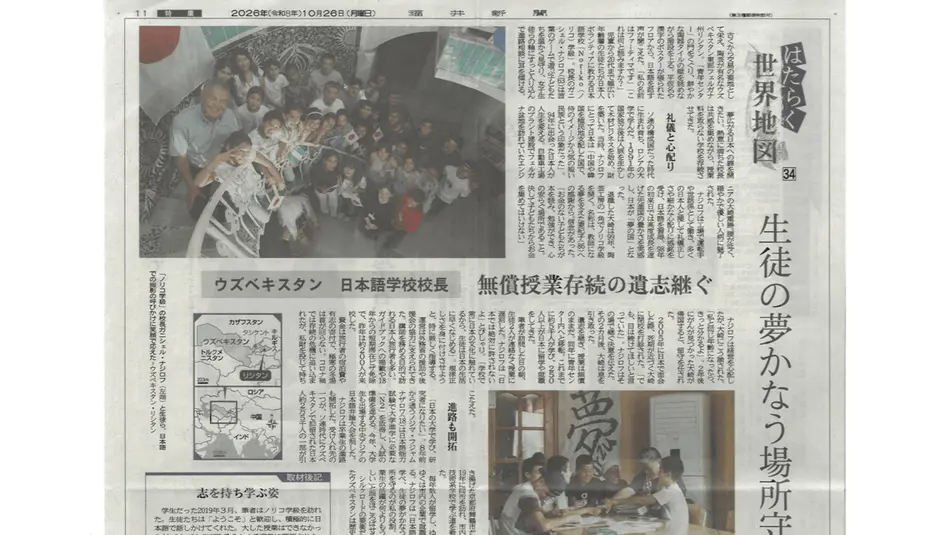
TOKYO, November 22. /Dunyo IA/. In October and November, eight Japanese newspapers – Kyoto Shimbun, To-o Nippo, Nishi-Nippon, Chunichi, Chubu Keizai, Hokkoku, Yamagata, and Fuku – published articles about the free “Noriko” Japanese Language School in Rishtan District of Fergana Region and its director, Ganisher Nazirov, reports Dunyo IA correspondent.
The school has been operating for nearly 27 years. According to its figures, around 5,000 young people have studied Japanese there, approximately 300 of whom have continued their education in Japan. Some graduates now work for Japanese companies, while others have established their own businesses in Uzbekistan.
The school's history dates back to November 19, 1999, when it was founded on the initiative of Shigekatsu Osaki, an engineer with Japanese company Komatsu. During a business trip to the Fergana Valley, he was impressed by the hospitality of local residents and young people's eagerness to learn. After retiring, he and his wife, Noriko, established a free language school using their personal funds and named it after her.
Local educator Ganisher Nazirov, who had independently learned Japanese, was involved in the project from its early stages. Following Osaki's death in 2005, he continued his work while preserving the school's fundamental principle of free education. That same year, the school moved to the building that now houses the Youth Center, with support from Japan's Ministry of Foreign Affairs under its Grant Assistance for Grassroots Human Security Projects programme.
Classes are conducted primarily by volunteer teachers arriving from Japan. In addition to language instruction, students are encouraged to embrace values traditionally associated with Japanese society, including diligence, discipline, punctuality, respect for elders, and a sense of responsibility.
The Japanese publications also put forward recommendations for the school's further development, including attracting more volunteers, providing modern textbooks, expanding online interaction, introducing scholarship programmes for talented graduates, and establishing an alumni network to support mentorship.

Latest News




See all
Read also
“The Nation”: Freedom of conscience firmly guaranteed as a constitutional right in Uzbekistan