Indian Magazine Highlights Navruz Celebrations in Uzbekistan
March 21, 2026. 10:00 • 3 min
• 1335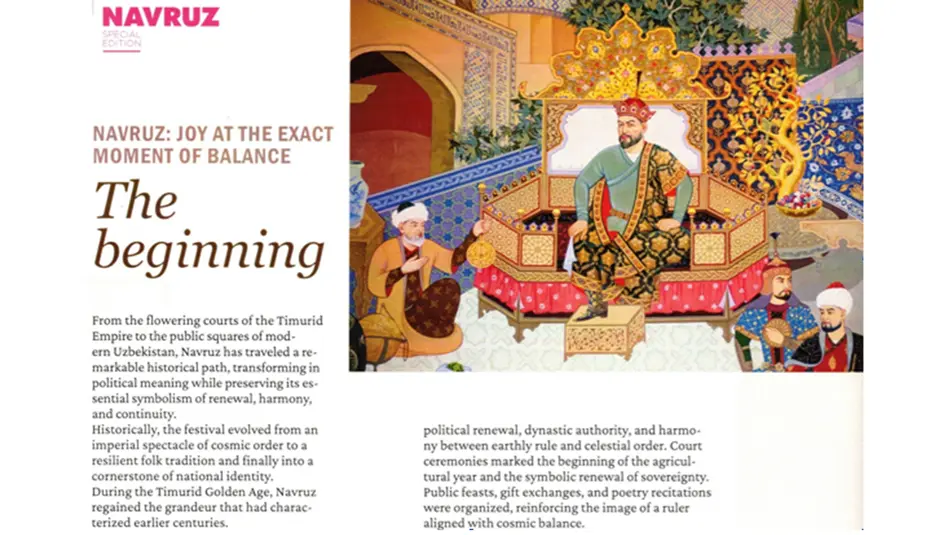
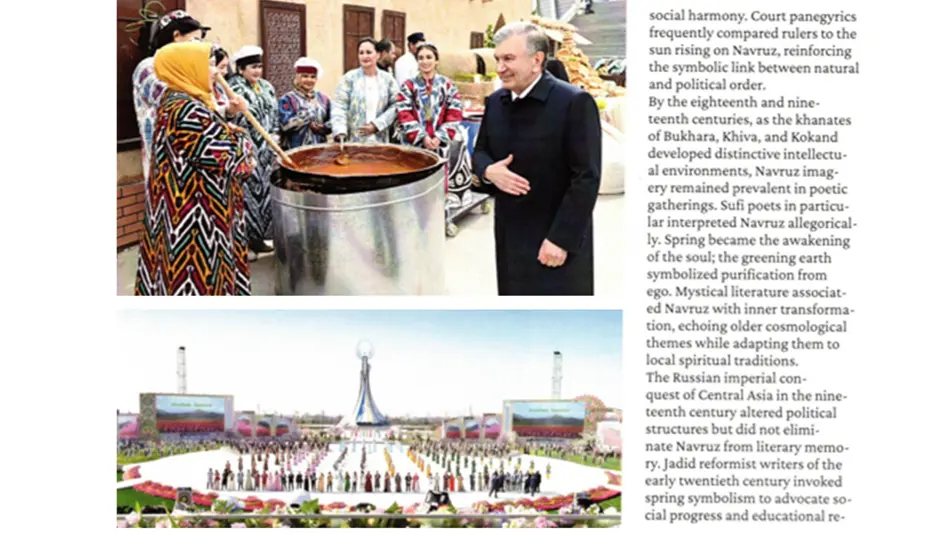
DELHI, March 21. /Dunyo IA/. The Indian publication “Business Central Asia” has dedicated a series of articles to the celebration of Navruz in Uzbekistan, reports Dunyo IA correspondent.
In the lead-up to the spring equinox, the magazine published an in-depth analytical article in which Navruz is considered not only as a calendar ritual but also as a key element of cultural identity, evolving over centuries – from the astronomical discoveries of Mirzo Ulugbek to the works of Alisher Navoi.
The authors trace the historical evolution of Navruz in Uzbekistan. The publication notes that the holiday, which originated as a symbol of cosmic order, reached particular prominence during the Temurid era.
For Amir Temur, Navruz became a tool of cultural legitimacy, linking celestial order with earthly authority. Special attention is given to the contributions of Mirzo Ulugbek. Thanks to his scientific work at the Samarkand observatory, the holiday gained a profound astronomical dimension, connecting traditional celebrations with precise scientific calculations, the magazine notes.
“Navruz functioned simultaneously as a cultural festival and a reflection of Central Asia’s deep knowledge in astronomy and mathematics,” the publication emphasizes.
Business Central Asia notes that, despite ideological restrictions during different periods of history, Navruz was preserved thanks to the dedication of the Uzbek people and later returned to public life during the years of independence, becoming an official symbol of national renewal.
The second article focuses on the reflection of Navruz in Uzbek literature. The publication highlights that in poetic tradition, the holiday has evolved from a simple date into a multilayered symbol.
A central place in the analysis is given to the works of the great Alisher Navoi. The authors examine his ghazals in detail, showing how the poet incorporates the image of Navruz into his works.
The publication also refers to the memoirs of Zahiriddin Muhammad Babur, who warmly described the gardens of Andijan and the spring atmosphere of Samarkand, as well as later literary traditions. For modern writers, Navruz has become a bridge connecting ancient roots, the Temurid Renaissance, and the modern identity of Uzbekistan.
The materials in “Business Central Asia” are notable for presenting Navruz not merely as an ethnographic ritual, but as a living philosophy of the Uzbek people.

See all