Chintan Research Foundation: Uzbekistan has chosen dignity over domination, dialogue over perpetual confrontation, and strategic agency over dependence
October 15, 2026. 17:20 • 5 min
• 82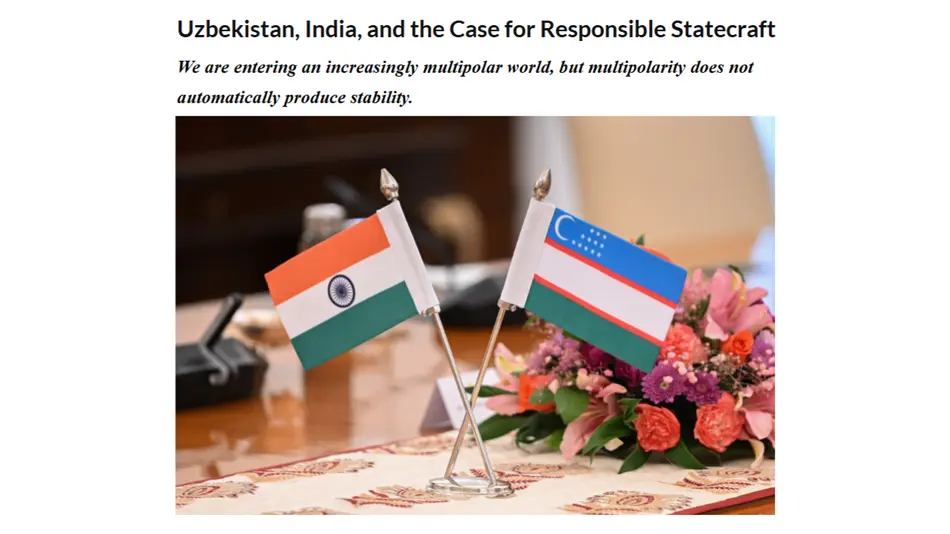
TASHKENT, October 15. /Dunyo IA/. In their article, Javier M. Piedra and Sumeer Bhasin examine the address delivered by Saida Mirziyoyeva, Head of the Administration of the President of Uzbekistan, at the 81st session of the United Nations General Assembly as an example of responsible statecraft and compare it with India’s experience of strategic autonomy, reports Dunyo IA correspondent.
The authors emphasise that, despite the differences between the two countries, their approaches to the world order, development and security follow a similar logic.
Chintan is a leading Indian analytical platform with close ties to the ruling Bharatiya Janata Party. It publishes expert analysis on international affairs, promoting the idea of India’s strategic autonomy and its role as a voice of the Global South.
Javier M. Piedra is a financial consultant, geopolitical analyst and international development specialist with many years of experience in Central Asia. He and Sumeer Bhasin are experts at Chintan, an Indian think tank specialising in international affairs.
I. As the authors note, at the 81st session of the UN General Assembly on 23 September, Saida Mirziyoyeva answered the question of choosing between “East and West” by stating that Uzbekistan’s choice was “human dignity”, together with openness and dialogue.
In her words, power is not above the law. The authors stress that these statements cannot be regarded merely as moral declarations, as they reflect a pragmatic understanding of a changing order in which multipolarity alone does not guarantee stability.
In this context, they draw attention to the alignment between this position and India’s path from the Non-Aligned Movement towards strategic autonomy and multi-alignment. India engages with the United States while maintaining relations with Russia, participates in the Quad while remaining a member of BRICS and the Shanghai Cooperation Organisation (SCO), and builds ties with all actors in West Asia.
The objective, in the authors’ view, is not neutrality for its own sake, but the preservation of strategic freedom of choice. Nevertheless, they highlight a parallel with Saida Mirziyoyeva’s formulation that engagement does not imply direct support, dialogue does not amount to surrender, and independence does not require isolation.
II. The authors also note a deeper civilisational similarity between the two approaches. The Indian concept of Vasudhaiva Kutumbakam (“the world is one family”) places human well-being above geographical, ideological, ethnic and religious divisions. During India’s G20 presidency, it was embodied in the theme “One Earth, One Family, One Future”.
The authors see a direct parallel here with her view that a state’s strength is measured not only by its military and economic capabilities, but also by its ability to protect people’s dignity, rights and interests.
According to the authors, the results of domestic reforms provide evidence of this approach. India’s multidimensional poverty rate fell from 29% in 2013–2014 to 11% in 2022–2023, while Uzbekistan’s economy grew from approximately $50 billion to $147 billion and its poverty rate declined to 4%, alongside a reduction in infant mortality and an increase in life expectancy. The overall conclusion is that the true value of reforms must be evident in people’s lives.
III. The authors pay particular attention to Afghanistan, where, in their assessment, the similarity between the two countries’ positions is most apparent.
They cite Saida Mirziyoyeva’s argument that viewing Afghanistan solely as a source of threats will not resolve the problem facing the region, and recall that governments change, while geography, peoples and enduring interests remain.
In this context, India’s engagement with Kabul encompasses infrastructure, education, healthcare, capacity building, trade and people-to-people ties, rather than being confined to intergovernmental contacts.
Afghanistan is viewed as a key hub in an interconnected strategic space linking Central Asia, Iran, South Asia and the Persian Gulf.
For this reason, the authors argue, Uzbekistan’s doctrine represents pragmatic policy rather than idealism detached from geopolitics.
IV. In the concluding part of the article, the experts turn to global governance. In their view, Saida Mirziyoyeva’s call for reform and expansion of the UN Security Council, together with Uzbekistan’s forthcoming chairmanship of the Non-Aligned Movement, fits into a broader trend in which the Global South is increasingly refusing to serve as an arena for great-power rivalry.
They emphasise that the Global South does not seek to create another rigid bloc, but instead seeks genuine agency: the ability to defend its interests and participate in shaping international institutions.
The authors also cite Narendra Modi’s observation that the Global South now finds itself in the front row of global crises but in the back row of decision-making, and call for this “pyramid of privilege” to be transformed into a “platform of partnership”.
The authors extend the same principle to artificial intelligence. Saida Mirziyoyeva’s question – whether technology serves people or people are compelled to adapt to technology – closely aligns with India’s approach to AI regulation, which emphasises transparency, accountability and continued human oversight.
V. Overall, the authors conclude that human dignity, dialogue, sovereign choice, inclusive development, the responsible use of technology and the prioritisation of engagement over isolation form a coherent philosophy of governance.
In their view, rejecting a binary geopolitical choice does not amount to passivity: a country can engage with competing powers without becoming subordinate to them, while also strengthening its economic capacity and measuring development by improvements in people’s lives.
The experts recognise that Uzbekistan has chosen dignity over domination, dialogue over perpetual confrontation, and strategic agency over dependence.
In the new multipolar order, as the world is once again tempted to divide into competing camps, such responsible statecraft may prove not only morally persuasive but strategically indispensable.

Latest News

See all
Read also

View from Madrid: Uzbekistan promotes agenda of mutually beneficial partnership and sustainable development within the CIS space

Shogo Aoki: Asian Games strengthened ties of friendship between Nagoya and Uzbekistan