President of Uzbekistan was briefed on measures aimed at developing the silk industry based on a new system
February 17, 2026. 17:51 • 4 min
• 85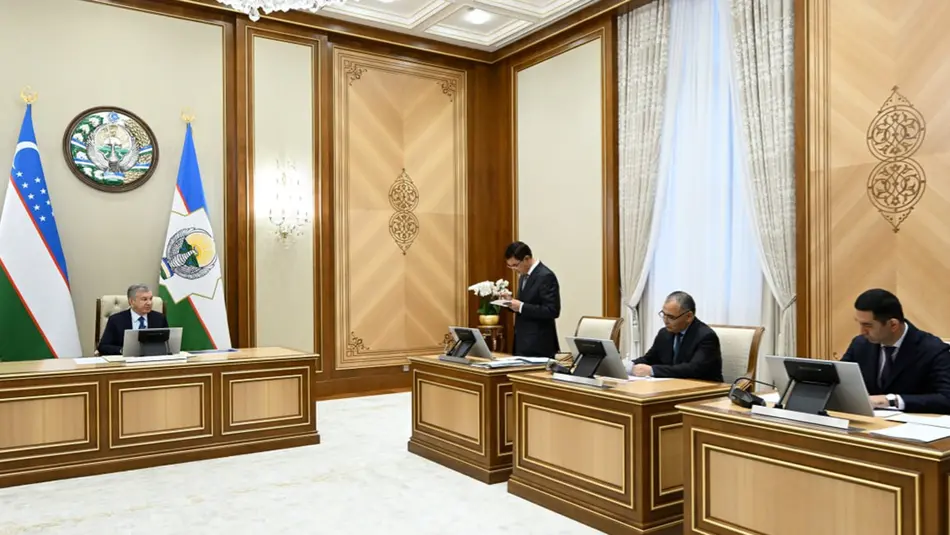
ТASHKENT, February 17. /Dunyo IA/. President Shavkat Mirziyoyev was briefed on measures aimed at developing the silk industry, reports Dunyo IA correspondent.
According to the press service of the Head of our State, in Uzbekistan, sericulture and the procurement of silkworm cocoons play an important role in providing the population with profitable work, increasing employment in rural areas, and expanding export potential. However, challenges accumulated at all stages, from the fodder base to cocoon processing, hinder the full realization of the industry’s potential.
In particular, a significant share of silkworm eggs is imported. It was noted that by 2030, the use of local silkworm eggs can be increased to 75 percent, which requires the restoration of breeding stations.
During the presentation, plans were reported to establish breeding stations in the Fergana and Khorezm regions for the production of elite silkworm egg varieties, as well as to create two new silkworm egg production enterprises this year in the Bukhara and Namangan regions in addition to the 10 existing ones, and four more enterprises in the Tashkent, Jizzakh, Samarkand and Surkhandarya regions in 2027–2029.
To support breeding and silkworm egg enterprises, it was proposed to introduce a mechanism to cover half of the costs associated with attracting qualified foreign specialists and paying seasonal workers, as well as to exempt the activities of seasonal workers from income and social taxation.
It was emphasized that improving cocoon quality requires strengthening the fodder base.
Between 2026 and 2030, a phased expansion of the fodder base is planned. In particular, new mulberry plantations will be established on 8,000 hectares, single-row mulberry plantings will be organized on 41,500 hectares, and existing mulberry plantations will be restored on 15,000 hectares. As a result, by 2030, some 200 million mulberry seedlings are expected to be planted, increasing the fodder base by 30 percent.
The volume of silkworm rearing will be determined based on an analysis of the fodder base. In particular, it is planned to produce 30,000 tons of cocoons in 2026 and 36,000 tons by 2030.
Work in the industry will be organized under a new system. The “Uzbekipaksanoat” Association, regional and district structures of “Agropilla”, as well as sericulture clusters, will operate in a coordinated manner, organizing the activities of farmers, home-based workers and cocoon producers, and providing them with support at all stages, from the establishment of new mulberry plantations to the procurement of cocoons.
Special attention will be paid to engaging low-income families and individuals included in the social register in sericulture and providing them with support. In particular, starting this year, a subsidy amounting to 35 percent of the cost of one kilogram of procured cocoons will be provided through the “mahalla seven”, along with loans of up to 20 million soums for the purchase of equipment and inventory for silkworm rearing.
An important priority identified is the expansion of industrial cocoon cultivation. At present, silkworm cocoons are mainly produced in household settings, however, greater production stability and quality can be ensured through the establishment of specialized silkworm farms. It was proposed to encourage clusters to construct and operate such farms, including by exempting them from land and property taxes until January 1 2029.
Particular attention was paid to issues of increasing exports and added value in the industry.
It was noted that the share of high-quality raw silk obtained from locally produced cocoons and its processing currently remains low. It was indicated that, by improving quality and expanding deep processing, export earnings could increase to $250 million. In particular, the implementation of 21 investment projects with a total value of $200 million by 2030 will raise the level of raw silk processing to 75 percent, increasing output to 3,000 tons. This will enable the production of 18.5 million linear meters of silk fabric.
Measures have been defined to increase the share of finished products in exports, develop new markets, and form and support national brands.
The need for the widespread introduction of digital technologies in the industry was noted. A decision was made to develop a unified information system covering the accounting of the feed base, a register of enterprises, electronic reporting and settlements, as well as real-time monitoring of the volumes of silkworm eggs and harvest, and cocoon collection points.
Having approved the proposals for the development of sericulture, the President instructed the responsible officials to strengthen the fodder base, expand domestic silkworm egg production, introduce industrial methods, and increase the share of finished products.

See all