
President of Uzbekistan: Today we are almost alone fighting the devastating consequences of the global catastrophe of the Aral Sea, which is disappearing before the eyes of one generation
November 14, 2023. 09:24 • 5 min
• 1362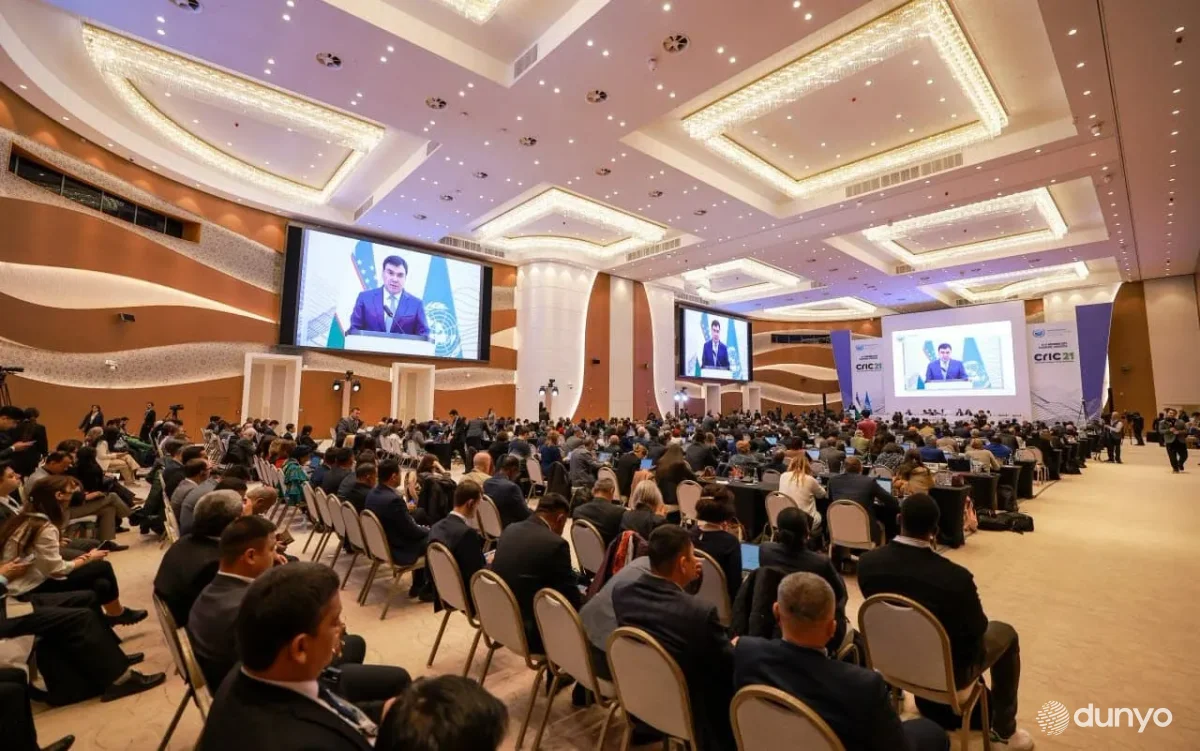
TASHKENT, November 14. /IA "Dunyo"/. Yesterday, the 21st session of the Committee to Review the Implementation of the UN Convention to Combat Desertification (CRIC 21) began work in Samarkand, reports a "Dunyo" information agency correspondent.

According to the government portal gov.uz, the United Nations Convention to Combat Desertification (UNCCD) was created to unite the efforts of the public and private sectors at the international level to combat desertification, land degradation and mitigate the effects of drought. 196 countries and the EU are parties to the Convention. The Convention was adopted in Paris on 17 June 1994 as a result of the UN Conference on Environment and Development in Rio de Janeiro and entered into force on 26 December 1996. In 2012, the Convention was ratified by 195 countries.
About 500 delegates from 196 countries and the European Union, representatives of civil society and academia will take part in CRIC-21 at the Silk Road Samarkand Convention Center, who will analyze progress in achieving the strategic goals of the Convention. For the first time since the signing of the UNCCD, one of its most significant meetings will take place in Central Asia.
Parties to CRIC 21 will have the opportunity to discuss progress and make recommendations to achieve global goals to prevent land degradation in accordance with the UNCCD strategy for 2018 - 2030.
At the opening of the event, a welcoming speech by the President of Uzbekistan Shavkat Mirziyoyev was read out.
"The agenda of the high forum includes vital issues of jointly countering the climate challenges of our time and developing broad international cooperation in the fight against desertification. I would like to emphasize that Uzbekistan and the entire region of Central Asia as a whole are especially susceptible to the negative effects of climate change and are fully experiencing the dire consequences of the social and environmental problems caused by them.
Today, we are almost alone fighting the devastating consequences of the global catastrophe of the Aral Sea, which is disappearing before the eyes of one generation. All these threats and many other factors directly affect the well-being and health of the population not only in our region, but throughout the world, which requires even greater consolidation and strengthening of partnerships to achieve the key Sustainable Development Goals.
I count on the strong support of the international expert community for the initiative of Uzbekistan to adopt, following the results of the current session, the Samarkand Declaration on Sand and Dust Storms.
I am confident that this multilateral document will become an important contribution to our common efforts aimed at early warning and effective counteraction to such serious environmental challenges, will expand scientific exchange, initiate the implementation of new technical assistance programs and specific investment projects," said President Shavkat Mirziyoyev.
As part of the 1st day of the event, the first Plenary meeting began on November 13, at which opening statements were made by the Chairman of CRIC 21, the Executive Secretary of the UNCCD Ibrahim Thiaw, the Minister of Ecology, Environmental Protection and Climate Change of Uzbekistan Aziz Abdukhakimov and the Chairman of the Senate of the Oliy Majlis Tanzila Narbaeva.
"The droughts, wildfires and heat waves we are seeing around the world are symptoms of climate and nature crises that are worsening and interconnected. Since 2015, about 4 million square kilometers of healthy and productive land have been lost. This is the equivalent area of Central Asia. We must urgently stop further land degradation and restore at least 1 billion hectares to achieve global land use goals by 2030," said Ibrahim Thiaw, executive secretary of the UN Convention to Combat Desertification.
This meeting comes at a critical time, as the latest data presented by the UNCCD shows that the world's annual loss of healthy and productive land amounts to about 100 million hectares. If current trends continue, 1.5 billion hectares will need to be restored to achieve land degradation neutrality globally by 2030. However, stopping additional degradation and accelerating implementation of existing commitments may exceed the stated goals.
"As the world grapples comprehensively with a triple planetary crisis, rethinking our relationship with the earth is a matter of urgency. Keeping our lands healthy must be a priority in our climate change mitigation and adaptation efforts.
It is no coincidence that CRIC-21 is being held in Uzbekistan, since it is an example of one of the most vulnerable countries experiencing all the negative consequences of land degradation: from increased droughts, sand and dust storms to loss of agricultural productivity and biodiversity.
For centuries, Uzbeks have traditionally been engaged in agriculture, so land has historically been seen as the most important source of livelihood. Therefore, seeing this important source of livelihood under serious threat is alarming and signals the need for concrete action.
While we do face numerous challenges caused by climate change and human activity, we also see them as an opportunity to truly rethink our relationship with the earth and nature as a whole. I am pleased to report that the environment and climate change agenda is one of the top strategic priorities of the Government of Uzbekistan. We are striving to achieve land degradation neutrality and are already seeing some first results in this," said Aziz Abdukhakimov.
It is worth noting that Uzbekistan was the first state in the Asian region and the CIS to ratify the UN Convention to Combat Desertification in 1995.
In 2023, our country will for the first time host the Committee to Review the Implementation of the UN Convention (CRIC 21), organized by the Ministry of Ecology, Environmental Protection and Climate Change of Uzbekistan.
The 21st session of the Committee to Review the Implementation of the UN Convention to Combat Desertification will continue until November 17.
Latest News
See all
Read also
Uzbekistan–Japan: Expanding the Boundaries of Strategic Partnership

Uzbekistan-Paraguay: A dialogue bridging continents and oceans
New Uzbekistan: From Constitutional Reforms to Constitutional Stability

Ambassador of Uzbekistan presents credentials to the President of Greece