Uzbekistan – Azerbaijan: From historical ties to strategic alliance
August 22, 2026. 09:10 • 8 min
• 1429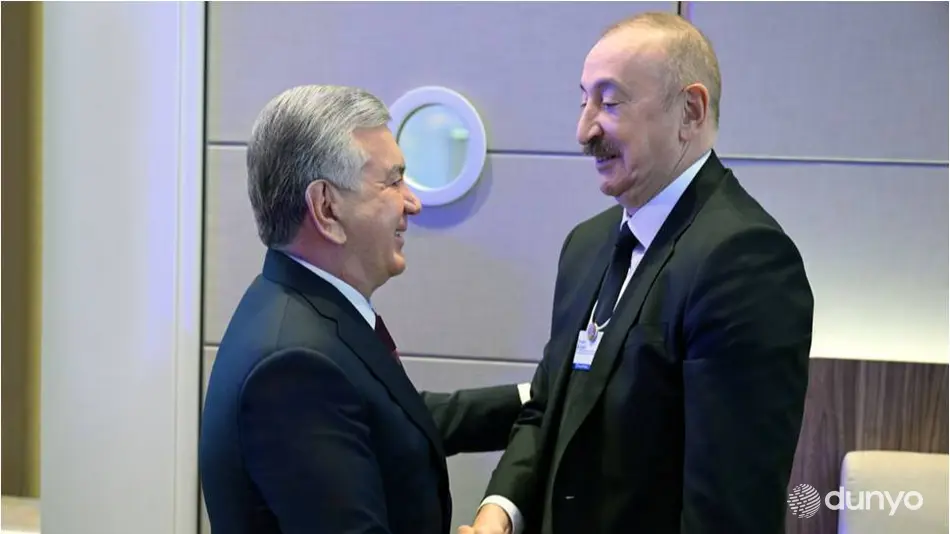
TASHKENT, August 22. /Dunyo IA/. On August 23-24th, President of Azerbaijan Ilham Aliyev, will pay a state visit to Uzbekistan, reports Dunyo IA correspondent.
Currently, relations between Uzbekistan and Azerbaijan have reached a qualitatively new level in terms of both substance and scale. Historical and cultural proximity, shared Turkic values and sincere relations between the peoples establish a solid foundation for political trust and practical interaction.
Uzbek-Azerbaijani relations have been developing dynamically since 2017, consistently strengthening and transitioning from a strategic partnership to an alliance. Today, cooperation between the two countries holds vital significance not only for the development of bilateral ties but also from the perspective of strengthening interregional connectivity between Central Asia and the South Caucasus.
Diplomatic relations between Uzbekistan and Azerbaijan were established on October 2nd, 1995. In 1996, Treaty of Friendship and Cooperation was signed in Baku, laying the legal foundation for bilateral relations. In the subsequent years, this treaty and legal framework has been consistently expanded and supplemented with new agreements aimed at strengthening the strategic partnership.
Trust-based and regular dialogue between the heads of the two states has played a decisive role in bringing relations to today's high level. Strategically significant meetings between the leaders of Uzbekistan and Azerbaijan contribute to strengthening political mutual understanding and alignment of the two countries' positions.
In June 2022, the state visit of the President of Azerbaijan Ilham Aliyev, to Uzbekistan imparted a new impetus to the development of bilateral relations. Following the visit, Declaration on Deepening Strategic Partnership and Enhancing Comprehensive Cooperation was adopted.
State visit of the President of Uzbekistan Shavkat Mirziyoyev, to Azerbaijan in August 2023 marked a significant step toward the institutional strengthening of bilateral ties. Within the framework of the visit, an agreement was reached on the establishment of the Supreme Interstate Council. This mechanism has imparted additional impetus to the strategic dialogue at the highest level.
A few years ago, speaking on the return of the Karabakh region to Azerbaijan, President Shavkat Mirziyoyev described it as the restoration of historical justice and emphasized Uzbekistan's readiness to assist in the restoration of ancient monuments, cultural and educational facilities located on this land.
Practical embodiment of these noble intentions was the opening in 2023 in the Azerbaijani city of Fuzuli of the Mirzo Ulugbek Secondary School, built at the initiative of the President of Uzbekistan and designed for 960 students. Grand opening ceremony took place with the participation of the leaders of the two countries within the framework of the state visit.
Today, new educational institution serves not only as a modern educational platform but also as an important spiritual and educational center, contributing to the further rapprochement of the peoples of Uzbekistan and Azerbaijan. School is also designated to introduce Azerbaijani youth to the rich history and culture of Uzbekistan, as well as the scientific and educational heritage of its great ancestors.
On November 16th, 2025, at the Seventh Consultative Meeting of the Heads of State of Central Asia held in Tashkent, Azerbaijan joined this format as a full member. This decision was made under the chairmanship of the Leader of Uzbekistan, who has consistently supported Azerbaijan's participation in this format. At the summit, President Shavkat Mirziyoyev noted that Azerbaijan's accession opens up new opportunities for building a solid bridge between Central Asia and the South Caucasus and forming a unified space of cooperation.
One of the key directions of Uzbek-Azerbaijani relations is economic cooperation. In recent years, the volume of mutual trade has increased severalfold, opening new opportunities for a closer alignment of the economic potential of the two countries.
While the trade turnover volume stood at $32 million in 2017, it exceeded $300 million in 2025. The parties have set a goal to bring the volume of mutual trade and investments to $1 billion in the coming years.
Substance of economic interaction is also undergoing significant changes. While primary attention was previously focused on trade operations, today investment cooperation, industrial synergy and the implementation of joint manufacturing projects play an increasingly vital role. The agreement reached in 2023 on the establishment of a joint investment fund with an authorized capital of $500 million has become an important mechanism for financing large-scale projects.
Currently, over 470 enterprises with the participation of Azerbaijani capital operate in Uzbekistan. They are engaged in such sectors as industry, energy, construction, food and light industries, the financial sector and the services sphere. Concurrently, the activities of Uzbek companies are expanding within the Azerbaijani market as well.
Projects being implemented in such fields as mechanical engineering, energy, the chemical industry, the mining sector, the textile industry, agriculture, urban planning and construction imbue bilateral economic cooperation with increasingly tangible, practical substance. The portfolio of major projects being formed within the framework of business forums testifies to the growing role of the private sector in this process.
Cooperation in the energy sector is also becoming one of the promising areas. In July 2025, a production sharing agreement was signed between the State Oil Company of the Republic of Azerbaijan (SOCAR) and JSC “Uzbekneftegaz”, providing for geological exploration activities on investment blocks of the Ustyurt oil and gas region, with subsequent hydrocarbon production. This agreement elevated the energy partnership to a new level and established a solid foundation for long-term cooperation in the exploration and development of hydrocarbon resources.
Geographical location of Uzbekistan and Azerbaijan imparts a special strategic significance to cooperation in the transport sector. One of the key directions where the interests of the two countries intersect is the Trans-Caspian International Transport Route – the Middle Corridor, which connects Central Asia through the Caspian Sea with the South Caucasus and European markets.
This objective was further facilitated by the establishment in 2022 of a trilateral dialogue format between Uzbekistan, Azerbaijan and Türkiye at the level of ministers of foreign affairs, economy and transport. Subsequently, this format has become an effective instrument for strengthening transport and logistics interaction, as well as regional economic connectivity.
For Uzbekistan, gaining access to the Caspian Sea and European markets via Azerbaijan holds vital significance in terms of expanding its export geography, diversifying supply routes, and ensuring the sustainability of foreign trade. For Azerbaijan, in turn, rapprochement with the large markets and production potential of Central Asia opens up new economic opportunities.
Implementation of electronic permits, increasing volumes of cargo transportation, and the expansion of air connectivity demonstrate that transport cooperation is not limited to political agreements but is acquiring an increasingly tangible economic substance.
Another vital feature of bilateral relations is the expansion of cooperation to the regional level, as well as the active involvement of business communities, educational institutions, and the public.
A number of agreements were signed at the Uzbek-Azerbaijani interregional forums held in Tashkent, Guba and Baku. Partnership ties between such cities as Samarkand and Ganja, Khiva and Shusha, Bukhara and Lankaran, Kokand and Sheki, create new opportunities not only for the development of trade and investment but also for tourism, cultural cooperation and the exchange of experience.
Cultural and humanitarian ties stand as one of the most enduring factors uniting the two nations. The heritage of the great thinkers Alisher Navoiy and Nizami Ganjavi, the affiliation with a shared Turkic cultural space, as well as the proximity in such spheres as music, literature and art, contribute to the further strengthening of the spiritual kinship between the peoples of the two countries.
Such symbolic initiatives as the complexes dedicated to Nizami Ganjavi and Heydar Aliyev in Tashkent, as well as the monument to Alisher Navoiy in Baku, serve as a vivid expression of mutual respect and friendship between the nations. The regular holding of Culture Days, film festivals, theater tours, scientific conferences and various artistic events imbues this spiritual kinship with concrete, practical substance.
In the sphere of education, the holding of rectors' forums and the signing of new agreements between higher educational institutions demonstrate the formation of a shared educational and scientific space. The expansion of youth exchanges, tourism ties and humanitarian contacts will, in the long term, contribute to the further strengthening of the social foundation of allied relations.
Allied relations between Uzbekistan and Azerbaijan represent more than just the development of bilateral ties. They are becoming a vital factor in bringing Central Asia and the South Caucasus closer together.
Two countries actively cooperate within the framework of the United Nations, the Non-Aligned Movement, Organization of Turkic States, the Organization of Islamic Cooperation, Economic Cooperation Organization and other multilateral platforms, coordinating their positions on a range of regional and global issues.
Today, relations between Uzbekistan and Azerbaijan are transforming into a full-fledged model of alliance, distinguished by a solid institutional foundation, rich economic substance and expanding interaction at the civil society level. The primary task at this stage is to translate the achieved political agreements into concrete economic, technological and humanitarian results.
In this regard, the priority tasks remain bringing the volume of mutual trade to 1 billion dollars, effectively utilizing joint investment mechanisms, expanding industrial synergy, fully unlocking the potential of the Middle Corridor, promoting green energy projects, and developing cooperation in digital technologies and innovations. Further expanding interregional ties, alongside cooperation in education, science, tourism, and cultural-humanitarian interaction, will enhance the practical returns of the alliance for the peoples of both nations.
In conclusion, it is worth noting that modern relations between Uzbekistan and Azerbaijan have undergone a rapid evolution within a short period - from the establishment of diplomatic ties to friendship and strategic partnership, and subsequently to institutionally reinforced allied relations. At the core of this process lie political trust, mutual interest, historical and cultural proximity, and a shared vision for future development.
Photo from the archive of the Press Service of the President of Uzbekistan

Latest News

See all
Read also

View from Moscow: Visit of the President of Uzbekistan to Seoul confirms Tashkent's course toward expanding the circle of technological and investment partners

View from Ankara: An expanding mutual interest takes shape between Uzbekistan and South Korea