Rashad Mammadov: Azerbaijan is undeniably a part of the Central Asian space
August 23, 2026. 11:00 • 10 min
• 169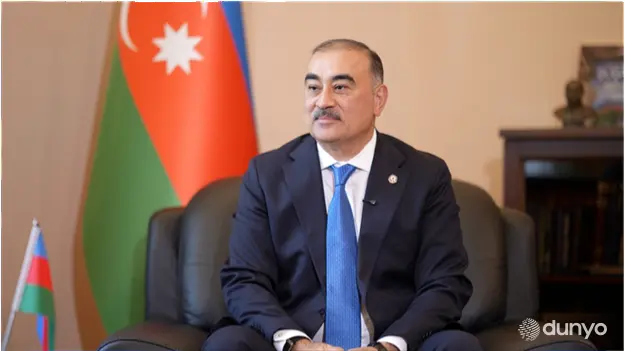
TASHKENT, August 23. /Dunyo IA/. Ambassador of Azerbaijan to Uzbekistan, Rashad Mammadov, ahead of President Ilham Aliyev’s state visit to Uzbekistan on August 23rd, gave an exclusive interview to the correspondent of the Dunyo IA.
– Mr. Ambassador, how do you assess the dynamics of contacts at the highest and high levels, and how is the status of allied relations between Uzbekistan and Azerbaijan reflected in the practical substance of bilateral cooperation?
– State visit of the President of Azerbaijan Ilham Aliyev, if counted, will be the fifteenth reciprocal visit at the highest level between Uzbekistan and Azerbaijan in recent years. This fact alone demonstrates how important Uzbekistan is to Azerbaijan. Our shared traditions, culture and values, common interests and strategic plans for the future dictate the need to develop our relations precisely at such a high level – at the level of an alliance.
Our countries are developing ties across all areas, including the economy, investment and trade, science, culture, education and digitalization. Transport, logistics and transit are also among the key areas. These sectors contribute to the development of mutually beneficial cooperation between our two countries.
Economies of the two countries are highly complementary. Since gaining independence, Azerbaijan has invested extensively in transport and logistics projects. Today, the opportunities created are opening up new prospects for the countries of Central Asia, including Uzbekistan.
Uzbekistan is very close to our people in spirit. Our music is practically the same, our languages are closely related, and our people understand each other when communicating. This creates a strong social demand among our peoples for the further development of relations.
Moreover, Uzbekistan is a regional leader in Central Asia in terms of the pace of economic development and population growth, as also confirmed by forecasts from international rating agencies. Azerbaijan, for its part, is one of the leaders in the Caucasus. I believe that cooperation and a unique synergy between our two countries will provide a strong impetus to their further development, create new opportunities for other states in the region, and enhance the political weight and international standing of Azerbaijan and Uzbekistan among both European and Asian countries.
We, Azerbaijan and Uzbekistan, are strong states. I cannot say that Azerbaijan is a large country; we are a compact state. But a country’s strength is measured not by its territory or population, but by its influence in international relations, its ability to ensure its security, territorial integrity and sovereignty, as well as to build mutually beneficial relations with its neighbours and other members of the international community.
Today, Azerbaijan has substantial financial resources and mutually beneficial economic ties with major powers across Europe, Asia, America and Africa.
Uzbekistan, too, is a self-sufficient country that has built its own strength. Its people have created a state that is today developing successfully. Since 2016, a new chapter has opened in Uzbekistan’s development. The country has opened up to the world, including to Azerbaijan.
It was precisely under the leadership of the highly respected President of Uzbekistan Shavkat Mirziyoyev that the country began developing at a truly rapid pace, modernizing the state across all areas – the economy and politics, the humanitarian sphere, education, healthcare and the social sector. This is not an easy task, but you have succeeded.
Uzbekistan has become an attractive destination for foreign investment, welcoming investors from around the world, including Azerbaijan, who are eager to invest in the country’s economy. The personal and friendly relations between our presidents serve as a political guarantee for investors. They are very close to each other and set the tone for relations between our two countries.
– Trade and economic cooperation between our countries is expanding noticeably. In your view, which areas have the greatest potential for increasing bilateral trade?
– We are developing all sectors of the economy, from the use of the natural resources available in our countries to the production of industrial goods. Our presidents have set the goal of increasing bilateral trade to $1 billion by 2030. I believe this goal will be achieved. We have every opportunity to reach the target that has been set.
Azerbaijan and Uzbekistan are rapidly reforming their economies and judicial systems, while creating favourable conditions for attracting foreign investment. In 2024, we also established a joint fund with a capital of $500 million, providing financial resources to invest in new projects in both Uzbekistan and Azerbaijan. The fund is operating successfully, with projects already financed and being implemented across a number of areas. This work will continue.
Alongside the development of trade and economic ties, transport and logistics should become a key area of our cooperation. Uzbekistan’s geographical location is so important that we are in a position to develop a second route of the Middle Corridor connecting Southeast Asia with Europe.
The first route runs through China and Kazakhstan, via the ports of Aktau and Kuryk on the Caspian Sea, then through Azerbaijan towards the Black Sea and Türkiye. The second route could be developed jointly with Uzbekistan. It could run along the China–Kyrgyzstan–Uzbekistan–Turkmenistan route, through Turkmen ports to the Port of Alat in Baku, and then onward by the Baku–Tbilisi–Kars railway towards the Black Sea ports and Türkiye.
Alternatively, following the implementation of the TRIPP project, it could pass through the Zangezur Corridor: the Port of Alat in Baku – Armenia – the TRIPP corridor – the Nakhchivan Autonomous Republic of Azerbaijan – Iğdır – Kars in Türkiye. In this way, we would diversify our transport and logistics routes.
Uzbekistan is a very large country with an enormous consumer market and a population approaching 40 million. At the time of the dissolution of the Soviet Union and independence, Uzbekistan’s population was around 20 million; today, it exceeds 38 million. Azerbaijan’s population stood at around 7.5 million at that time, while today it exceeds 10.5 million.
Alongside our other friendly and brotherly states in Central Asia, the populations of Azerbaijan and Uzbekistan themselves represent a substantial market for goods produced in our countries. Therefore, trade must continue to expand.
Another important area of economic cooperation is energy. Together with “Uzbekneftegaz”, we established a joint company, as well as another company involving the oil and gas research institutes of Azerbaijan and Uzbekistan. These companies are engaged in the development and geological exploration of gas and oil fields in Uzbekistan. We hope this work will continue successfully and deliver strong results.
Another area is the generation, transmission and supply of electricity from renewable energy sources to the European premium market. Kazakhstan, Azerbaijan and Uzbekistan have already signed a relevant agreement on transmitting electricity along the seabed of the Caspian Sea through a dedicated cable to Azerbaijan, and subsequently via Azerbaijan to Türkiye or towards the Black Sea and the European market.
We believe that Kazakhstan, Azerbaijan and Uzbekistan have strong potential for generating electricity from renewable energy sources. European countries have confidence in us and are interested in implementing such projects. I am confident that, through our joint efforts, we will see the implementation of new major projects in the years ahead.
– Uzbekistan and Azerbaijan are united not only by political and economic interests, but also by deep historical and cultural ties. What projects in the cultural and humanitarian sphere are planned for implementation in the coming years?
– As you know, here in Tashkent, Heydar Aliyev Azerbaijan Cultural Centre operates under the Embassy of Azerbaijan. It carries out very important and noble work, organizing concerts, exhibitions and various courses, including Azerbaijani language and traditional Azerbaijani dance courses.
I believe that developing cultural ties is of paramount importance. Furthermore, we are not merely developing them - we are ensuring that our shared culture is never forgotten. As I mentioned at the outset of our interview, we are the descendants of a common ancestry. We bear a profound resemblance to one another. We hold shared values, similar family traditions, and foundations. It is vital to preserve all of this.
We are the descendants of people who, at a time when culture in many European countries had not yet reached such advancement, were here developing medicine, poetry, literature, urban planning and architecture. We have not forgotten this heritage and continue to pass it from generation to generation.
In Azerbaijan, we listen to Uzbek music with great pleasure. The Days of Culture of Uzbekistan are held in our country with resounding success, and people perceive this culture as close and kindred, recognizing themselves within it and listening to music that resonates deeply with them.
If our nations remain culturally close, and if people of Azerbaijan perceive Uzbek culture, traditions, and customs as their own, then for us, the population of Uzbekistan will not be 38 million, but 48.5 million - adding more than 10 million Azerbaijanis living in Azerbaijan. The same applies to Azerbaijan: there will not be 10.5 million of us, but 48.5 million together with our Uzbek brothers.
As you know, a foundation capsule has already been laid in Azerbaijan for the construction of the five-hectare “Uzbekistan” park in the center of Baku. This is highly significant. People who visit this park daily will be able to figuratively experience Uzbekistan and feel its atmosphere. There will be restaurants, cafes, and everything that evokes Uzbekistan: its cuisine, culture and music.
In turn, the opening of a similar park of Azerbaijan is expected here in Uzbekistan, so that the residents of the country, when visiting it, can figuratively experience Azerbaijan.
Numerous joint projects are being carried out. In recent years, non-governmental organizations of Azerbaijan and Uzbekistan have begun to interact very actively. They implement shared projects, with some events taking place in Azerbaijan and others in Uzbekistan.
A vast number of works by Uzbek writers have been translated into the Azerbaijani language, while the works of Azerbaijani writers and poets, in turn, are being translated into the Uzbek language.
We will be organizing numerous visits to Azerbaijan so that our Uzbek brothers - professionals from various fields, ranging from media personnel and educators to public figures, cultural and art practitioners, university faculty and political science circles can witness their second country firsthand. This will enable them to establish contacts with Azerbaijani colleagues, experience Azerbaijan, savour delicious Azerbaijani cuisine, listen to Azerbaijani music and subsequently return home.
Naturally, reciprocal visits from Azerbaijan to Uzbekistan will also be organized.
– Last November, the heads of state of Central Asia in Tashkent supported the decision to admit Azerbaijan as a full-fledged participant in the Consultative Meeting format. How do you assess the significance of this decision, and what practical importance does the Azerbaijani side attach to it, including in the context of further developing cooperation with Uzbekistan?
– The C5 format is very interesting. The Central Asian states are of tremendous importance to Azerbaijan in every respect – economically and in terms of trade, as well as culturally and historically.
If anyone believes that the Caspian Sea separates us, I would say the opposite: the Caspian Sea brings us together. It does not even allow us to put up barbed wire between our countries. Today’s technologies, our capabilities in the Caspian and the Caspian Sea merchant fleet have created conditions in which no one feels that a sea lies between us. It is a small sea that, on the contrary, unites our countries.
In this sense, Azerbaijan is undoubtedly part of the Central Asian space and a gateway for Central Asia to Europe. The Middle Corridor, the Trans-Caspian International Transport Route and other routes passing through Kazakhstan and the Central Asian states converge in Azerbaijan. Through Azerbaijan’s ports, railways and highways, the Central Asian countries gain connectivity with the states of Eastern and Western Europe, including Türkiye.
I believe that Azerbaijan’s transport infrastructure cannot reach its full potential without the Central Asian states. At the same time, the railway, road and logistics infrastructure, as well as the seaports of the Central Asian countries, cannot fully realize their potential without Azerbaijan’s infrastructure. In this respect, we complement each other.
Therefore, the decision to invite Azerbaijan to cooperate within the “Central Asia + Azerbaijan” format will benefit everyone – Azerbaijan, Uzbekistan and the other states of the region.

Latest News


See all
Read also

Alpár Kató: The most important change in New Uzbekistan - renewal of people's mindset

Attitude from UN: Resolution adopted at the Initiative of Uzbekistan has important strategic significance