Eldor Aripov: Fergana Valley stands as a clear illustration of the ongoing transformation in Central Asia
June 22, 2026. 17:30 • 4 min
• 80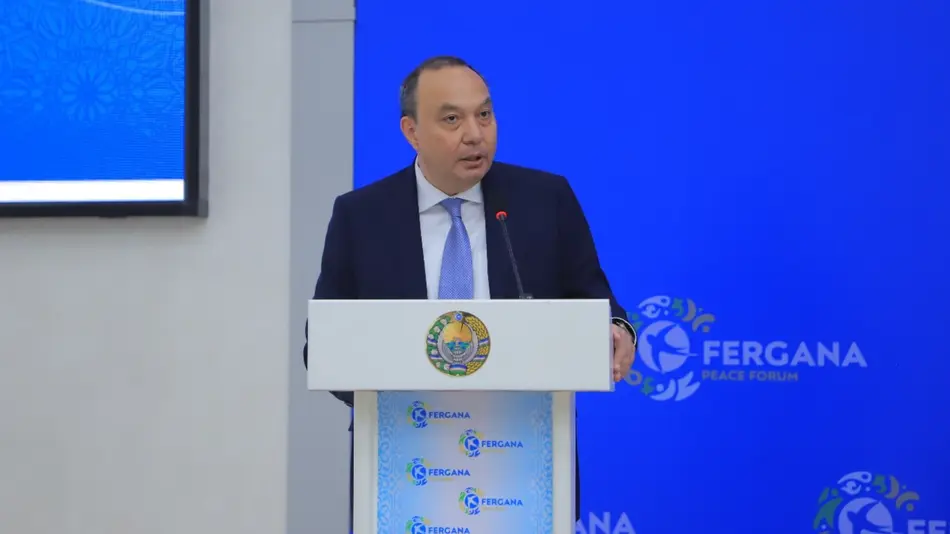
FERGANA, June 22. /Dunyo IA/. Today, the international youth seminar “Cross-Border Initiative of Young Peacebuilders” officially commenced at Fergana State University, reports Dunyo IA correspondent.
The seminar brought together young leaders, representatives of government institutions, international organizations, and civil society institutions from Kyrgyzstan, Tajikistan, and Uzbekistan.
At the opening of the event, a high-level delegation was present, including Eldor Aripov, Director of the Institute for Strategic and Regional Studies under the President of Uzbekistan (ISRS); Kaha Imnadze, Special Representative of the UN Secretary-General for Central Asia and Head of the United Nations Regional Centre for Preventive Diplomacy for Central Asia (UNRCCA); Serge Rumin, Special Representative of the OSCE Chairperson-in-Office for the Promotion of Dialogue and Confidence-building; Antti Karttunen, OSCE Project Co-ordinator in Uzbekistan; Sabine Mahl, United Nations Resident Coordinator in Uzbekistan; Khayrullo Bozorov, Governor of the Fergana Region; and Alisher Sadullayev, Director of the Youth Affairs Agency and Senator.
Opening the seminar, Eldor Aripov emphasized the special significance of the event as the first practical initiative implemented under the auspices of the Fergana Peace Forum. He noted that the Fergana Peace Forum, initiated by the President Shavkat Mirziyoyev was established as a new regional platform to strengthen dialogue, trust, and cooperation among the countries of the Fergana Valley. He recalled that the forum’s inaugural session, held last October, marked an important milestone in regional engagement, reflecting a shared demand for the development of sustainable mechanisms of cooperation in the region.
According to the Director of the ISRS, it is symbolic that the first initiative held under the auspices of the Fergana Peace Forum is dedicated to youth. This, he said, reflects the understanding that sustainable peace is not built by states and international organizations alone. Its durability depends on the extent to which the principles of good-neighbourliness, mutual respect, and cooperation become part of the worldview of the younger generation. “It is precisely then that peace ceases to be a political declaration and becomes a reality,” he stated.
Eldor Aripov noted that the Fergana Valley stands as a clear illustration of the ongoing transformation in the region. Not so long ago, it was associated with closed borders, limited contacts, and mutual distrust. Today, however, local communities are benefiting from open borders, growing trade, and expanding humanitarian ties. What was once perceived as a source of tension is gradually turning into a space of new opportunities.
According to him, the results achieved to date have been made possible by the political will, strategic vision, and pragmatic leadership of the heads of state of Central Asia. At the core of these changes lies a new philosophy of regional cooperation, which prioritizes partnership, good-neighbourliness, and shared development.
In this context, he noted that the signing of the Declaration on Eternal Friendship and the Treaty on the Junction Point of State Borders in Khujand last March marked a historic milestone, firmly consolidating a new era of good-neighbourliness between Uzbekistan, Kyrgyzstan, and Tajikistan.
At the same time, the expert noted that the new philosophy of regional cooperation is now gaining recognition at the global level as well. A clear confirmation of this was the adoption in May of this year by the United Nations General Assembly of the resolution initiated by Uzbekistan, entitled “Strengthening regional cooperation and economic integration to ensure sustainable development in the Central Asian region.” Equally important was the United Nations resolution “Peaceful Resolution of Border Disputes,” jointly submitted by Kyrgyzstan, Tajikistan, and Uzbekistan.
Eldor Aripov noted that both resolutions are united by a common idea: peace and development in Central Asia must be built through cooperation. According to him, this approach is no longer confined to political declarations, but is being translated into practical action through concrete agreements, joint projects, and new opportunities for millions of people across the region.
“As a result, Central Asia is increasingly seen as an example of how trust, political will, and good-neighbourliness can transform the difficult legacy of the past into the foundation of a shared future,” the Director of ISRS stated.
The international youth seminar “Cross-Border Initiative of Young Peacebuilders” will continue until 25 June. The event is organized by the Institute for Strategic and Regional Studies (ISRS), the Youth Affairs Agency of Uzbekistan, and the Fergana Regional Administration.
The seminar is being held in partnership with the United Nations Regional Centre for Preventive Diplomacy for Central Asia (UNRCCA) and the OSCE Project Co-ordinator in Uzbekistan, underscoring its international character and strong institutional support.

Latest News
See all