Israeli Analyst Examines Foreign Media Coverage of Uzbekistan’s Role at C5+Korea Summit
September 26, 2026. 17:30 • 3 min
• 104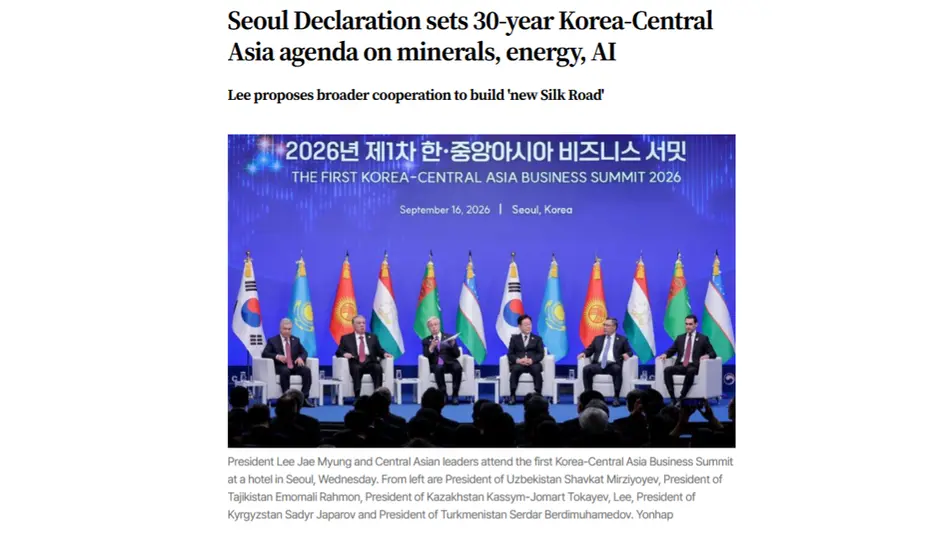
TEL AVIV, September 26. /Dunyo IA/. Yuri Bocharov, Director of Israel’s Institute for the Study of Information Wars, has prepared an article with the support of the Embassy of Uzbekistan in Tel Aviv examining foreign media coverage of the first “Central Asia-Republic of Korea” Summit and Uzbekistan’s role in the new cooperation format, reports Dunyo IA correspondent.
The review looks at coverage of the September 16 summit in Seoul and international media attention to Uzbekistan’s initiatives and its role in developing the new framework for cooperation.
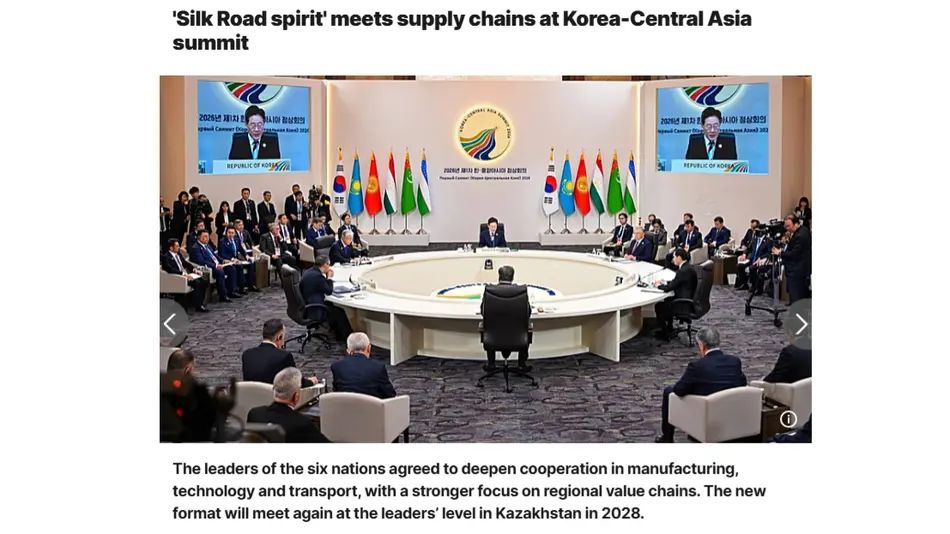
South Korean media identified one of the key outcomes as the transformation of the previous consultative format into a permanent mechanism of cooperation at the level of heads of state. Under the Seoul Declaration, summits will be held every two years, while ministers and senior officials will oversee implementation of agreements between meetings.
“The Korea Times” described the Seoul Declaration as a 30-year roadmap for South Korea’s relations with Central Asia. The next summit is scheduled to take place in Kazakhstan in 2028.
South Korean media also highlighted a new model of economic cooperation, moving beyond the exchange of Central Asian raw materials for Korean vehicles, equipment and finished goods toward joint production chains covering geological exploration, extraction and processing of critical minerals and the manufacture of finished products.
Foreign media paid particular attention to Uzbekistan. The Korea Times noted that Uzbekistan is the only Central Asian country with the status of a special strategic partner of South Korea.
“Asia Business Daily” reported that the South Korean government views Uzbekistan as a potential base for Korean companies seeking to expand into the Central Asian market, particularly in critical minerals, artificial intelligence and biotechnology.
The article also noted that more than 700 enterprises with South Korean capital already operate in Uzbekistan, alongside four branches of South Korean universities and five vocational training centers established with support from KOICA.
“Euronews” focused on Uzbekistan’s proposal to establish a Regional Critical Minerals Investment Alliance. The initiative would bring together geological exploration, extraction, deep processing and the production of high-value-added finished goods.
The news outlet also highlighted Uzbekistan’s proposal to increase South Korea’s trade with Central Asian countries to $20 billion by 2030.
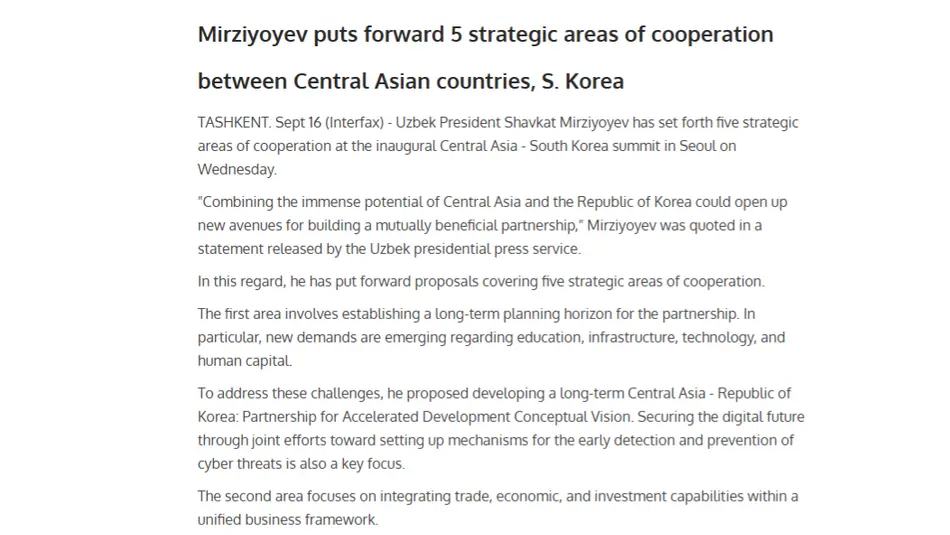
“Interfax” separately examined five areas proposed by Uzbekistan: long-term planning, industrial cooperation, critical minerals, climate partnership and workforce training.
The practical basis for the bilateral agreements was provided by 13 agreements, memorandums and contracts signed by Uzbekistan and South Korea. The documents cover plans to supply eight additional high-speed trains, establish a national genomics and biobank center, introduce artificial intelligence in industry, and cooperate in critical minerals, biotechnology, pharmaceuticals, smart cities and military-technical fields.
A prospective project portfolio worth about $12 billion was also formed. South Korea’s Export-Import Bank is expected to participate in identifying and financing projects in six strategic sectors, including critical minerals, data centers, pharmaceuticals and industrial zones for Korean companies.
The article stresses that the $12 billion figure represents the value of the prospective project portfolio rather than investments already received. Most of the signed documents are framework agreements, while individual projects still need to undergo feasibility studies.
According to the author, international media coverage of the summit presented Uzbekistan not simply as one of the five participating Central Asian countries, but as a country putting forward concrete initiatives in investment, industrial cooperation, critical minerals, technology and workforce development.

Latest News
See all
Read also
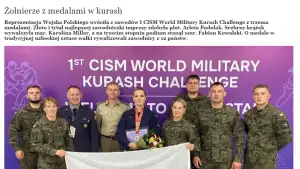
Polish Media Highlight Uzbekistan’s Growing Cooperation in Sports, Tourism and Economy
Russian Media highlight key points from the Address by the Head of the Presidential Administration of Uzbekistan at the UN
“Komsomolskaya Pravda”: More than 737,000 people in Uzbekistan have already completed training under the “Human + AI” programme