
Tree care and survival rates to become priorities under the “Yashil Makon” project
September 21, 2026. 19:03 • 5 min
• 782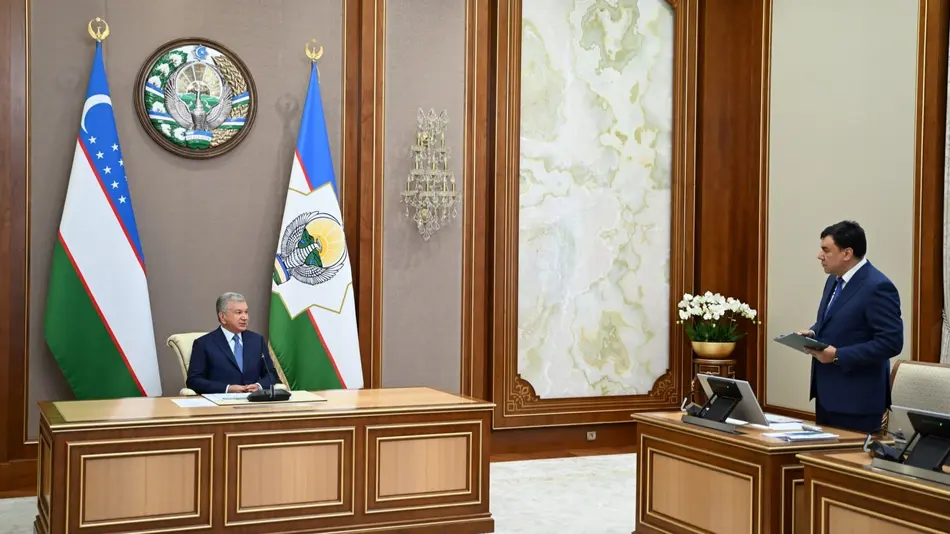
ТASHKENT, September 21. /Dunyo IA/. Today, President Shavkat Mirziyoyev reviewed a presentation on elevating the nationwide “Yashil Makon” project to a new level, creating a favourable ecological environment in mahallas and introducing innovative solutions, reports Dunyo IA correspondent.
According to the press service of the Head of our State, large-scale efforts are underway in the country to expand green spaces and create parks and gardens. At the same time, shortcomings remain in ensuring the survival of planted saplings, their irrigation and systematic care.
Some of the saplings planted last spring have dried out. This is due to selecting tree species unsuitable for the climatic and soil conditions of particular regions, planting saplings in areas without a water supply, and insufficiently effective measures to combat diseases and pests. Problems were also noted in maintaining forests established on the dried-up bed of the Aral Sea and in ensuring their protection.
Head of State emphasized the need to assess the effectiveness of the work carried out by examining the survival rate of saplings after one, three, and five years.
In this regard, approaches were presented that cover the entire process – from the scientifically grounded organization of landscaping activities, soil preparation, and the establishment of irrigation systems to the care of saplings for at least three years. Planting periods are to be determined based on each region’s weather conditions and scientific recommendations, with priority given to species adapted to the local climate and resistant to heat, cold, and water scarcity.
Committee on Ecology was instructed to develop and make available to the public green maps for each mahalla, indicating the types of saplings, their planting locations, and irrigation systems. The task was to regularly monitor the condition of trees and saplings on every street, in coordination with mahalla chairpersons, identify the causes of drying, and take measures to address them.
Priority was emphasized for organizing tree-planting activities in densely populated areas, along pedestrian walkways, and on streets operating around the clock. The need was noted to create comfortable conditions for people to move around and rest by increasing the number of shade trees in these areas.
During the presentation, proposals were also considered for providing comprehensive services to mahallas under the My Green Mahalla program. It is planned to arrange the supply of high-quality saplings, organic fertilizers, and water-saving irrigation equipment at the request of mahallas, as well as to provide services to protect trees from diseases and pests.
A forestry mentor is to be assigned to each mahalla to train residents in planting, watering, and caring for saplings. Small green areas and community parks are also to be created between residential buildings, schools, and kindergartens. The task was set to involve volunteer groups, comprising mahalla activists and young people, in this work.
A proposal to introduce a green rating for mahallas was also discussed. The main criteria will include the share of green areas, the number of trees per capita, the survival rate of newly planted saplings, and public participation. Instructions were given to develop mechanisms to incentivize mahallas that achieve strong results, including through the allocation of additional funds for landscaping and targeted microgrants for the implementation of green projects.
It was proposed to implement greening programs based on the “3-30-300” principle. Under this approach, every person should be able to see at least three trees from where they live, work, or study, at least 30 percent of residential areas should be covered by tree canopy, and a green recreational area should be within 300 meters of every home.
During the presentation, projects for the practical application of this approach were presented, taking into account the specific natural and urban development conditions of Tashkent’s Yangihayot district, Alat district in Bukhara region, and Urgut district in Samarkand region.
In Yangihayot, plans include creating mahalla and public parks, shaded pedestrian streets, and green belts around industrial enterprises. Proposed measures include collecting and reusing groundwater for irrigation, using permeable surfaces, and producing compost from organic waste. Greening efforts will proceed alongside measures to reduce industrial emissions, introduce automated air-quality monitoring, and improve the waste management system.
In Alat, the main focus will be to expand green cover using plants adapted to desert conditions and requiring little water. It is proposed to develop local sapling production, establish a dendrological park and a garden of salt-tolerant plants, and plant protective tree belts along roads and canals.
Greening in Urgut is planned with due regard for the specific features of its mountainous and foothill areas. A dendrological park and public parks are to be created, along with green belts around the industrial zone and along the railway. Measures will also be taken in the Omonquton National Nature Park to restore natural vegetation using seeds of local tree and shrub species.
Strengthening scientific support for the project and introducing modern technologies were also addressed in the presentation. It is proposed to establish in vitro laboratories and modern nurseries to produce healthy planting material adapted to the conditions of different areas, and to gradually replace water-intensive ornamental lawns with drought-resistant plants.
The “Yashil AI” module is planned for pilot testing. Data on soil, climate, and water supply will be analysed using artificial intelligence to identify optimal planting areas and provide recommendations for tree species selection. The system will enable early detection of risks related to sapling die-off, water shortages, diseases, and pest outbreaks, timely notification of responsible officials and open monitoring of results on a unified map.
Issues related to combating desertification, restoring degraded land, and attracting international grants to this area were also discussed. The need was emphasized to effectively use the potential of land resources and medicinal plants in desert areas, as well as to launch projects on pastures to create added value with the participation of the private sector. Instructions were given to launch such a pilot project in each region by July 1, 2027.
Responsible officials were instructed to refine the proposals presented, taking into account the views expressed, to improve the culture of tree planting and care in mahallas, and to strengthen responsibility and oversight for the preservation of green areas.

Latest News





See all
Read also