Uzbekistan and India unlock new opportunities for deepening strategic partnership
August 29, 2026. 09:10 • 7 min
• 1327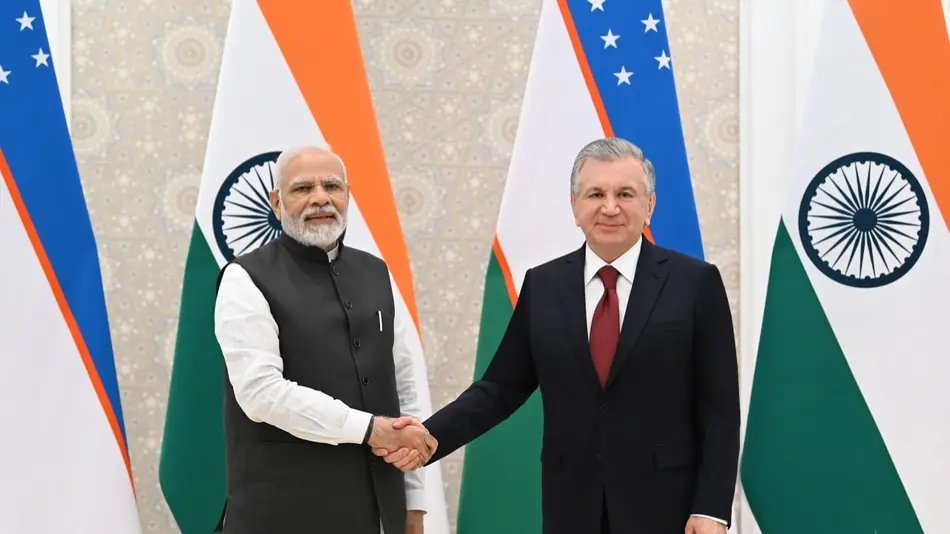
TASHKENT, August 29. /Dunyo IA/. On August 29–30th, 2026, Prime Minister of India will pay a state visit to Uzbekistan, reports Dunyo IA correspondent.
Uzbek-Indian relations today are characterized by a steady development dynamic, a high level of political dialogue and the consistent expansion of interaction across trade, economic, investment, transport, humanitarian, and other sectors.
India recognized the independence of Uzbekistan on December 26th, 1991 and diplomatic relations between the two nations were established on March 18th, 1992. In September 1992, Consulate of Uzbekistan opened in New Delhi, which was subsequently upgraded to an Embassy in 1994. The Consulate General of India, established in Tashkent in August 1988, was transformed into an Embassy in 1992.
Over the period from 1991 to 2026, 12 mutual visits at the highest level have taken place, which testifies to the regularity of the political dialogue between the two states.
Regular meetings between the leaders of the two countries play a special role in strengthening bilateral ties. On September 30th – October 1st, 2018, President of Uzbekistan paid a state visit to India. On January 17-18th, 2019, President of Uzbekistan visited India on a working visit to participate in the “Vibrant Gujarat – 2019” International Investment Summit.
Within the framework of the visits in 2018–2019, 98 trade and investment documents were signed for a total amount of $2.3 billion.
On December 11th, 2020, an online summit was held between the President of Uzbekistan and the Prime Minister of India, following which nine bilateral agreements were signed and a Joint Statement on Close Friendship and Strong Partnership was adopted.
Contacts between the leaders of the two countries have also been consistently developing in recent years. On October 23rd, 2024, a meeting was held in Kazan between President of Uzbekistan and Prime Minister of India on the sidelines of the BRICS summit. On September 1st, 2025, negotiations between the leaders of the two countries took place in Tianjin on the sidelines of the SCO summit.
An important area of bilateral interaction is inter-parliamentary cooperation. In June 2020, inter-parliamentary cooperation groups with the upper and lower houses of the Parliament of India –Rajya Sabha and Lok Sabha – were established in the Senate and Legislative Chamber of the Oliy Majlis.
In February 2025, Speaker of the Legislative Chamber of the Oliy Majlis approved the new composition of the inter-parliamentary cooperation group with the Lok Sabha, the lower house of the Parliament of India.
A significant event was the participation of the Indian parliamentary delegation, led by the Speaker of the lower house, Om Birla, in the 150th anniversary session of the Inter-Parliamentary Union, held on April 5–11th, 2025, in Uzbekistan.
In February 2026, Speaker of the Lok Sabha approved the new composition of the inter-parliamentary cooperation group with the Oliy Majlis, comprising representatives from both the upper and lower houses of the Parliament, which created additional opportunities for the further development of parliamentary diplomacy.
Trade, economic and investment cooperation occupies a central place in the Uzbek-Indian partnership. Foundation of bilateral economic ties is the 1992 Agreement on Economic and Trade Cooperation, in accordance with which the most-favoured-nation treatment has been established in mutual trade. In 2024, Agreement on the Promotion and Reciprocal Protection of Investments was also signed, creating additional conditions for expanding mutual investments and implementing long-term projects.
Following the results of 2025, trade turnover between Uzbekistan and India exceeded $1.3 billion, increasing by 33.3 percent. The positive dynamic is maintained in the current year as well. For January–June 2026, the volume of mutual trade reached $598 million, which is 28.5 percent more compared to the same period last year.
Structure of mutual trade is characterized by diversity. Basis of Uzbekistan’s exports comprises chemical products, services, precious and semi-precious stones, non-ferrous metals and articles thereof. Pharmaceuticals, food products, mechanical equipment, vehicles and spare parts, chemical products and electrical goods account for a significant share of imports from India.
An important mechanism for the development of economic ties is the Intergovernmental Commission on Trade-Economic and Scientific-Technical Cooperation, which has been operational since 1992. On June 19th, 2026, 14th meeting of the Intergovernmental Commission was held in Tashkent, within the framework of which an Uzbek-Indian business forum was organized with the participation of more than 150 entrepreneurs from the two countries. Particular attention was paid to joint projects in the fields of pharmaceuticals, education, information technology and “green” energy.
An additional impetus to business contacts was provided by the Uzbek-Indian Business Forum, held on August 3rd, 2026, in New Delhi. Hosting such platforms contributes to expanding direct contacts between entrepreneurs, promoting joint projects and identifying new areas of mutually beneficial cooperation.
Cultural and humanitarian cooperation occupies a special place in Uzbek-Indian relations, relying on historical ties and the mutual interest of the peoples of the two countries in each other's cultural and spiritual heritage.
An important hub for the development of humanitarian contacts is the Indian Cultural Centre, opened in Tashkent in 1995. In 2005, it was renamed the Lal Bahadur Shastri Centre for Indian Culture.
India-Uzbekistan Friendship Society has been operational in New Delhi since 1998, contributing to the strengthening of public and cultural ties between the two nations.
Particular attention is paid to the development of cooperation in the field of education. Hindi is taught at School No. 24 in Tashkent, the University of World Economy and Diplomacy, the Tashkent State University of Oriental Studies, and the academic lyceum of this university.
Branches of four higher educational institutions of India operate in Uzbekistan: Amity University in Tashkent, Sharda University in Andijan, Sambhram University in Jizzakh and Acharya University in Bukhara.
Main educational areas include information and communication technologies, electrical engineering, and business management.
An important element in the development of technological and educational interaction was the establishment of the Software Products and Information Technologies Park (IT Park) in Tashkent on July 24th, 2019.
Student exchanges are expanding significantly. According to data for 2026, more than 13,000 Indian students are studying in higher educational institutions of Uzbekistan.
Concurrently, the study of the Uzbek language and literature is developing in India. Starting from the 2026–2027 academic year, the short-term courses in the Uzbek language and literature, which have been operating since 2004 at “Jamia Millia Islamia” university in New Delhi, have been upgraded to a full undergraduate degree program. Two academic buildings of the university have been named after outstanding thinkers of the East – Abu Rayhan Beruni and Abu Ali ibn Sina.
Tourism interaction between Uzbekistan and India demonstrates a positive dynamic. The number of tourists from India who visited Uzbekistan increased from 4.8 thousand people in 2020 to more than 80 thousand people in 2025.
Uzbekistan and India actively cooperate on a multilateral level, utilizing international and regional organizations as important platforms for promoting common interests and developing political dialogue.
Two countries closely cooperate within the framework of the United Nations, the Shanghai Cooperation Organization, BRICS, World Trade Organization and Non-Aligned Movement.
An important area of interaction is the “India – Central Asia” format, which creates additional opportunities for strengthening ties between India and the states of the region. Uzbekistan also takes an active part in the “Voice of the Global South” format, which unites developing countries and is aimed at promoting their interests on the international agenda.
Dynamic development of Uzbek-Indian relations relies on an established contractual and legal framework covering political, trade, economic, investment, humanitarian and other spheres of cooperation. To date, 114 bilateral documents have been signed between Uzbekistan and India.
Today, Uzbekistan and India possess significant potential for the further expansion of partnership. The combination of political trust, growing economic ties, investment opportunities, humanitarian interaction, and shared interests in strengthening regional connectivity creates a solid foundation for transitioning to new large-scale projects and achieving the long-term goals of a comprehensive strategic partnership.
Photo from the archive of the Press Service of the President of Uzbekistan

Latest News

See all
Read also

View from Austria: Uzbekistan revives its role as a crossroads of civilizations through a new format of cooperation with South Korea

View from Moscow: Visit of the President of Uzbekistan to Seoul confirms Tashkent's course toward expanding the circle of technological and investment partners