“DKNews”: Central Asia is forging a distinctive model of cooperation based on pragmatism and sovereignty
November 06, 2026. 11:00 • 3 min
• 244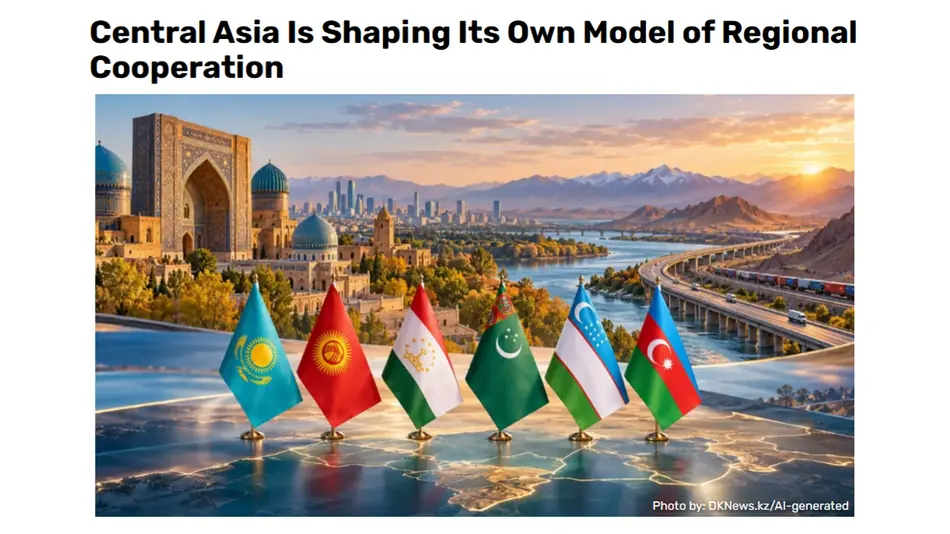
ASTANA, November 6. /Dunyo IA/. Kazakhstani online media outlet “DKNews.kz” has published an article in both English and Russian entitled “Central Asia Is Shaping Its Own Model of Regional Cooperation”, reports Dunyo IA correspondent.
According to the publication, emerging model neither replicates the European Union nor envisages the creation of a supranational bloc. Instead, the countries of the region are developing a more flexible framework based on sovereignty, political dialogue and practical cooperation. Whereas Central Asia was previously often viewed through the prism of fragmentation, due to unresolved border, water and trade issues, political dialogue has now become more regular, while the practice of consultation is gradually acquiring an institutional character.
Article highlights Uzbekistan’s role in this process, noting that since 2017 the country has made relations with its neighbours one of its foreign-policy priorities. President Shavkat Mirziyoyev proposed holding regular Consultative Meetings of the Heads of State of Central Asia, the first of which took place in March 2018. These meetings have not evolved into a supranational structure: the region has neither a common commission nor a parliament, and cooperation is pursued through presidential meetings, ministerial coordination and intergovernmental agreements. The author describes this as institutionalization without the transfer of sovereignty.
Among the developments illustrating these changes, the publication cites the signing of the Treaty on the State Border between Kyrgyzstan and Tajikistan in March 2025. The Seventh Consultative Meeting of the Heads of State of Central Asia, held in Tashkent on November 16th, 2025, marked a further stage in regional cooperation, with the leaders adopting a decision to admit Azerbaijan to the format as a full-fledged participant. External partners are increasingly engaging with Central Asia as a coherent regional space. This was demonstrated by the first “European Union–Central Asia” Summit, held in Samarkand on April 4th, 2025, which resulted in the elevation of relations to the level of a strategic partnership.
Author also acknowledges the limitations of this model: the consensus-based approach may slow decision-making, while a light institutional structure can result in uneven implementation of agreements. Therefore, in his view, the next stage should be assessed not by the number of summits held, but by the achievement of sustainable results in transport, trade, water and energy resources, climate and security.
In conclusion, Jakhongir Isaev notes that Central Asia may never become another European Union, nor is this necessarily its objective. The significance of the region’s experience lies in demonstrating that it can become more cohesive and more prominent on the international stage while pursuing its own institutional path.

Latest News


See all
Read also

“Global News Pakistan”: Development of Artificial Intelligence Technologies receives attention at the level of state policy in Uzbekistan
“Kierunek Kaukaz”: The level of contacts between Presidents Shavkat Mirziyoyev and Donald Trump described as “Exceptional”

“Avesta” IA: Uzbekistan develops mechanisms to protect citizens in the age of Artificial Intelligence