“Origo”: Uzbekistan expands educational and scientific cooperation with SCO Member States
August 15, 2026. 11:00 • 3 min
• 289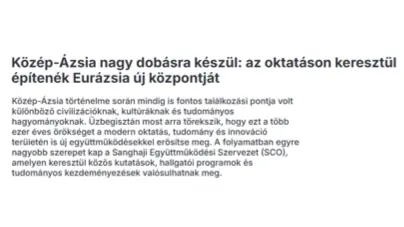
BUDAPEST, August 15. /Dunyo IA/. Hungarian news portal “Origo” has published an article about the development of cooperation among Central Asian countries in education, science and innovation, as well as Uzbekistan’s role in shaping a new scientific and educational space in Eurasia, reports Dunyo IA correspondent.
Publication notes that Central Asia has historically been a center for the exchange of knowledge and scientific traditions. Today, this potential is being further developed through joint educational and research programs within the framework of the Shanghai Cooperation Organization (SCO).
Particular attention is paid to creating conditions for academic mobility, the mutual recognition of diplomas, joint research, and the expansion of student and faculty exchanges. The publication also highlights the importance of digital education, artificial intelligence, and cooperation in the field of green technologies.
Article highlights Uzbekistan’s achievements in education and science. In 2025, more than 250 young scientists from the country undertook internships at leading foreign research centers, while 5,250 places were provided for admission to master’s and postgraduate programs. More than 50,000 young people took part in youth technopark programs.
Particular emphasis is placed on the development of Uzbekistan’s international scientific cooperation with SCO member states. In 2025, Uzbek institutions, together with partners from Russia, Belarus, Kazakhstan, China and Pakistan, participated in the preparation of joint scientific projects. More than 140 young researchers and specialists undertook internships at scientific and educational centers in China, Russia, Kazakhstan and India.
Article also draws attention to the role of the Shanghai Cooperation Organization (SCO) in expanding educational and scientific cooperation. The organization brings together countries accounting for nearly 40 percent of the world’s population, creating significant potential for joint research, academic mobility and technological exchange.
As an example of youth cooperation, the publication highlights the international competition “100 Future Innovators of the SCO”, held as part of the “Engineers of the Future” International Festival in Tashkent. The competition brought together students, young researchers, and engineering and technology teams from SCO member states.
According to the publication, the further development of joint educational programs, digital systems, green technologies and scientific exchanges could strengthen ties among the countries of Central Asia and shape the long-term directions of the region’s economic and scientific and technological development.

Latest News


See all
Read also
“Vecherniy Bishkek” Newspaper: Education and Innovation within the SCO serve as a leading driving force for human capital development and ensuring peace and stability

Uzbekistan-Initiated Resolution strengthens cooperation among parliaments, governments and the United Nations