“Orta Lectura”: The Third Renaissance is a large-scale project of comprehensive modernization
July 02, 2026. 10:30 • 3 min
• 149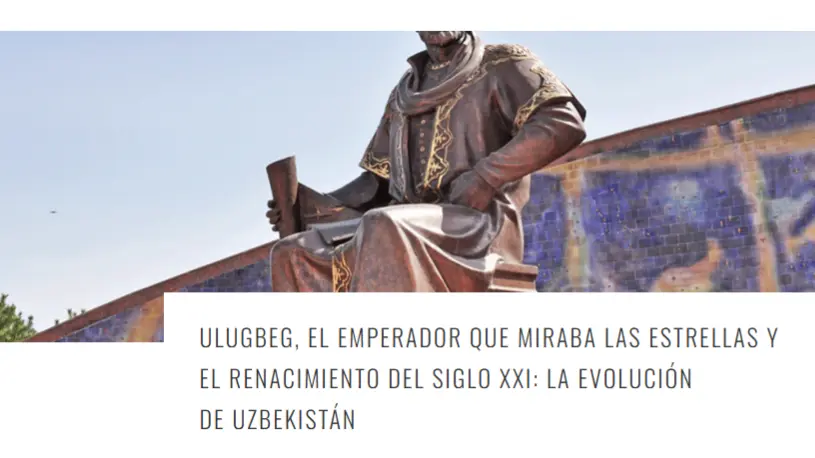
MADRID, July 2. /Dunyo IA/. Spanish analytical and news portal “Orta Lectura” has published an article titled “Ulugbeg, the Emperor who looked at the stars and the Renaissance of the 21st Century: The Evolution of Uzbekistan”. Publication highlights the profound historical legacy of Mirzo Ulugbek and examines the contemporary development of Uzbekistan within the framework of the “Third Renaissance” concept, reports Dunyo IA correspondent.
In the very heart of Central Asia, along the historic crossroads of the Great Silk Road, a new narrative is unfolding today—one that seamlessly converges profound historical heritage with contemporary transformation. This is the central theme of the article titled “Ulugbeg, the Emperor who looked at the stars and the Renaissance of the 21st Century: The Evolution of Uzbekistan”.
Author notes that Mirzo Ulugbek, the grandson of Amir Timur, transformed Samarkand into one of the world’s preeminent centers of science during the 15th century, ushering in what historians define as the Second Renaissance of Central Asia. The Samarkand Observatory, which he established, and his monumental astronomical treatise, Zij-i Sultani, made a profound contribution to the advancement of global science. Furthermore, the madrasahs founded under his patronage became premier institutions for the study of mathematics, astronomy, geometry and other natural sciences.
Publication places particular emphasis on the concept of the Three Renaissances. The First Renaissance (9th-12th centuries) is intertwined with the legacy of Muhammad al-Khwarizmi, Abu Ali ibn Sina (Avicenna) and Abu Rayhan al-Biruni, who made fundamental contributions to the advancement of mathematics, medicine, and natural sciences. The Second Renaissance (14th–15th centuries) is represented by the era of Amir Timur and Mirzo Ulugbek, a period marked by the flourishing of architecture, science, astronomy and culture. The author directly attributes the Third Renaissance to the contemporary stage of Uzbekistan’s development and the comprehensive reforms being implemented under the leadership of President Shavkat Mirziyoyev.
Article underscores that the “New Uzbekistan” concept is envisioned as a large-scale modernization project grounded in the development of human capital, education, science, innovation, and an open economy. Furthermore, it notes that in the 21st century, a nation’s power is defined by its capacity to generate knowledge and to remain comprehensively integrated into the global economy.
Among the pivotal dimensions of contemporary state policy, the author highlights the harmony between science and spiritual heritage, the advancement of modern scientific and educational infrastructure and the expansion of access to higher education. In this context, the establishment of the Center of Islamic Civilization in Uzbekistan is cited as a prime example, envisioned as a cutting-edge research hub that seamlessly integrates the study of historical heritage with the deployment of advanced digital technologies.
In conclusion, the publication underscores that contemporary Uzbekistan views its profound historical heritage as the cornerstone of its prospective development. Under the leadership of President Shavkat Mirziyoyev, while preserving continuity with the intellectual traditions of the past, the nation resolutely pursues a strategic course toward the advancement of science, education, technology and international cooperation within the grand framework of the Third Renaissance concept.

Latest News


See all
Read also
“Sputnik Georgia”: Over recent years, relations between Uzbekistan and Georgia have acquired a more sustainable economic substance
Pakistan Media: Uzbekistan and Georgia strengthen Eurasia’s Transport Connectivity