Central Asia recognized by the International Community as a region of dynamic development and productive cooperation
June 30, 2026. 08:10 • 9 min
• 136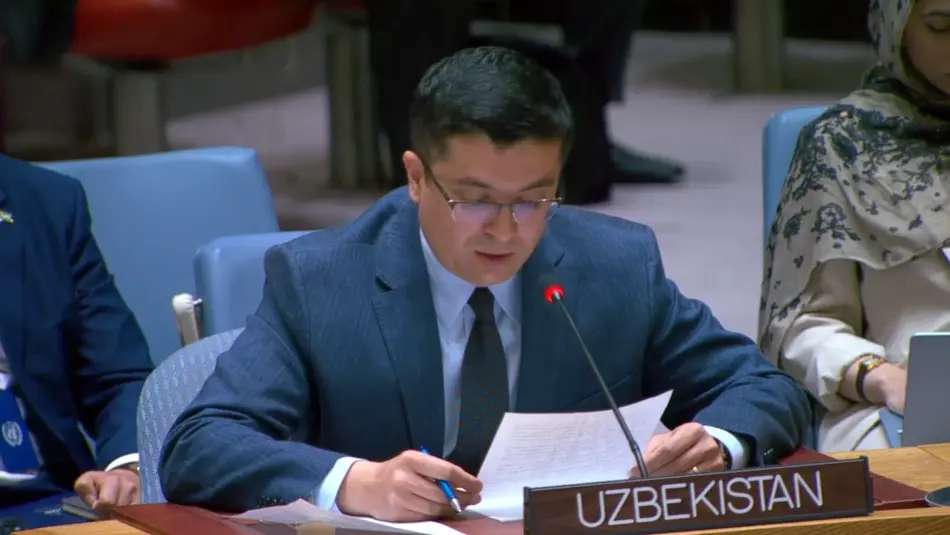
TASHKENT, June 30. /Dunyo IA/. Permanent Representative of Uzbekistan to the United Nations Ulugbek Lapasov, extended his commentary to Dunyo IA regarding the adoption by consensus of the resolution “Strengthening regional cooperation and economic integration to ensure sustainable development in the Central Asian region”, spearheaded by Uzbekistan at the 80th session of the UN General Assembly:
- On May 20th, 2026, the plenary meeting of the 80th session of the United Nations General Assembly unanimously endorsed by consensus the resolution “Strengthening regional cooperation and economic integration to ensure sustainable development in the Central Asian region”.
Conceptual framework of this landmark document was put forward by the President of Uzbekistan Shavkat Mirziyoyev, during the high-level general debate of the milestone 80th session of the UN General Assembly in September 2025.
Resolution has anchored global recognition of the profound, comprehensive transformation sweeping Central Asia. A region that was formerly characterized as an arena of complex contradictions and deep-seated mutual distrust is today steadily emerging as a model of dialogue, good-neighborly relations and shared prosperity.
Particular weight is lent to the document by its adoption against the backdrop of persistent international tension. The global community demonstrated absolute solidarity in backing the strategic course toward reinforcing cooperation and interconnectedness across Central Asia.
A total of 66 states spanning all global regions acted as co-sponsoring nations for the resolution, encompassing all Central Asian states, alongside China, the Russian Federation, Germany, Brazil, Türkiye, Azerbaijan, Indonesia, the Republic of Korea and other countries.
Implications of this document extend far beyond the parameters of its formal adoption. It mirrors the newly emerged political reality of Central Asia while simultaneously defining the strategic blueprints for its future advancement.
Back in the early 2010s, Central Asia was viewed predominantly as a constellation of disparate nations, fragmented by unresolved border demarcation disputes, competition over shared water resources, and a severe deficit of mutual trust. A unified regional agenda was effectively absent.
A watershed moment occurred in 2016, when the President of Uzbekistan Shavkat Mirziyoyev, designated the creation of a stable, prosperous, and deeply interconnected Central Asia as a top strategic priority of the nation's foreign policy. This groundbreaking initiative served as the catalyst for sweeping, large-scale positive transformations.
In the ensuing years, Uzbekistan's relations with all neighbouring states were elevated to the level of strategic partnership, while ties with Kazakhstan and Tajikistan reached the status of an alliance. Mutual trust, the indispensable foundation for any regional integration, was systematically restored.
Simultaneously, intraregional trade flows, cross-border and inter-sectoral collaboration developed rapidly, complemented by the expansion of tourism and cultural-humanitarian exchanges. The newly instituted regional mechanisms successfully channeled Central Asia's collective potential into a practical dimension, unlocking fresh drivers of economic growth.
Joint initiatives spanning industry, transport, logistics, agriculture, and other domains deeply enhance the interconnectedness of national economies, laying the groundwork for the emergence of a unified regional market.
Spearheaded by the President of Uzbekistan, a new framework for regional dialogue was institutionalized in 2018 - Consultative Meetings of the Heads of State of Central Asia. Within a remarkably brief period, these summits have transformed into the premier platform for harmonizing shared positions and forging a collective vision for the region's future.
In the ensuing years, seven high-level summits have been convened - in Astana, Tashkent, Avaza, Cholpon-Ata, Dushanbe, subsequently in Astana and most recently in November 2025 in Tashkent. Each successive meeting has solidified an advanced benchmark of political trust and substantive cooperation.
Particular strategic significance was attached to the seventh Consultative Meeting of the Heads of State of Central Asia in Tashkent, which reaffirmed the irreversibility of the trajectory toward regional rapprochement and raised the interaction among the countries to a qualitatively advanced benchmark.
Leaders endorsed a comprehensive package of instruments designed to reinforce regional cooperation and security, backed the candidacy of Kyrgyzstan for a non-permanent seat on the UN Security Council and formalized Azerbaijan's accession to the summit framework as a full-fledged participant.
Furthermore, subsequent steps were coordinated to advance trade and economic cooperation, bolster transport connectivity, safeguard energy and water resource sustainability, and broaden cultural and humanitarian exchanges. Consequently, Central Asia has transitioned from the phase of confidence-building to institutionalizing a durable model of regional partnership.
The states of the region maintain a tight, substantive political dialogue, fostering the preservation of regional peace, security, and stability. This precise track record of progress garnered high commendation from the United Nations General Assembly and served as the cornerstone for the newly adopted resolution.
Today, Central Asia showcases a rare paradigm of positive regionalism in contemporary international practice, anchored in the principles of mutual trust, sovereign equality, and shared benefits.
Amidst unprecedented global volatility, the states of the region place their strategic bet on collaboration and solidarity. The newly adopted UN General Assembly resolution formally institutionalizes and anchors this very political reality.
The instrument stands out for its structural consistency and strategic orientation. Its preamble draws substantively upon prior UN General Assembly resolutions concerning Central Asia, thereby establishing a solid jurisprudential foundation to sustain regional partnership.
Of fundamental importance is the explicit recognition of the Consultative Meetings of the Heads of State of Central Asia as the pivotal mechanism for regional interaction. In doing so, the United Nations confirms the multilateral legitimacy and high demand for this format as a highly effective instrument for confidence-building and safeguarding sustainable development.
Substantive focus within the resolution is directed toward economic integration and the expansion of connectivity. The document underscores the critical value of the unfettered transit of people, goods, and services as the very cornerstone for building a unified space of cooperation and resilient economic growth.
Special recognition is due to the support of industrial co-production and interaction between small and medium-sized enterprises (SMEs), which is of paramount importance amidst the ongoing structural transformation of the global economy. It is precisely at the enterprise level that durable commercial ties are forged, joint production facilities established, technology transfer secured and fresh employment opportunities generated.
The burgeoning role of Central Asia as a vital link in the transport-logistics connectivity of Eurasia lends acute urgency to regional integration. The advancement of international transport corridors expands the region's weight in global supply chains and amplifies the imperative for further strategic coordination among the states.
A pivotal provision of the resolution is its call upon the specialized agencies, funds, and programs of the United Nations system to align their activities with the priorities defined by the Central Asian nations themselves. This explicitly reaffirms the core principle that international support must complement national and regional development strategies.
Furthermore, the document underscores the critical importance of preventive diplomacy and highlights the role of the United Nations Regional Centre for Preventive Diplomacy for Central Asia (UNRCCA) in Ashgabat as a vital mechanism for conflict prevention and the reinforcement of regional stability.
Within the practice of the United Nations General Assembly, the adoption of resolutions by consensus serves as a clear testament to an exceptionally high level of international support. In this instance, it reflects the growing confidence of the global community in the processes unfolding across Central Asia.
Of particular significance is that this consensus was achieved amidst the ongoing fragmentation of the international system, where geopolitical contradictions increasingly impede the formulation of collective decisions. The unanimous endorsement of the document by states maintaining diverse foreign policy approaches firmly validates the universal nature of the principles enshrined therein.
The diverse and extensive coalition of co-sponsors is a direct testament to the large-scale diplomatic efforts undertaken by the states of the region, led foremost by Uzbekistan. Within United Nations practice, co-sponsorship signifies not only political endorsement but also a concrete readiness to facilitate the practical implementation of the proposed initiative.
The adopted resolution reflects a qualitatively new phase in the engagement between Central Asia and the United Nations. In recent years, the region has transitioned from being a mere recipient of international assistance to increasingly asserting itself as an autonomous architect of the global agenda.
It is highly indicative that between 2018 and 2026, the United Nations General Assembly adopted approximately ten resolutions dedicated to Central Asia, spanning critical areas such as sustainable development, environmental protection, tourism, drug control, preventive diplomacy, and artificial intelligence. Each of these documents directly mirrors the shared commitment of the region's states to collectively forge responses to contemporary global challenges.
Of substantive significance is the provision within the new resolution concerning the expansion of bilateral and regional cooperation, which unlocks additional pathways for engagement with the United Nations system. This firmly reaffirms a transformed paradigm of relations, wherein the Organization actively supports initiatives originating directly from the Central Asian states themselves.
It would be remiss to view the adopted resolution merely as an endorsement of already achieved results. The document is profoundly future-oriented: it institutionalizes political benchmarks and establishes a solid foundation for the further advancement of regional cooperation.
For the states of Central Asia, the resolution serves as an additional catalyst for deepening economic integration and expanding practical engagement. For the United Nations system, it establishes a strategic directive to align its operational activities with the priorities articulated by the region's nations themselves. To international partners, the document sends an unequivocal signal that Central Asia represents a zone of sustainable cooperation, fully open to investments and joint initiatives.
Transformation that has unfolded across Central Asia in recent years merits profound attention far beyond the borders of the region. Within a geographic space that was once widely perceived as a zone of chronic instability, a novel model of regional cooperation is steadily emerging - one firmly anchored in the political will of its leaders, inclusive dialogue, the pursuit of mutually acceptable solutions, and the institutionalization of long-term partnership mechanisms.
The experience of Central Asia serves as a compelling demonstration that even the most complex challenges, including border demarcation and transboundary water resource management, can be effectively resolved through diplomatic negotiations, mutual respect, and strategic political compromise. Consequently, the region is attracting growing interest from the international community as an exemplary paradigm of how regional solidarity can actively serve as a cornerstone for sustainable development and global stability.
On the whole, the resolution on regional cooperation and economic integration in Central Asia, adopted by the United Nations General Assembly on May 20, 2026, has become an international recognition of the region's new political reality.
As the President of Uzbekistan Shavkat Mirziyoyev, noted at the Tashkent Summit, “Today, Central Asia is a space of dynamic development and fruitful cooperation, opening up new opportunities for sustainable growth and prosperity”.
The historic significance of the resolution lies in the fact that it consolidates a new international image for Central Asia - as a region of trust, mutual understanding and constructive engagement.

Latest News

See all
Read also

Serge Rumin: Central Asia demonstrates the power of dialogue and confidence to the world
Peace begins with dialogue: Unique school of practical peacebuilding launches in Fergana