How Uzbekistan emerged as an aspiring Nuclear Energy Nation in just a few years: Key findings of the International Atomic Energy Agency Mission
July 08, 2026. 11:30 • 4 min
• 144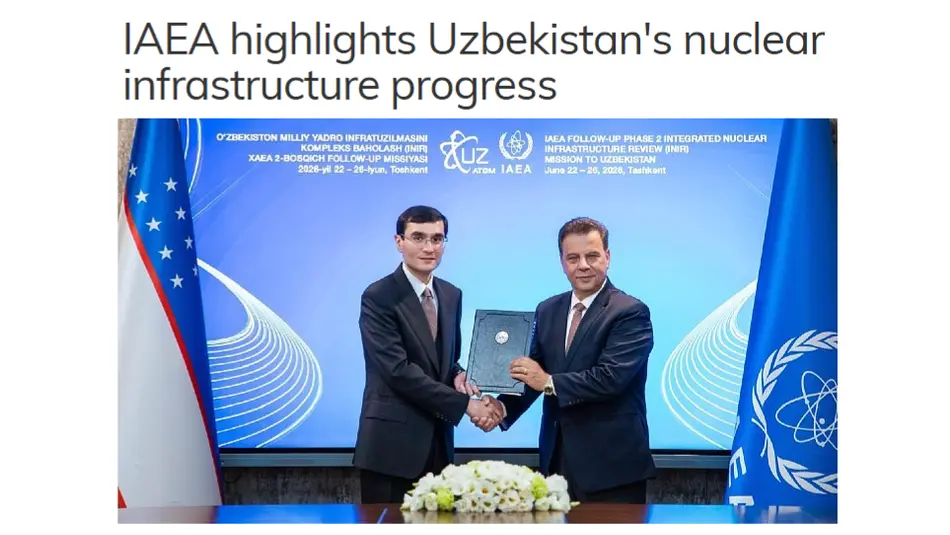
LONDON, July 8. /Dunyo IA/. Uzbekistan is accelerating the development of its national nuclear infrastructure and strategic preparations for the commissioning of its inaugural nuclear power plant, according to the comprehensive evaluation by the International Atomic Energy Agency (IAEA) mission following its visit to the country in late June, reports Dunyo IA correspondent, citing with reference to the British publication “World Nuclear News”.
According to the findings of the mission, Republic has achieved substantial and institutional progress across several critical dimensions, most notably in the fortification of its legislative and regulatory frameworks, the development of specialized human capital, enhancement of robust nuclear safety and security systems and the establishment of independent industry oversight mechanisms.
Transition to Nuclear Power Plant Construction
Experts directed particular attention to the fact that Uzbekistan has successfully transitioned from the planning phase to the practical execution of the project. In strategic partnership with Russia, construction of the nation's inaugural nuclear power plant has commenced.
Scope of the project encompasses both small modular reactors (SMRs) of the RITM-200N type and larger, high-capacity reactors of the VVER-1000 class. According to data disclosed during the mission, the pouring of the first safety-related concrete for the small modular reactor was recently completed - a critical milestone that officially marks the commencement of construction works.
Nuclear power plant project in Uzbekistan initially envisioned a capacity of approximately 330 MW, encompassing six small reactors. However, in 2025, the project configuration was strategically revised: current plans entail the construction of two large-capacity units and two small modular reactor (SMR) units, thereby expanding the total installed capacity to over 2100 MW.
IAEA Assessment
IAEA mission team leader noted that Uzbekistan has demonstrated a “commitment to develop a safe and sustainable nuclear power programme” and is actively implementing the recommendations and suggestions from the previous 2021 assessment.
Among the key milestones achieved, the following have been highlighted:
· Accession to foundational international nuclear agreements and legal instruments;
· The comprehensive modernization of national legislative frameworks;
· The development of robust systems for industry licensing and oversight;
· The formulation of strategic plans for national power grid modernization.
Concurrently, the experts emphasized that institutional efforts remain ongoing. Specifically, further measures are required to consolidate the absolute independence of the regulatory authority and to finalize the project’s comprehensive feasibility studies.
Symbolic Launch and International Interest
Construction of the inaugural reactor has emerged as one of the most prominent energy projects in the region. Within the scope of the works, large-scale earthmoving operations and foundational preparations have already been executed, encompassing the excavation of millions of cubic meters of soil and the pouring of hundreds of cubic meters of concrete.
According to representatives of the atomic energy agency of Uzbekistan, the IAEA mission served as a vital platform for open professional dialogue and for benchmarking the national project against international standards.
The agency’s experts also emphasized that Uzbekistan’s experience in the construction of small modular reactors could serve as a model for other nations developing their nuclear energy programs.
Historical Context
Uzbekistan already possesses foundational experience in the field of nuclear technology, operating research reactors and maintaining a substantial resource base, as the Republic ranks among the world’s prominent global suppliers of uranium.
Presently, the country is effectively making a transition from its traditional research and resource-oriented role toward the establishment of full-scale nuclear energy generation.
Final report of the IAEA mission will be officially published following the comprehensive analysis of the preliminary findings, which have been formally transmitted to the Uzbek side.

Latest News



See all
Read also

Egyptian Media extensively highlights the strategic significance of the First International Forum of Islamic Civilization in Tashkent

“Infora News”: Uzbekistan promotes International Cooperation in the study and preservation of Islamic Heritage