Major International Conference on upholding the rule of law convened in Tashkent
November 30, 2025. 11:09 • 4 min
• 462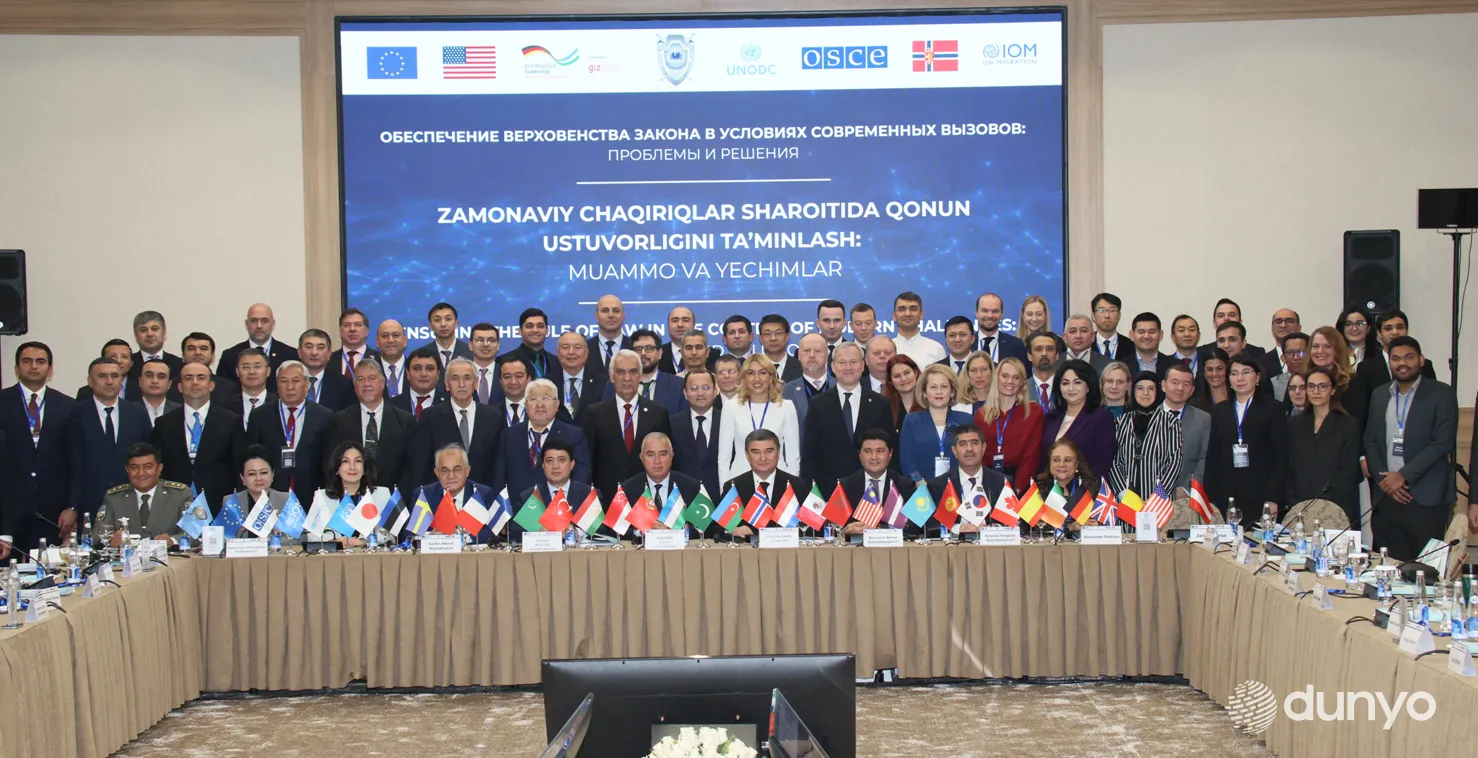
TASHKENT, November 30. /Dunyo IA/. An international scientific and practical conference titled “Ensuring the Rule of Law Amid Contemporary Challenges: Issues and Solutions” was held on 27–28 November at the Law Enforcement Academy of Uzbekistan, reports Dunyo IA correspondent/
The conference, dedicated to the third anniversary of the establishment of the Academy, served as the concluding and central event of an academic decadal programme comprising nine major international training and scientific-practical forums. This series of events was aimed at strengthening the rule of law, enhancing the professional competencies of law-enforcement personnel, addressing modern challenges, and expanding international cooperation.
The event was convened in a hybrid format by the Academy in partnership with the Deutsche Gesellschaft für Internationale Zusammenarbeit (GIZ), the Organization for Security and Co-operation in Europe (OSCE), the United Nations Office on Drugs and Crime (UNODC), the U.S. Department of Justice’s International Criminal Investigative Training Assistance Program (ICITAP), the International Organization for Migration (IOM), as well as a number of other international partner institutions.
The conference brought together 49 experts from 34 countries who travelled to Tashkent to take part in the discussions, with the total number of participants exceeding 120 specialists. Delegates represented a wide geographical range, including the United States, the United Kingdom, Germany, France, Spain, the Netherlands, Türkiye, Canada, the Republic of Korea, Malaysia, Morocco, Latvia, Kazakhstan, the Kyrgyz Republic, Tajikistan, Azerbaijan and several other nations.
Delegations from leading international organisations—including the United Nations, the Organization for Security and Co-operation in Europe (OSCE), the European Union, the International Association of Prosecutors, UNESCO, UNICEF, MESA, the International Anti-Corruption Academy (IACA), and the International Organization for Migration (IOM)—also took part in the high-profile event.
The conference programme featured a plenary session and six parallel thematic sessions. Discussions covered a broad range of priority issues, including combating money-laundering and the financing of terrorism; strengthening education and scientific research in the field of law enforcement; enhancing anti-corruption efforts; establishing legal frameworks for artificial intelligence; ensuring cybersecurity; and protecting human rights in the context of global migration.
At the plenary session, senior representatives of the Office of the Prosecutor General of Uzbekistan, the Supreme Court, the National Center for Human Rights, the Ministry of Internal Affairs, the National Guard, the State Customs Committee, the Anti-Corruption Agency, and the Ministry of Higher Education, Science and Innovation, as well as members of the Senate of the Oliy Majlis, delivered keynote remarks.
Speakers highlighted the vital role of academic and scientific capacity in the ongoing modernisation of the law-enforcement system, emphasising the need to introduce advanced technologies, including artificial intelligence. They also underlined the importance of developing highly qualified specialists capable of addressing transnational threats and responding effectively to contemporary global challenges.
Foreign experts actively contributed to the discussions. Leaders of the Law Enforcement Academies of Kazakhstan and Kyrgyzstan underscored the urgent importance of expanding international cooperation and exchanging best practices in personnel training. Representatives from the European Union, the United Nations, the Organization for Security and Co-operation in Europe (OSCE), and the International Association of Prosecutors highlighted the need to further strengthen collaboration in combating transnational crime, corruption, and terrorism, as well as in protecting human rights.
During the parallel sessions, participants examined issues related to the use of artificial intelligence and digital technologies in combating the legalization of criminal proceeds, the development of international information exchange mechanisms, ensuring sustainable cybersecurity, and improving practices in handling electronic evidence. Particular attention was also given to the implementation of international anti-corruption standards and the ethical and legal aspects of applying artificial intelligence in judicial and law-enforcement activities.
A dedicated session focused on the protection of the rights of migrants and victims of human trafficking, as well as regional and international efforts aimed at their rehabilitation and reintegration.
Within the framework of the conference, the Law Enforcement Academy signed memoranda of understanding on cooperation with the Ministry of Internal Affairs’ Main Expert-Criminalistics Center, leading international cybersecurity company Group-IB, and the Youth Parliament under the Legislative Chamber of the Oliy Majlis. Meetings with foreign delegations were also held to discuss promising directions for future collaboration.
As a result of the conference, a set of practical recommendations was developed aimed at strengthening the rule of law, implementing international anti-corruption standards, enhancing the effectiveness of measures to counter the financing of terrorism, improving mechanisms for identifying, seizing, and returning criminally-acquired assets, protecting human rights, and expanding both interagency and international cooperation.

Latest News



See all
Read also
Strategic cooperation established between Uzbekistan and France to modernize “Uzhydromet” Hydrometeorological System