Under the Chairmanship of the President of Uzbekistan, Results of reforms and priority tasks in Namangan region discussed
March 31, 2026. 17:47 • 6 min
• 204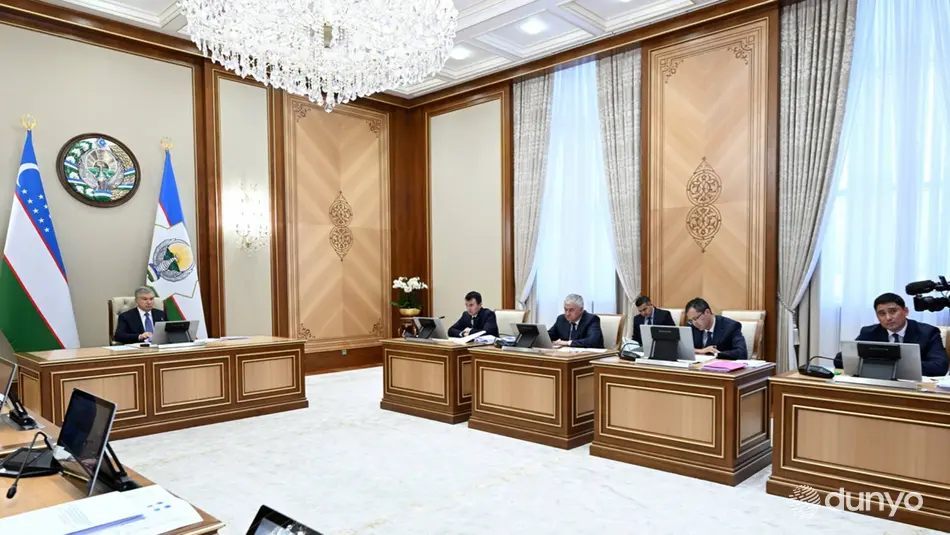
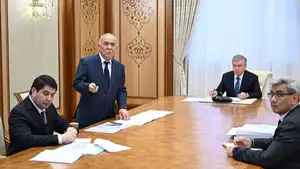
ТASHKENT, March 31. /Dunyo IA/. Today, President Shavkat Mirziyoyev chaired a meeting on March 31 to discuss the effectiveness of reforms and identify further key tasks in Namangan region, reports Dunyo IA correspondent.
According to the press service of the Head of our State, it was emphasized that in recent years, Namangan has experienced substantial growth in industry, the services sector, and entrepreneurship, making the region a model for others in many areas. Notably, over the past 8 years, more than 40,000 new enterprises have been established, and production volumes have increased sixfold, reaching 40 trillion UZS.
According to the 2025 results, the gross regional product totalled 85.4 trillion UZS, reflecting an 8.2 percent growth. Industrial output reached 40.1 trillion UZS, while the service sector volume amounted to 56.3 trillion UZS. The region attracted $3.3 billion in foreign investment, and exports were $916 million.
The Head of State highlighted that during global market instability, it is essential to maintain economic growth and develop new growth areas in Namangan. In this context, regional leaders were tasked with achieving 9.2 percent economic growth, 9 percent industrial growth, 16.3 percent in services, and 6.8 percent in agriculture by 2026. Additionally, there are goals to increase tourism exports by 1.7 times. Targets were also set to raise foreign investment to $5 billion and exports to $1.2 billion.
It was noted that the goal is to reduce the unemployment rate to 3.5 percent and the poverty rate to 2.5 percent by the end of the year. Additionally, the aim is to make the city of Namangan and the districts of Davlatabad, Yangi Namangan, Namangan, Kasansay, Norin, and Uychi free from unemployment and poverty.
Special attention at the meeting was given to an in-depth analysis of regional potential using artificial intelligence technologies. It was noted that, for example, the opportunities of Norin district were analyzed, demonstrating reserves to double investment, increase industrial output by 10.4 percent, and boost exports by 35 percent already this year. It was directed to expand this approach to all districts in the region.
It was noted that securing food supply under current conditions is one of the most urgent tasks. Due to disruptions in transport and logistics chains, as well as in the supply of fuel and mineral fertilizers, it is necessary to improve agricultural efficiency. Therefore, a goal has been set to establish modern intensive orchards on 2.5 thousand hectares of low-productivity plantations and to develop 8 thousand hectares of new land. These measures will create additional income sources and new jobs.
Particular attention was paid to major investment projects. In particular, the need was emphasized to build an additional electrical substation for the full implementation of 15 projects totalling $547 million in the “Sabzazor” neighbourhood of the Namangan Free Economic Zone. So far, 7 projects worth $215 million have already been initiated there.
It was also proposed to build a modern IT Park building valued at $20 million. This project is expected to attract international IT companies, create new jobs, and accelerate growth in digital transformation, artificial intelligence, e-commerce, and the region’s startup ecosystem.
Discussions also covered plans to turn Davlatabad district into a smart city, establish an artificial intelligence research lab, and create a startup club using the unused facilities of the Namangan State Technical University. It was reported that the phased integration of public utilities, waste management, environmental monitoring, and transportation systems is planned to be carried out through the unified digital platform “Smart City Namangan”.
Several new initiatives in industry and entrepreneurship were discussed. Notably, a proposal was made to allocate 24 hectares of land for a 60-megawatt green energy project in Chust district. A project for an enterprise producing non-alcoholic soft drinks, juices, and baby food in Chartak district was introduced.
It was highlighted that considerable resources are also allocated to agriculture. In 2026-2027, as part of relevant initiatives, the plan is to establish orchards and vineyards on 3,948 hectares, plant 1.3 million seedlings, and implement drip irrigation on 1,500 hectares.
Plans were announced for a major $50 million poultry industry project, which will increase capacity to produce 813 million eggs and 2,000 tons of meat. This will fully meet the region’s demand for eggs and enable exports of poultry products worth $42 million to Central Asian and Arab countries.
The meeting also focused on transforming tourism into a key sector of economic development.
To transform the region into a tourism hub of the valley, it was proposed to build a modern and innovative tourism complex on the shores of Lake Arashan in Pap district, the international multifunctional mountain resort area Qamchiq Mountain Resort in the Qamchiq Pass area, a tourism center in Gulistan mahalla of Chodak village, a large tourism center in Olmazor mahalla of Kasansay district, and also to implement a project to create an artificial lake in Nanay settlement of Yangikurgan district.
Additionally, it was proposed to develop a tourism complex in the historic part of Namangan, blending national architectural and craft traditions with modern amenities. Suggestions were made to establish modern eco-bazaars based on the “Chorsu” and “Sardoba” markets, as well as to build multi-level parking facilities. These projects are expected to help revitalize the urban economy and generate new jobs in trade and services.
Several major projects to enhance infrastructure were also considered. Specifically, through a public-private partnership, plans include reconstructing the sewerage system in the city of Namangan and, for the first time, providing wastewater drainage networks to the district centers of Uchkurghan and Uychi districts. In these same districts, there are plans to build a new treatment facility with a capacity of 10,000 cubic meters, lay 40 kilometers of new networks, and upgrade 28 kilometers of outdated pipelines. Overall, the modernization will benefit 42 residents and 6,983 households.
The issue of speeding up construction work in the New Namangan town was also discussed separately. As part of the project, there are plans to create 30,000 new jobs, repair 25.2 kilometers of roads, lay 7.2 kilometers of pedestrian paths, install 4.7 kilometers of water supply networks, and establish 7.4 kilometers of green zones.
Large-scale initiatives were also introduced in the social sector. Specifically, in 2026, plans were made to establish kindergartens with a capacity of 15,000 seats in Namangan, along with the construction of kindergartens through public-private partnerships on 42,000 square meters of unused land owned by 21 educational institutions.
In the healthcare sector, such initiatives included establishing the Namangan branch of the Republican Specialized Center of Traumatology and Orthopedics, equipping the oncology and radiology center with a modern PET scanner, reconstructing the multidisciplinary medical center, and introducing advanced surgical procedures. It was noted that these efforts will expand the capacity to provide high-quality medical care not only to residents of the region but also to patients from neighboring regions.
Following the meeting, the President of Uzbekistan instructed responsible officials to fully utilize the potential of Namangan region, turn each project into tangible results, increase employment and residents’ incomes, and expand the production of high-value-added, export-oriented goods.

See all