
“The Art Newspaper”: Renovated iconic museum in Nukus sparks cultural revival in Central Asia
December 24, 2025. 18:46 • 3 min
• 77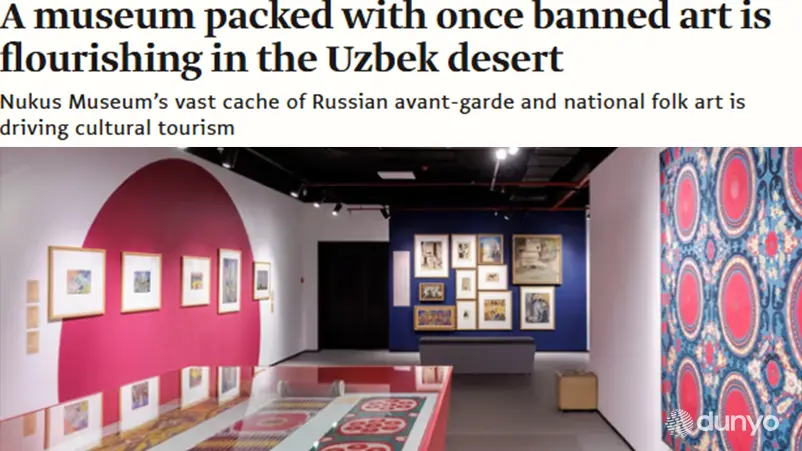
LONDON, December 25. /Dunyo IA/. The Karakalpakstan State Museum of Art Named after Igor Savitsky, internationally known as the “Louvre in the Desert”, has attracted record public attention following its extensive renovation and international exhibitions in Italy, reports Dunyo IA correspondent, citing the British publication “The Art Newspaper”.
It is noted that in a corner of Uzbekistan, close to the cracked, muddy crater that was once the Aral Sea, lies an unlikely treasure trove. The I.V. Savitsky State Art Museum of the Republic of Karakalpakstan (as the museum is formally designated), in the city of Nukus, holds close to 100,000 works of art from the middle decades of the 20th century: canvases, etchings and naturalistic sketches of rural life alongside folk art and textiles from a region whose vast, unbounded expanses were crossed for a thousand years by the caravans, travellers and thieves of the ancient Silk Road.
This year, Nukus Museum has received more attention than ever before, both at home and abroad. Following the exhibition of its collection in Florence and Venice in 2024, the museum has been completely overhauled by Italian academics and its new director, Gulbahar Izentaeva, who was appointed at the beginning of the year. It is now “central Asia’s most important and up-to-date museum of 20th-century art”, according to Silvia Burini, a professor of art history at the Ca’ Foscari University of Venice, who has been working on the collection for the past four years.
Experts emphasize that the works displayed in Nukus should not be seen merely as a periphery of Russian avant-garde. The region’s art absorbed local visual traditions—ikat patterns, suzani embroidery, and Islamic architecture of Samarkand and Bukhara—and entered into a complex dialogue with European and Caucasian artistic movements. Scholars have termed this phenomenon the “Avant-Garde of the East”.
The museum was founded by Igor Savitsky, a Soviet official and passionate collector, who, at the risk of his career, saved works by avant-garde artists and examples of local folk art from destruction. After the collapse of the USSR, the museum faced a financial crisis, but thanks to international support and initiatives to catalog its collection, its integrity was preserved.
Today’s revival of the museum is closely linked to the activities of the Uzbekistan Art and Culture Development Fund, which finances restoration and research projects as well as the digitization of the collection. According to the museum’s administration, around 3,000 works have already been digitized.
The results are already visible: since the beginning of the year, the museum has welcomed nearly 70,000 visitors, more than a quarter of whom were international tourists. Authorities and experts now consider Nukus as a new center of cultural tourism, alongside Bukhara and Samarkand.
“For Karakalpakstan, this is not just a tourist site, but part of our identity”, - emphasizes Gulbahar Izentaeva, noting that introducing the region’s youth to this heritage is becoming an important element of cultural self-awareness and dialogue with the global history of art.

Latest News
See all
Read also
“The World News”: Uzbekistan aims to boost textile industry output to 147 trillion UZS by 2026
“Travel Tomorrow”: Uzbekistan among the world’s fastest-growing tourist destinations
Iraqi Newspaper “Azzaman”: Iraq and Uzbekistan: Historical roots and a renewed path