Uzbekistan and Germany: Consistent deepening of multifaceted cooperation based on mutual interests
June 17, 2026. 08:55 • 6 min
• 79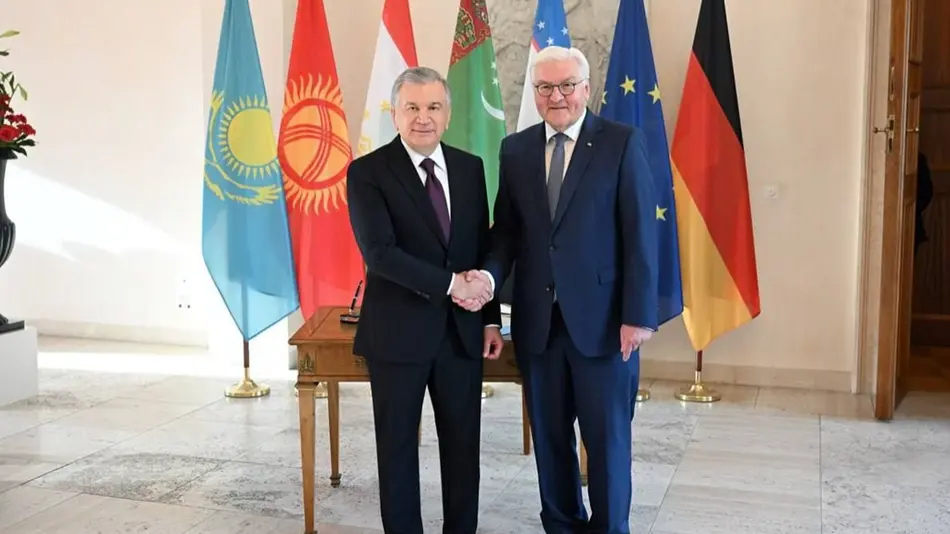
ТАSHKENT, June 17. /Dunyo IA/. At the invitation of the President of Uzbekistan Shavkat Mirziyoyev, Federal President of Germany Frank-Walter Steinmeier will pay an official visit to Uzbekistan on June 17-18th, 2026, reports Dunyo IA correspondent.
Uzbekistan and Germany are consistently developing bilateral cooperation based on a sustainable political dialogue, expanding trade and economic ties, and strengthening humanitarian interaction. In the modern context of the dynamic transformation of international processes and the growing interdependence of states, the partnership between Tashkent and Berlin is acquiring an increasingly systemic and multifaceted character.
Germany was among the first to recognize the independence of Uzbekistan on December 31st, 1991, and diplomatic relations between the two states were established on March 6th, 1992. Over the past period, a solid institutional framework for cooperation has been formed, covering political, economic, investment, educational and cultural-humanitarian spheres.
Regular contacts at the highest level have played a significant role in intensifying Uzbek-German relations. In January 2019, President of Uzbekistan Shavkat Mirziyoyev paid an official visit to Germany, during which meetings were held in Berlin with the Federal President Frank-Walter Steinmeier, Federal Chancellor Angela Merkel and the leadership of the Bundestag. Following the talks, a substantial package of agreements was signed in the fields of investment, finance, science, education and culture.
Four months later, on May 27-29th, 2019, Federal President of Germany Frank-Walter Steinmeier paid a return visit to Uzbekistan, which became an important milestone in the development of bilateral dialogue. During the highest-level talks, the sides discussed issues of expanding political, trade and economic, educational and cultural-humanitarian cooperation.
The official visit of the President of Uzbekistan to Germany on May 2–3rd, 2023, gave a new impetus to interaction, following which intergovernmental and interdepartmental documents aimed at further deepening the partnership between the two countries were signed. As a continuation of the intensive political dialogue, Head of Uzbekistan visited Germany in September of the same year to participate in the first Central Asia - Germany Summit. The visit featured talks with the Federal President and the Federal Chancellor of Germany, as well as participation in a business forum organized by the Eastern Committee of German Business.
The official visit of the Federal Chancellor of Germany to Uzbekistan in September 2024 became a significant event in the development of bilateral dialogue. During the highest-level summit, the sides discussed topical issues on the bilateral agenda and identified promising areas for further expanding interaction.
The signing of a memorandum of understanding between the relevant interparliamentary cooperation groups in January 2019 was an important step in institutionalizing parliamentary interaction between Uzbekistan and Germany.
A parliamentary group for interaction with Central Asian countries operates in the German Bundestag, while an interparliamentary group for cooperation with the German parliament functions in the Oliy Majlis of Uzbekistan.
Trade and economic cooperation between Uzbekistan and Germany is characterized by sustainable development and relies on established institutional mechanisms of interaction. German-Uzbek Business Council, established in February 2015, serves as one of the key coordination tools. The Council’s activities are aimed at expanding business contacts, promoting joint initiatives, and developing direct interaction between business representatives of the two countries.
Intergovernmental Working Group on Trade and Investments serves as an additional mechanism for developing economic ties, facilitating the discussion of promising projects and the coordination of priority areas of cooperation.
The most-favoured-nation treatment applies in bilateral trade, creating additional conditions for the development of mutual trade turnover. The dynamics of trade in recent years have demonstrated a predominantly upward trend. While the trade turnover volume stood at 765.7 million dollars in 2021, the figure reached 1.427 billion dollars by 2025. In January–April 2026, the volume of mutual trade amounted to 411.6 million dollars.
The structure of bilateral trade turnover reflects the complementary nature of the economies of the two countries. The basis of Uzbek exports is formed by services, textile, and food products, while imports from Germany are predominantly represented by machinery, mechanical equipment, vehicles and components, as well as pharmaceutical and chemical products.
The practical dimension of investment cooperation is reflected in the activities of enterprises with the participation of German capital. Currently, 225 enterprises with German investments operate in Uzbekistan, including those with 100% foreign ownership and representative offices of German companies are accredited.
Intergovernmental Mixed Commission on Cultural Cooperation serves as a significant mechanism for coordinating cultural and humanitarian cooperation, with its activities contributing to the strengthening of humanitarian contacts and the expansion of joint initiatives.
Cooperation in the field of education and science remains one of the most dynamic areas. Leading German educational and public institutions operate in Uzbekistan, implementing projects in language training, academic exchange, and the development of educational infrastructure.
The sphere of healthcare serves as a promising area of humanitarian interaction. To date, a number of joint projects related to the development of medical infrastructure, personnel training, and the introduction of modern educational programs in the medical field have been implemented.
The activities of the German diaspora in Uzbekistan, as well as the development of interregional ties, which form an additional basis for further expanding humanitarian cooperation, remain an important social factor in the development of bilateral relations.
Over the years of bilateral cooperation between Uzbekistan and Germany, 169 agreements of various levels have been signed, including interstate, intergovernmental, interdepartmental, and other documents. The established legal architecture covers a wide range of areas of cooperation and reflects a high level of institutionalization of relations between the two states.
Over the years of partnership, Uzbekistan and Germany have succeeded in forming a sustainable system of interstate interaction based on regular political contacts, developed institutional mechanisms, and an expanding legal framework. The intensification of mutual visits, the growth of trade volumes, the implementation of investment projects, and the development of humanitarian initiatives testify to the transition of cooperation to a more comprehensive and practice-oriented model.
The economic dimension of relations is acquiring particular importance, accompanied by the expanding presence of German business in Uzbekistan, the strengthening of industrial cooperation, and the implementation of projects in priority sectors of the economy. Concurrently, the development of educational, scientific, cultural and humanitarian contacts contributes to forming a long-term foundation for further rapprochement between the two states.
In the context of the contemporary international agenda, Uzbekistan and Germany demonstrate a mutual desire to further deepen their mutually beneficial partnership based on a pragmatic approach and mutual respect. According to experts, the further strengthening of bilateral ties will contribute to expanding Uzbekistan’s cooperation with Europe as a whole and will create additional opportunities for implementing joint initiatives in the political, economic and humanitarian spheres.

Latest News
See all
Read also
Attitude from Pakistan: Tashkent International Investment Forum serves as an important platform for exploring new cooperation formats
Uzbekistan and Albania set long-term agenda for mutually beneficial political and economic partnership