Tashkent Hosts Workshop on Human Rights and Detention Management
June 25, 2026. 10:30 • 4 min
• 77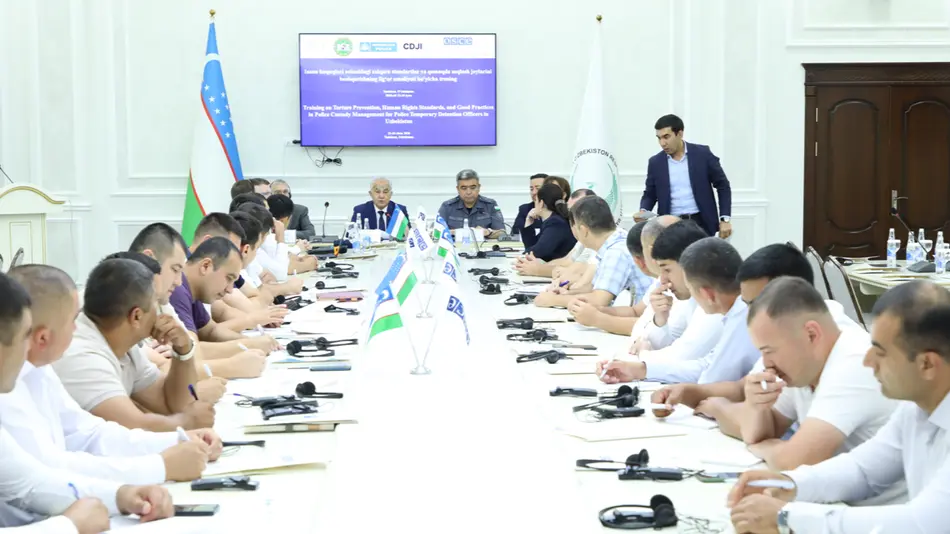
TASHKENT, June 25. /Dunyo IA/. A three-day training course titled “International Human Rights Standards and Modern Practices in the Management of Detention Facilities” concluded yesterday at the Human Rights House in Tashkent, reports Dunyo IA correspondent.
The training was organized within the framework of a joint project of the National Centre for Human Rights of Uzbekistan, the OSCE Project Co-ordinator in Uzbekistan, and the Ministry of Internal Affairs, with the assistance and direct participation of the Metropolitan Police Service of the United Kingdom.
The Metropolitan Police Service is the largest police force in the United Kingdom and is responsible for maintaining law and order in London. Established in 1829, it currently employs more than 40,000 personnel. In addition to policing London, the service carries out a number of nationwide responsibilities, including counterterrorism operations and the protection of members of the Royal Family.
The training focused on strengthening the capacity of law enforcement personnel working in pre-trial detention facilities in the areas of torture prevention and compliance with international human rights standards.
The opening session featured remarks by Akmal Saidov, Director of the National Centre for Human Rights; Andrew Jurkowski, International Project Manager at the Office of the OSCE Project Co-ordinator in Uzbekistan; Mansur Sattarov, First Deputy Head of the Investigative Department under the Ministry of Internal Affairs; and Elina Steinerte, Vice-Chair of the UN Subcommittee on Prevention of Torture and Chair of the Board of the Centre for Development and Justice International.
Akmal Saidov noted that the prohibition of torture and cruel treatment is a fundamental right recognized by both international human rights instruments and national legislation. He emphasized that the revised Constitution of Uzbekistan prohibits torture under all circumstances and without exception.
He also highlighted the ongoing incorporation of the Nelson Mandela Rules into national legislation, the expansion of prisoners’ rights, and efforts to reduce periods of detention and the application of preventive measures.
During the training, participants reviewed international and national legal frameworks for preventing torture and ill-treatment, including the UN Convention against Torture, its Optional Protocol, and key safeguards for persons deprived of liberty. These topics were presented by Ikbolbek Abdumajidov, Head of the Department for International Cooperation of the National Centre for Human Rights, and Azamat Shambilov, International Consultant on Criminal Justice Reform and Human Rights Advocate and Representative of the International Penitentiary Foundation.
Representatives of the Metropolitan Police in London, Philip Michael Andrews and John Norton Dantourn, provided detailed presentations on human rights standards applicable to detention and temporary holding facilities. They also discussed safeguards that apply from the moment of detention, including access to legal counsel, medical assistance, notification of relatives, registration and documentation procedures, as well as management and accountability mechanisms within detention facilities.
Particular attention was given to vulnerable categories of detainees, gender-sensitive approaches, and medical safeguards. Participants also examined the UN Bangkok Rules and issues related to gender-sensitive treatment in detention settings.
The training covered approaches to identifying and working with vulnerable detainees, including women, children and juveniles, persons with disabilities, foreign nationals, and individuals with mental health conditions. The acquired knowledge was reinforced through group presentations and discussions.
Another session focused on medical examination and documentation procedures in detention facilities as tools for preventing and detecting torture and ill-treatment. Participants reviewed recent legislative and procedural changes in Uzbekistan related to mandatory medical examinations prior to placement in detention facilities and assessed their compliance with international standards.
During practical exercises, participants developed principles and skills for responding to medical risks and potential human rights violations in places of detention.
The event concluded with a question-and-answer session, a summary of the training outcomes, and an exchange of views among participants.

Latest News



See all
Read also
Uzbek Schoolchildren Join International Cultural and Educational Project “Train of Memory”
Eldor Aripov: Fergana Valley stands as a clear illustration of the ongoing transformation in Central Asia