Won Do Yeon: The state visit of the President of Uzbekistan to the Republic of Korea is of special significance
September 15, 2026. 08:10 • 9 min
• 54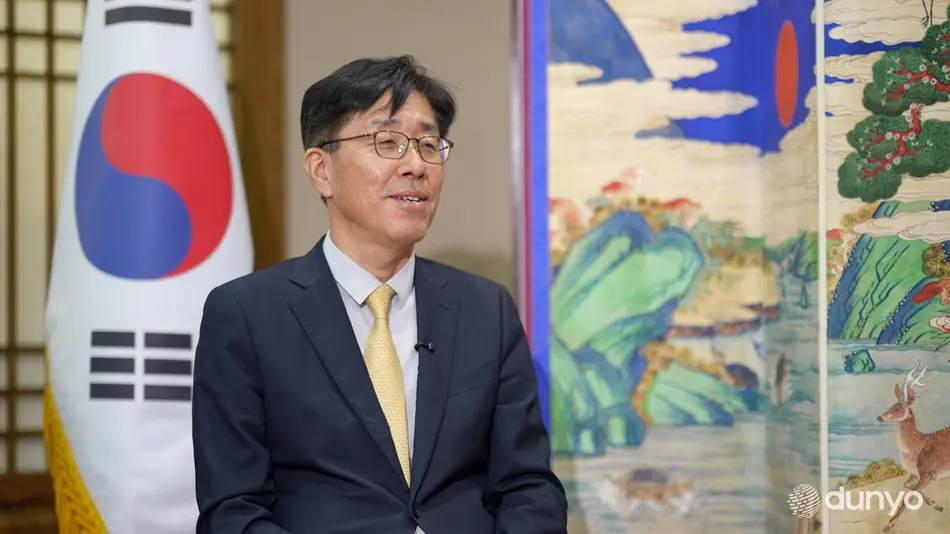
TASHKENT, September 15. /Dunyo IA/. Ambassador of South Korea to Uzbekistan Won Do Yeon gave an exclusive interview to a correspondent of Dunyo IA ahead of the state visit of President of Uzbekistan Shavkat Mirziyoyev to the Republic of Korea:
Mr. Ambassador, how do you assess the current level of the special strategic partnership between Uzbekistan and the Republic of Korea, and which areas, in your view, will shape its further development?
— Our countries established relations of special strategic partnership in 2019. Today, in my view, these relations have reached an unprecedentedly high level of development. Cooperation is actively expanding across various areas. Investment and trade volumes are growing, as is the number of South Korean tourists visiting Uzbekistan. Currently, around 100,000 Uzbek citizens are in our country for work or study. Overall, relations between the two countries are becoming increasingly close.
As for promising areas of cooperation, our countries are successfully working together not only in traditional fields such as manufacturing and transport infrastructure. At the same time, cooperation is expanding into forward-looking areas such as artificial intelligence, pharmaceuticals, biotechnology, and climate change.
Foundation of all this cooperation is people-to-people contact. I believe that, in developing human ties, the Korean diaspora in Uzbekistan serves as a key pillar supporting relations between our two countries.
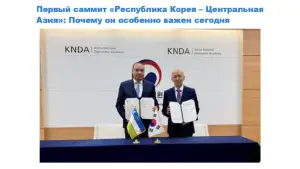
In the coming days, the state visit of the President of Uzbekistan to Seoul will take place, along with the first “Central Asia–Republic of Korea” Summit. What significance does the South Korean side attach to these events, and what specific agreements and practical outcomes are expected in further deepening bilateral cooperation and strengthening the partnership?
— The state visit of President of Uzbekistan Shavkat Mirziyoyev to South Korea is of special significance.
The “Republic of Korea–Central Asia” summit will be held for the first time at the highest level in history. Meetings that have been held at the ministerial level since 2007 are now being elevated to the level of heads of state for the first time.
Our country hosts many international events and meetings, but the summit will be the only multilateral summit held this year. That is why it is particularly important.
A large number of documents are expected to be signed, along with the announcement of a number of measures to strengthen cooperation. Since the official documents have not yet been announced, I would not like to disclose detailed information about them. However, I can say that important documents will be signed not only in areas such as transport infrastructure, manufacturing and climate change, but also in healthcare and education, which are of great interest to Uzbekistan.
Of course, signing documents is important. But above all, I believe that President Shavkat Mirziyoyev’s visit to South Korea will be a valuable opportunity for the two leaders to become even closer.
Our two presidents have a lot in common. They have already had two contacts. Last year, on the occasion of President Shavkat Mirziyoyev’s birthday, they held their first telephone conversation. Later, the two leaders met on the sidelines of the UN General Assembly. The upcoming meeting will be their third contact.
Although close relations have already developed between the two leaders, I expect the current visit to provide an opportunity for a deeper dialogue and for them to truly become partners.
As I mentioned, the two presidents have much in common. This year, President Shavkat Mirziyoyev declared 2026 the “Year of Mahalla Development and Society,” emphasizing the importance of balanced regional development. President Lee Jae Myung also attaches great importance to this issue.
Therefore, I believe this visit is of special significance, as it provides an excellent opportunity for the two presidents to truly grow closer.
Since the beginning of 2026, trade turnover between Uzbekistan and the Republic of Korea has increased by 12 percent, while the total volume of South Korean investment in our country’s economy has exceeded $8 billion. How do you assess the potential for further growth in bilateral trade? Which new sectors and areas do you consider the most promising for attracting South Korean investment and implementing joint projects in Uzbekistan?
— Investment and trade between South Korea and Uzbekistan are increasing significantly. In my view, the potential for further development of cooperation is virtually limitless. As the Ambassador of the Republic of Korea, I feel this every day.
If we talk about important projects currently underway, for example, the KIA vehicle manufacturing plant in Jizzakh previously produced only one model, the Sonet, but production of the K3 model has now also begun.
Many people probably know that the high-speed train “Jaloliddin Manguberdi,” received from South Korea, has begun operating on the Tashkent–Khiva route.
I am sure that many people are already feeling how much closer Korean-Uzbek relations are becoming and how actively Korean companies are entering the Uzbek market and investing in the country.
Cooperation is actively developing in traditional areas, particularly manufacturing and transport infrastructure. However, I believe that the most promising areas for the future are artificial intelligence and high-tech industries.
Among the significant investments currently being implemented is that of the South Korean company “Robotis,” which specializes in robotics. The company is investing around $100 million in Uzbekistan and is building a plant to manufacture robot joints. In addition, the company AHA is building a plant for the production of electronic boards in the Fergana region.
The driving force behind the strengthening of economic ties between our two countries is their complementarity. Our country has a high level of technological development, while Uzbekistan has not only rich natural resources and mineral deposits but also a large pool of skilled workers. It is precisely because of this complementarity that Robotis decided to establish production in Uzbekistan.
From this perspective, cooperation in critical minerals is a promising area for the future. Our countries are actively discussing joint exploration and development of critical minerals, the production of high value-added products, and the export of such products to Korea, Europe and elsewhere.
Uzbekistan and South Korea are actively developing cooperation in education: branches of South Korean universities are opening in our country, and joint educational programmes are expanding. How do you assess the role of this cooperation in training personnel for the economy of New Uzbekistan?
— At present, branches of South Korean universities in Uzbekistan, including Inha University, Ajou University and Bucheon University, play an important role in developing cooperation in education.
Many people ask me what has been the main driver of the economic development of the Republic of Korea. First and foremost, I answer: investment in human capital. I think no one would disagree that South Korea was able to achieve rapid development precisely because of significant investment in education.
In this regard, not only the branches of South Korean universities in Uzbekistan play an important role, but also Uzbek students studying in our country. Currently, around 15,000 students from Uzbekistan are studying in South Korea in various fields.
In South Korea, Uzbek students receive an education, learn advanced technologies and modern industries, and then return to Uzbekistan and contribute to the development of the Uzbek economy.
Strong humanitarian ties have developed between the peoples of Uzbekistan and South Korea. How do you assess the prospects for further expanding cultural exchanges and mutual tourism, as well as implementing new projects?
— First of all, I would like to note that interest in Uzbek culture is growing in South Korea.
There is a “Central Asia Street” in South Korea, and my friends go to Uzbek restaurants and try Uzbek dishes, including plov and kebab.
I believe that developing people-to-people contacts and cultural cooperation requires, above all, mutual interest in each other. What pleases me most is that interest in Uzbekistan in South Korea is constantly growing. I attach great importance to this and view it very positively.
That is why the number of South Korean tourists visiting Uzbekistan is increasing rapidly. Last year, around 45,000 South Korean citizens visited Uzbekistan, which was 15–20 percent more than the previous year.
In turn, I would like to express my gratitude for the great interest in Korean culture, cuisine, cosmetics, K-pop and other aspects of Korean culture in Uzbekistan.
I believe that interest in Korean culture can contribute to the implementation of a number of concrete cooperation projects. For example, within the pharmaceutical cluster, a pharmaceutical faculty is currently being established jointly with South Korea’s Yonsei University. The project is expected to be expanded in the future, and not only Korean biotechnology companies but also cosmetics companies plan to establish production here.
Thus, interest in Korean culture in Uzbekistan and the K-beauty phenomenon can contribute to concrete projects for producing Korean goods in Uzbekistan.
I consider it a very positive signal that cultural cooperation is gradually developing into practical and economic interaction.
Looking at the next decade of Uzbek-South Korean cooperation, how would you like to see the strategic partnership between the two countries by 2035? Which areas could become its key pillars?
— I am confident that by 2035 Uzbekistan will become a developed country.
Observing the outstanding leadership of President Shavkat Mirziyoyev and the Uzbek government officials with whom I work every day, I have no doubt that Uzbekistan is moving towards becoming a developed country.
I believe that over the past 30 years, Korea has been a reliable partner for Uzbekistan. If the same level of cooperation and experience is built up over the next 10 years, the role and status of South Korea as a special strategic partner for Uzbekistan will be further strengthened.
We most often describe South Korean-Uzbek relations as a special strategic partnership. But the expression I like most is “brotherly countries.” I hope that by 2035 our countries will become not simply brotherly states, but the closest and friendliest brothers among brotherly countries.
As one of the key areas of cooperation that will form the basis of these brotherly relations, I would particularly highlight transport infrastructure. In order to become a developed country, Uzbekistan is currently making great efforts to move from the status of a “landlocked country” to that of a “land-linked country.” I believe this will become one of the most important drivers of Uzbekistan’s further development and its transformation into a developed country.
South Korea is already actively participating in these efforts. For example, Incheon International Airport is a key partner in the construction of New Tashkent Airport. We are also actively cooperating in the railway sector, including considering the expansion of supplies of the “Jaloliddin Manguberdi” high-speed trains that I mentioned earlier.
Through these joint efforts, South Korea intends to continue playing the role of a reliable partner in transforming Uzbekistan into a true “land-linked country.”
As for people-to-people ties between the two countries, ethnic Koreans – the 170,000-strong Korean community – play a particularly important role.
I hope that the number of Uzbek citizens living in South Korea will increase in the future from 100,000 to 200,000–300,000, while the number of Koreans visiting Uzbekistan will grow to 50,000–100,000.
I am confident that such people-to-people ties will become a reliable foundation that will allow relations between our countries to reach a new level and truly turn South Korea and Uzbekistan into brotherly countries.

Latest News
See all
Read also
Hassan Ibrahim: Global Conference of Young Parliamentarians in Samarkand was highly successful
Julieta Sierra: Opportunity to convene here in Samarkand, exchange institutional experiences, and collaboratively seek policy solutions carries profound significance