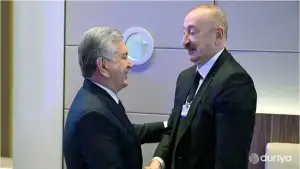
View from Baku: Azerbaijan-Uzbekistan Summit has become an important step toward strengthening brotherhood between our countries and peoples
August 26, 2026. 09:25 • 5 min
• 106
BAKU, August 26. /Dunyo IA/. Ilgar Velizade, an expert in political geography and geoeconomics, commented for Dunyo IA on the outcomes of the state visit of the President of Azerbaijan Ilham Aliyev, to Uzbekistan on August 23–24th:
- It has already become a fine tradition in recent years for the presidents of Azerbaijan and Uzbekistan to exchange mutual visits practically every year, strengthening not only the legal framework of relations but also progressively elevating the level of bilateral interaction.
Over the past five years, Ilham Aliyev and Shavkat Mirziyoyev have met within the framework of 15 mutual high-level visits. During this period, relations between the two countries have progressed through several successive stages. In 2022, the Declaration on Deepening Strategic Partnership and Enhancing Comprehensive Cooperation was signed; in 2023, the Supreme Interstate Council was established; and in August 2024, the parties concluded the Treaty on Alliance Relations. The state visit of Ilham Aliyev to Uzbekistan, which began on August 23rd, continued this tradition.
At the same time, political rapprochement is increasingly backed by economic results. According to data provided by the President of Azerbaijan Ilham Aliyev, in an interview with the National News Agency of Uzbekistan (UzA), trade turnover between the two countries more than tripled in 2025, reaching $795 million. This represents colossal growth, demonstrating the vast potential of bilateral interaction and it is far from the limit. In January–May 2026, trade turnover increased by another 33% compared to the same period of the previous year. Established three years ago, Azerbaijan-Uzbekistan Investment Company, with a capital of $500 million, finances joint projects in both countries, further stimulating mutual trade.
Industrial cooperation is also expanding. More than 130 commercial organizations with Uzbek capital are already operating in Azerbaijan. Joint production of “Chevrolet” cars and Isuzu buses is steadily developing. Azerbaijani businesses, in turn, are investing in major projects in Uzbekistan, including “The Ritz-Carlton” hotel and residential complex in Tashkent and “Sea Breeze Uzbekistan” in the Tashkent region.
Economics is not just important on its own here. It is precisely what transforms political closeness into a sustainable system of mutual interests. Joint investments, manufacturing, trade, and logistics create a tangible, material interest for both sides in preserving and further developing these established relations.
For Azerbaijan, cooperation with Uzbekistan is crucial as part of a broader process of rapprochement with Central Asia. Uzbekistan possesses a large domestic market, significant industrial potential and a rapidly growing economy. For Tashkent, Azerbaijan, in turn, serves not only as a market and a source of investment but also as a vital transit link on the route to Türkiye and Europe. This is precisely why the economic convergence of the two countries is directly tied to the development of transport cooperation.
Azerbaijan and Uzbekistan are situated on opposite shores of the Caspian Sea and effectively form the most critical links of the route between Central Asia, the South Caucasus, Türkiye, and Europe. In 2025, the volume of transit cargo transportation between the two nations grew by 6.7%, reaching 1.4 million tons. In the first half of 2026, growth increased by an additional 12.2%.
Significance of this corridor will continue to expand alongside the development of the China–Kyrgyzstan–Uzbekistan railway. Its connection across the Caspian Sea to the Middle Corridor enables the formation of a more seamless route from China and Central Asia through Azerbaijan toward Türkiye and European markets. Consequently, transport is progressively transforming from just one of many areas of cooperation between Baku and Tashkent into a core strategic interest for both countries.
All of this makes the current rapprochement part of a broader regional process. Azerbaijan is increasingly integrating with Central Asia. In 2025, a decision was made regarding its full participation in the Consultative Meetings of the Heads of State of Central Asia. Consequently, the previous format of the five Central Asian states has effectively expanded with the accession of Azerbaijan.
Particular importance is attached to the cooperation between Baku and Tashkent within the Organization of Turkic States (OTS). Azerbaijan and Uzbekistan advocate for strengthening the role of the OTS, transforming it from a predominantly consultative platform into a more influential organization with a growing political and economic dimension. This is no coincidence, as amid global political turbulence, the OTS is emerging as one of the most stable and predictable regional platforms. Relations among its members allow for the integration and realization of the core interests of their peoples, while their commonality of goals is increasingly reinforced by concrete economic, transport and investment projects.
For Azerbaijan and Uzbekistan, strengthening the OTS simultaneously means expanding the sphere of interaction between the South Caucasus and Central Asia, while creating additional opportunities to pursue a more independent regional policy.
Finally, historical and cultural proximity, shared traditions and linguistic ties remain an essential foundation of their relations. During one of his visits to Uzbekistan, President Ilham Aliyev noted that he can understand the Uzbek language without difficulty. At first glance, this might seem like a purely symbolic detail; however, cultural and linguistic closeness truly fosters growing mutual interest between the societies of both nations.
This is particularly evident in the tourism sector. Expansion of direct flights, the absence of visa barriers and relative geographical proximity make mutual travel increasingly accessible. Uzbekistan attracts Azerbaijani tourists primarily with Samarkand, Bukhara and Khiva, while the appeal of Baku, Karabakh and Azerbaijan's resort regions is growing for Uzbek tourists. The similarity in traditions, cuisine and lifestyle further facilitates people-to-people contacts.
As a result, tourism is becoming yet another practical dimension of the rapprochement between Azerbaijan and Uzbekistan. The growing number of mutual trips expands connections not only at the state and business levels but also between the societies themselves.
This is precisely why the state visit has become the next step toward strengthening the Azerbaijani-Uzbek brotherhood, which today relies not only on historical and cultural proximity but also on very concrete political, economic and strategic interests.

Latest News



See all