Arab expert: "Days Gone By" - an Uzbek realistic novel about the history of Central Asia
December 30, 2025. 13:03 • 5 min
• 729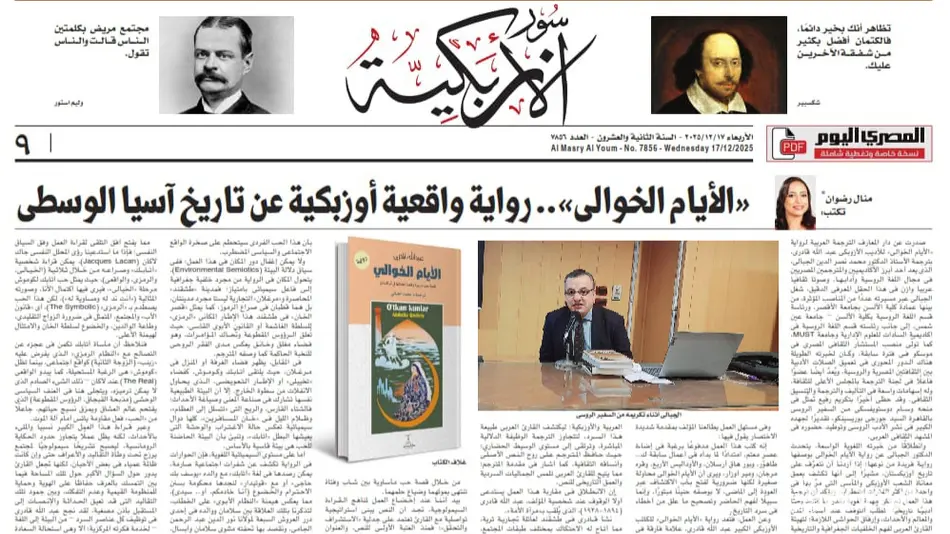
CAIRO, December 30. /Dunyo IA/. The widely read Egyptian print and online publication “Al-Masry Al-Youm” has published an in-depth article dedicated to the renowned novel “Days Gone By” (“O‘tkan Kunlar”) by Abdulla Qodiriy, reports Dunyo IA correspondent.
The article reports that the Uzbek classic novel “Days Gone By” (“O‘tkan Kunlar”) by Abdulla Qodiriy has been published in Arabic translation by the Egyptian publishing house “Dar Al-Ma’arif”. The translation was carried out by Professor Muhammad Nasr Al-Din Al-Jabali, one of Egypt’s leading scholars and translators in literature, widely recognized as an authority in this complex and nuanced field.
It highlights that Muhammad Nasr Al-Din Al-Jabali, a prominent cultural figure, is an active member of the Translation Committee under the Supreme Council of Culture and has made significant contributions to authorship, translation, and cultural coordination.
Drawing on his extensive linguistic expertise, Dr. Al-Jabali describes “Days Gone By” as a unique work for those seeking to understand Uzbekistan’s history. He emphasizes that the novel deeply portrays the sufferings of the Uzbek people and the tragedies they endured during one of the most turbulent periods in the nation’s history.
Muhammad Nasr Al-Din Al-Jabali emphasizes that translating “Days Gone By” (“O‘tkan Kunlar”) was not merely a linguistic task, but a literary-historical undertaking. The work required careful attention to the names of cities, monuments, and historical events, as well as the inclusion of explanatory notes to help Arab readers understand the geographical and historical context. He approached the text as a human and cultural document, aiming to convey it with both fidelity and precision, ensuring that the author’s voice and the novel’s themes reached readers clearly and authentically.
The project represents a natural continuation of Dr. Al-Jabali’s scholarly path and a deep interpretation that highlights the novel’s literary value and the importance of its translation in enriching readers’ knowledge of Central Asian history and collective memory.
As noted in the article, the author, Abdulla Qodiriy, opens the novel with a concise preface, explaining that he wrote the book to illuminate a dark period of history, building on themes from his earlier works, including “Tahir”, “Bur-hak Arslan”, “Four Odalisques”, “Kara-Mardjan” and “Mir Uzyar”. He presents “Days Gone By” as a small but essential attempt to open a door to understanding the past - not as a truncated nostalgia, but as a pathway to comprehending the present and correcting historical errors embedded in the narrative.
“Days Gone By” (“O‘tkan Kunlar”) stands as a milestone in the history of Central Asian literature - not only as the first Uzbek realist novel, but also as a human and historical document that reconstructs the collective memory of an ancient people at a pivotal moment in their history.
The article emphasizes that the Arabic translation by Professor Muhammad Nasr Al-Din Al-Jabali adds special significance to this critical interpretation. His work went far beyond a literal linguistic transfer, delving into the subtle nuances embedded within the text. By bridging the gap between Uzbek and Arab cultures, Al-Jabali has made it possible for Arab readers to fully appreciate the nature and depth of Qodiriy’s narrative.
In this way, the translation transcends its direct semantic function to become a form of civilizational mediation: the translator preserved the spirit of the original text and its cultural codes, as he notes in his preface, allowing readers to experience both the narrative’s aesthetic richness and historical profundity.
The publication also focused extensively on the life and legacy of Abdulla Qodiriy (1894–1938), often referred to as the “mirror of the nation.” Born into a prosperous family in Tashkent, Qodiriy was exposed to a wide spectrum of society - from merchants and artisans to the impoverished and the elite. This diverse social environment, combined with his early awareness of the complex political transformations of the early 20th century, including the transition from Tsarist rule to the Bolshevik Revolution, is directly reflected in the structure of his novel.
In “Days Gone By”, Qodiriy reconstructs history through the personal tragedy of Atabek and his beloved Kumush, seeking to understand the roots of social backwardness and political despotism experienced in Turkestan during the “era of the last Khans”.
From a semiotic perspective, the novel establishes a communicative strategy with the reader based on the dialectic of anticipation and confirmation. From the outset, even in the subtitle - “A Bitter Love Story Set in Turkestan” - the reader is introduced to a sense of impending tragedy. This narrative contract shapes perception, prompting the reader to follow the signs confirming the inevitability of catastrophe. The structure leaves no room for happy illusions: every detail, from the depiction of “bloody clouds hanging over Tashkent” to the “harsh weather of Margilan”, functions as a semiotic marker, reinforcing the expectation that this personal love story will ultimately crash against the harsh realities of social and political instability.
According to the translator, despite its relative length and event-rich narrative, the novel transcends a simple romantic story, becoming a semiotic exploration of a society under the weight of traditions and customs. While these traditions can often be blindly unjust, they confront the reader with a profound question: where lies the boundary between preserving tradition for identity and values, and rigid conservatism that impedes modernization and thoughtful engagement with the future.
The achievement of the translator, Professor Muhammad Nasr Al-Din Al-Jabali, lies in rendering this densely constructed text into expressive Arabic, preserving the poetics of Uzbek suffering and presenting readers with a mirror of history, reflecting both the past and the present. In doing so, he demonstrates that true literature is a melody that transcends space and time.

See all