
Tashkent to Host Second Meeting of Termez Dialogue on Connectivity Between Central and South Asia on June 4–6
May 29, 2026. 16:40 • 3 min
• 1017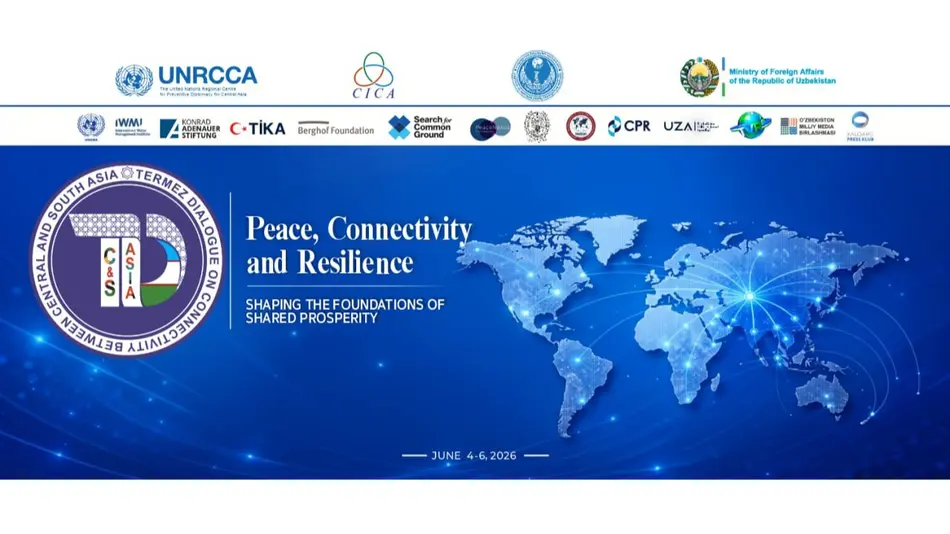
TASHKENT, May 29. /Dunyo IA/. On 4-6 June, Tashkent will host the second meeting of the Termez Dialogue on Connectivity between Central and South Asia under the theme: “Peace, Connectivity, and Resilience: Shaping the Foundation for Shared Prosperity”, reports Dunyo IA correspondent.
Established in 2025 as a permanent international platform, the Termez Dialogue is intended to facilitate the practical advancement of the initiative put forward by the President of Uzbekistan, Shavkat Mirziyoyev, aimed at strengthening interconnectivity between Central and South Asia. This initiative has received broad international support and was enshrined in a special resolution adopted by the United Nations General Assembly on 11 July 2022.
The current meeting is organized by the Institute for Strategic and Regional Studies under the Head of our State and the Ministry of Foreign Affairs of Uzbekistan in partnership with the Conference on Interaction and Confidence Building Measures in Asia (CICA).
The forum will bring together more than 150 representatives of political, business, and expert communities, as well as international and regional organizations from Central and South Asia, Europe, the CIS, the South Caucasus, the Asia-Pacific region, the Middle East, and the Americas. This underscores the inclusive and open nature of the Termez Dialogue as a comprehensive international platform for developing joint approaches to strengthening connectivity, trust, and sustainable development across the Eurasian space.
Partners and participants of the Dialogue include the United Nations Regional Centre for Preventive Diplomacy for Central Asia (UNRCCA), the United Nations Assistance Mission in Afghanistan (UNAMA), as well as leading think tanks, research institutions, and peacebuilding organizations, including the International Water Management Institute (IWMI), the Center for Progressive Reforms, the Konrad Adenauer Foundation, the Berghof Foundation, PeaceNexus, Search for Common Ground, Georgetown University, and other organizations.
The forum programme includes a high-level plenary session on the theme: “Political Dialogue and Economic Connectivity as Pillars of Sustainable Development in the CICA Region”, as well as two special thematic sessions dedicated to joint climate change adaptation and environmental sustainability, and to deepening cultural and humanitarian cooperation.
The event will also feature expert and academic discussions, as well as side events devoted to regional security, expanding engagement with Afghanistan, including the development of the Afghanistan–Uzbekistan–Pakistan dialogue, strengthening transport and logistics connectivity, fostering regional trust, and advancing a common sustainable development agenda. Particular attention will be paid to issues of Central Asian regional identity, as well as to expanding youth cooperation in the fields of peacebuilding and sustainable development.
The forum programme also envisages off-site sessions. Participants of the Dialogue are scheduled to visit Termez, where they will have an opportunity to familiarize themselves with the modern trade, economic, and logistics infrastructure supporting cooperation with South Asian countries, including the operations of the Airitom International Trade Center and the international logistics hub Termez Cargo Center, as well as experience the rich cultural and historical heritage of the ancient city.
The third day of the Dialogue will take place in Samarkand, where delegates will explore the unique civilizational heritage of the Samarkand Renaissance, which historically served as a bridge between East and West, North and South.
The meeting is expected to conclude with the adoption of a Communiqué intended to reaffirm the commitment to strengthening trust, advancing constructive cooperation, and promoting sustainable connectivity between Central and South Asia.

Latest News


See all
Read also

View from Israel: Over five years, the Tashkent International Investment Forum has turned into the largest investment platform in Central Asia
A view from Kazakhstan: TIIF–2026 strengthens Uzbekistan’s position as a dynamic investment hub