Uzbekistan and South Korea Reach a New Strategic Milestone
September 14, 2026. 08:10 • 7 min
• 80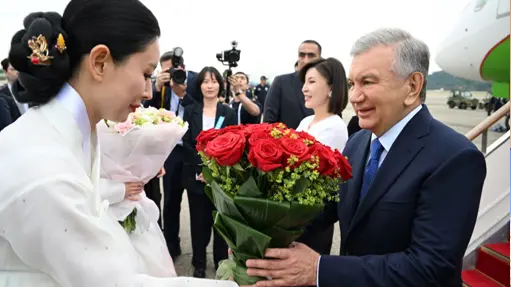
TASHKENT, September 14. /Dunyo IA/. From September 13 to 16, President of Uzbekistan Shavkat Mirziyoyev is paying a state visit to the Republic of Korea and participating in the first “Central Asia – Republic of Korea” Summit, reports Dunyo IA correspondent.
Seoul will host an event that participants are already describing as historic — the first “Central Asia – Republic of Korea” Summit. The leaders of the five Central Asian states and the Republic of Korea will sit at the same table to define the contours of cooperation for years to come.
For Uzbekistan, the summit is of particular importance. It will mark the culmination of more than three decades of steady development of bilateral relations and, at the same time, serve as a starting point for a new and even more ambitious stage of cooperation.
The history of relations between the two peoples dates back centuries. According to a widely accepted scholarly interpretation, envoys of the ancient Korean state of Goguryeo are depicted in the famous Afrasiab murals in Samarkand.
The Great Silk Road connected peoples not only through trade, but also through ideas, knowledge and technologies. Today, Uzbekistan and South Korea are recreating this interaction in a digital and technological format, transforming historical ties into a driver of modern development.
South Korea recognized the independence of Uzbekistan on December 30, 1991, and diplomatic relations between the two countries were established on January 29, 1992. Since then, 20 summits have been held at the highest level — an impressive indicator of the depth and intensity of the political dialogue.
A key milestone was the signing of the Joint Declaration on Strategic Partnership in 2006, while in 2019 bilateral relations were elevated to the level of a Special Strategic Partnership.
The dynamics of political contacts in recent years have been particularly impressive. Four summits and two high-level meetings have been held on the sidelines of sessions of the United Nations General Assembly. The leaders of the two countries have also maintained political dialogue through telephone conversations.
Particularly noteworthy is the cooperation between the two countries within international organizations, including mutual support for each other’s candidacies and initiatives. Seoul has repeatedly co-sponsored resolutions put forward by Uzbekistan at the UN General Assembly.
Within the framework of UNESCO, South Korea supported and co-sponsored Uzbekistan’s proposed draft decision to proclaim November 19 as the International Day of Documentary Heritage, which was adopted at the 224th session of the UNESCO Executive Board on April 23, 2026.
Trade and economic cooperation is one of the most dynamic areas of bilateral relations. In recent years, trade turnover between the two countries has increased fivefold, approaching US$2 billion in 2025. In the first half of 2026, trade turnover exceeded US$940 million, representing an increase of nearly 12 percent compared with the same period last year.
The total volume of direct South Korean investment in Uzbekistan’s economy has exceeded US$8 billion. More than 700 enterprises with South Korean capital are operating in Uzbekistan, while 60 investment projects worth US$8.8 billion are being implemented. During the first half of 2026, the volume of attracted investment exceeded US$290 million.
Together with the Korea Export-Import Bank (KEXIM) and its Economic Development Cooperation Fund (EDCF), 17 projects worth US$2.6 billion have been implemented. Following the Uzbek-South Korean summit in Tashkent in June 2024, a cooperation program with EDCF for 2024–2027 was signed, with a total value of US$2 billion.
Through the Korea International Cooperation Agency (KOICA), 36 projects worth US$124 million were implemented between 1995 and 2024. Currently, 19 projects worth more than US$200 million are being implemented in healthcare, education and vocational training, public administration and climate-related areas.
The digital agenda occupies a special place in bilateral cooperation. The partnership between Uzbekistan and South Korea encompasses telecommunications, e-government infrastructure, artificial intelligence, healthcare and education.
Uzbekistan has established the Uzbek-Korean Textile Technopark, the Scientific and Technological Center for Rare Metals and Alloys, the Design and Engineering Center for Agricultural Machinery, and the Uzbek-Korean Cooperation Center for E-Government. Construction is also underway on cooperation centers in construction and chemical technologies.
With the assistance of South Korean partners, the National E-Commerce Platform was launched in 2022. In March 2024, the first Uzbek-South Korean Trade House was opened in Seoul. Particular attention is being paid to the dynamic growth in the number of Korean-capital companies operating at IT Park Uzbekistan and to increasing exports of digital services to the South Korean market.
Against the backdrop of the transformation of global supply chains, cooperation in critical minerals is becoming increasingly important. South Korea’s efforts to diversify sources of supply in support of its national industries fully align with Uzbekistan’s interests in developing cooperation to secure supply chains for strategic raw materials and materials.
Cooperation in education is gaining increasing importance. Uzbek students constitute one of the three largest groups of foreign students in South Korea, with more than 20,000 young Uzbeks currently studying at Korean universities.
Uzbekistan is home to branches of four South Korean universities: Inha University, Bucheon University and Ajou University in Tashkent, as well as the Korea International University in Fergana. Uzbek higher education institutions cooperate with more than 45 South Korean universities and academic and research organizations. Forums of rectors of leading universities from the two countries have been held in both Tashkent and Seoul.
The Korean language is taught at nine universities and 24 schools in Uzbekistan. The Uzbek language and literature are taught at South Korean universities, including Hankuk University and Honam University.
More than 400 Uzbek medical professionals have received training and undertaken internships at leading clinics and medical centers in South Korea. In 2019, the Uzbek-South Korean Healthcare Cooperation Center was established. In 2020, with the support of the EDCF, a multidisciplinary children’s medical center was built in Tashkent.
The Seoul Park, established in Tashkent in 2014, and the Korean Culture and Arts House, opened in 2019, have become prominent symbols of the strong friendship between the peoples of the two countries. In 2018, one of Tashkent’s streets was renamed Seoul Street — “Seoul Moon” — which has become a popular leisure destination for residents. On December 16, 2021, a monument to the great Uzbek poet and thinker Alisher Navoi was unveiled in Seoul. In June 2025, the Korean-language edition of the renowned Uzbek writer Abdulla Qodiriy’s novel Bygone Days was presented in the South Korean capital.
The flow of tourists from South Korea to Uzbekistan has demonstrated steady growth, rising from more than 27,000 visitors in 2018 to nearly 45,000 in 2025. During the first seven months of 2026, approximately 27,000 South Korean citizens visited Uzbekistan.
The Korean diaspora in Uzbekistan plays a particularly important role in relations between the two countries. For nine decades, it has been an integral part of Uzbekistan’s multinational society. Koreans who, by force of circumstance, found themselves on Uzbek soil have made a significant contribution through their work to the development of agriculture, science, education, healthcare, industry, culture and entrepreneurship. While maintaining a special connection with the historic homeland of their ancestors, the diaspora serves as a spiritual bridge of friendship between the two states.
The state visit of the President of Uzbekistan will be his first visit to the country in nearly five years and his first since the election of the new President of South Korea in 2025. The first “Central Asia – Republic of Korea” Summit will serve as an important catalyst for bringing cooperation between the Central Asian capitals and Seoul to a qualitatively new level.
At the business summit in Seoul, practical projects in infrastructure, renewable energy, digital technologies, healthcare and supply chains will be discussed.
Uzbekistan and South Korea have reached a new strategic milestone. Ambitious goals and objectives lie ahead — to broaden the horizons of cooperation on the solid foundation of mutual trust and friendship built over the years, as well as the considerable potential of both countries.
Most importantly, however, the foundation of this partnership lies in something deeper than economic interests. As both sides rightly emphasize, the Uzbek and Korean peoples attach great importance to dignity, family, respect for elders, patience and hard work, as well as the desire to provide their children with a better future. At the heart of these shared values lies a philosophy that unites the two peoples: one cannot simply wait for the future to arrive; the future must be created with one’s own hands.

Latest News

See all
Read also
“Pakistan Observer”: South Korea–Central Asia Summit to Boost Strategic Cooperation
Attitude from Dushanbe: Partnership with Serbia opens new opportunities for Uzbekistan to strengthen its role in the emerging Eurasian Economic System
Attitude from Ankara: Belgrade Visit marks new step of Uzbekistan toward European Economic Area