An event dedicated to the memory of Amir Temur held at the Ankara Center for Research and Analytics
May 12, 2026. 12:25 • 3 min
• 879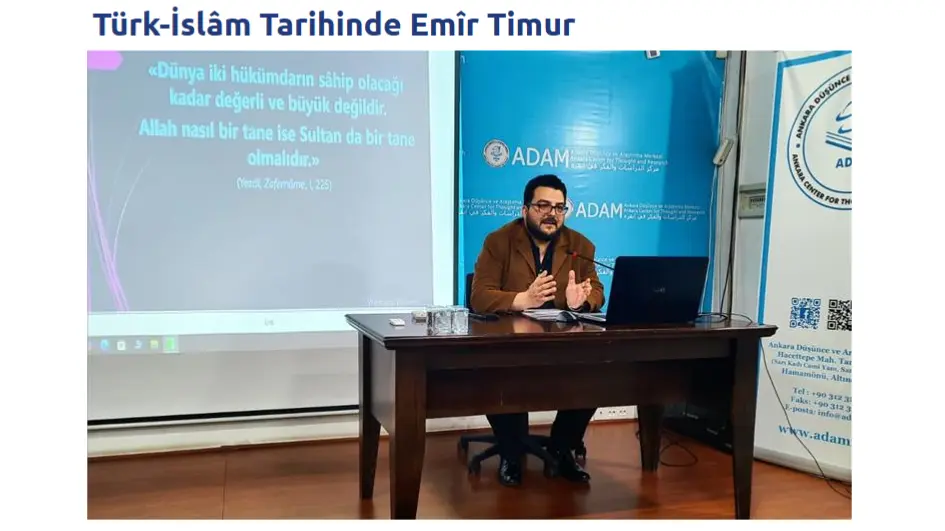
ANKARA, May 12. /Dunyo IA/. An educational event titled “The Role of Amir Temur in Turkic-Islamic History” was held at the Ankara Center for Thought and Research (ADAM) in the Turkish capital, with the participation of professors, scholars and students, reports Dunyo IA correspondent.
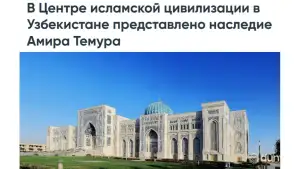
Speaking at the event, Dr. Muhammet Emin Koçak, a young Turkish researcher of Temurid history, spoke about his participation in the international scientific conference dedicated to the 690th anniversary of the birth of Amir Temur. The conference was held on April 9–11 at the Center of Islamic Civilization in Uzbekistan. He emphasized that he personally witnessed the large-scale work being carried out in the country to preserve the legacy of the great Sahibkiran and ensure its worthy transmission to future generations.
In his speech, the scholar focused on the historical role of Amir Temur:
- First and foremost, I would like to note that participating in the April event at the Center of Islamic Civilization left a deep impression on me. I witnessed the immense respect that our common great ancestor, Amir Temur, commands among the people. The reopening of the Temurid Museum after its modernization and equipment with new capabilities was a fitting tribute to the 690th anniversary of Sahibkiran. Since returning, I have been delivering lectures in Türkiye and I am glad to contribute to promoting the greatness and historical significance of Amir Temur among our people.
Amir Temur was, above all, an outstanding ruler in the history of the Turkic peoples, and the events of his reign had a profound impact on world history. Amir Temur attached great importance to scholars and religious figures, often organizing scientific disputes and discussions at his court.
During the era of Amir Temur, Samarkand transformed into one of the most important centers of the Eastern Islamic world, becoming a major cultural, scientific and artistic hub. Thanks to the scholars, artists and craftsmen relocated there, the city experienced a large-scale scientific, cultural, and architectural renaissance. By order of the ruler, new settlements named Damascus, Shiraz, Sultaniya and Baghdad were established around Samarkand, where residents from those respective regions were resettled.
The cultural, scientific and social development of Samarkand was effectively advanced after Amir Temur's death by his grandson, Mirzo Ulugbek. During his reign, research in astronomy and mathematics led to significant achievements in philosophy and science within the Islamic world. Scholars educated in the Temurid state spread across various Islamic countries, passing on their knowledge.
Amir Temur played a key role in this process. The legacy of Samarkand he created was continued and developed by his descendants, which contributed to the flourishing of rational and mathematical sciences in the Islamic world and subsequently led to the emergence of the term “Temurid Renaissance” in Europe.
In summary, it can be said that Amir Temur, who ruled for 35 years and went down in history as an undefeated ruler, possessed not only outstanding military talent but also high spiritual qualities. One of his most important achievements was transforming Samarkand into a world capital and laying the foundation for the Temurid Renaissance.

Latest News



See all
Read also
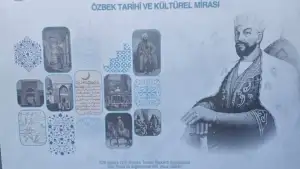
Ankara hosts exhibition showcasing Uzbekistan's historical and cultural heritage