Akramjon Nematov: Central Asian countries are ready to assume collective responsibility for a common future of the region
June 27, 2025. 14:46 • 5 min
• 597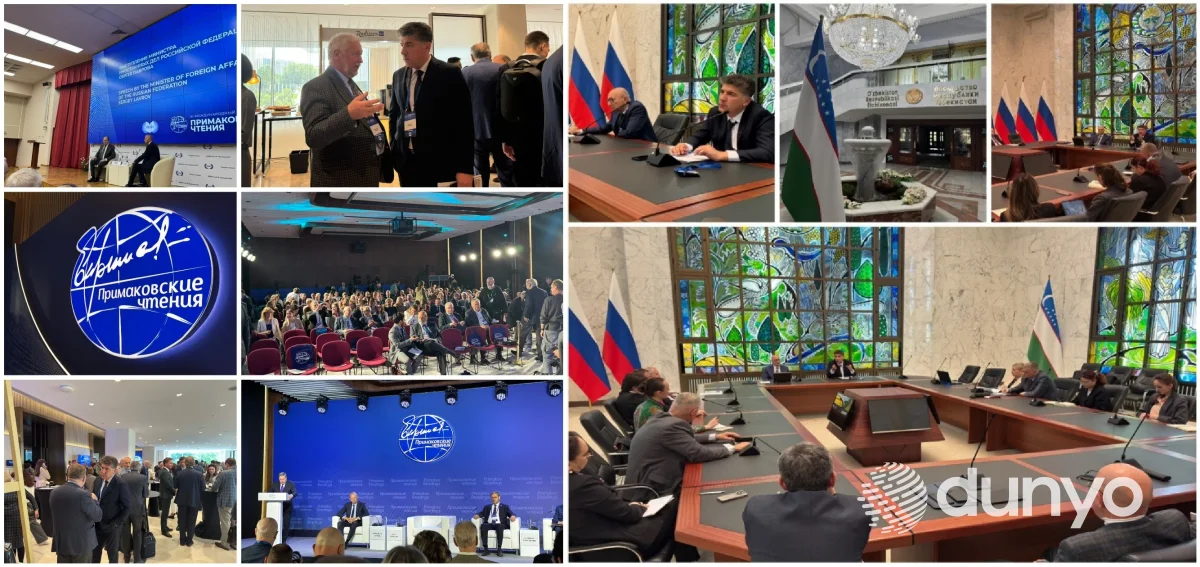
MOSCOW, June 28. /Dunyo IA/. On June 23-25, the 11th International Scientific and Expert Forum "Primakov Readings" was held in the capital of Russia, organized by the Institute of World Economy and International Relations of the Russian Academy of Sciences (IMEMO RAS), reports Dunyo IA correspondent.

Among the participants of the event were Assistant to the President of Russia Yury Ushakov, Minister of Foreign Affairs Sergey Lavrov, Deputy Chair of the Federation Council of the Federal Assembly Konstantin Kosachev, Vice President of the Russian Academy of Sciences Vladislav Panchenko, as well as leading experts, heads of major analytical centers, prominent politicians, and diplomats from 14 countries worldwide.
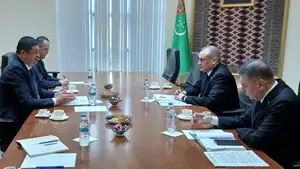
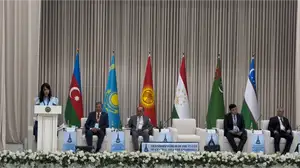
A delegation from the Institute for Strategic and Regional Studies under the President of Uzbekistan (ISRS), headed by First Deputy Director Akramjon Nematov, took part in the forum. He delivered remarks at the strategic session of the "Primakov Readings", held under the theme "Central Asia: A Space of Competition and Cooperation".
In his remarks, the ISRS representative noted that "in recent years, the Central Asian states have achieved significant progress in shaping a new political climate, firmly rejecting confrontational and ideologized approaches, and have collectively strengthened the region’s agency".
The five countries are demonstrating stability, sustainable economic development, and a clear commitment to fully realizing their potential. "Today, this is a different Central Asia – cohesive and strong, open to dialogue and full-scale partnership", the expert said, quoting President of Uzbekistan Shavkat Mirziyoyev.
According to Akramjon Nematov, the long-term nature of this trend is confirmed by the adoption of the Central Asia 2040 regional cooperation development concept, which reflects the countries’ deep understanding of shared interests and their willingness to assume collective responsibility for a common future.
At the same time, as the ISRS representative noted, the active foreign policy of Central Asian countries has brought a qualitatively new dimension to the development of the Central Asia Plus format. "While there were only four such formats prior to 2017, today that number has reached eleven", he stated.
"We believe that the development of these dialogue platforms makes it possible to align the interests of non-regional partners, direct them into a constructive channel, and jointly attract resources to unlock the economic potential of Central Asia", the expert emphasized.
This, he noted, is particularly important in the context of growing interest from external actors in Central Asia, driven by the region’s increasing geostrategic significance and the momentum of its economic development. "Over the past ten years, Central Asia’s annual GDP growth rate has exceeded 6%, which is twice the global average", - Akramjon Nematov pointed out.
He also stated that the share of the industrial sector in the economies of Central Asian countries is growing rapidly, with a growth rate exceeding 6%. In particular, Uzbekistan is actively developing its manufacturing sector, which now accounts for 85% of the country’s total industrial output.
He further noted the sharp increase in value-added production in Uzbekistan’s economy. For comparison, in 2017, the volume of value added was approximately USD 2.7 billion, whereas by the end of last year, this figure had increased tenfold, reaching approximately USD 28 billion.
An additional significant advantage, the expert emphasized, is the region’s strong demographic potential. Today, the population of Central Asian countries stands at 83 million, with an annual growth of around 1 million people.
"At the same time, the average age of the population in the region is 28 years, while in China and Europe it is around 40", the ISRS representative noted. In his view, this highlights Central Asia’s role as a promising market with a substantial pool of labor resources.
"Thus, political consolidation, sustainable development, and the region’s economic and demographic growth are having a positive impact across the entire Eurasian space, turning Central Asia into a dynamically developing part of Eurasia", - Akramjon Nematov concluded.
As part of their visit, the ISRS delegation, together with the International Institute for Central Asia and the Embassy of Uzbekistan, organized an expert roundtable titled "A Consolidating Central Asia – an Anchor of Stability in Greater Eurasia".
In his remarks, Akramjon Nematov stated that "Uzbekistan views Greater Eurasia not only as a geographic space, but also as a set of shared values and approaches to inter-state relations".
In this context, the expert emphasized the particular importance of the core principle of the Greater Eurasia concept – "recognition of the diversity of civilizations, cultures, and political systems that have naturally evolved through a long historical process".
A key element arising from this approach is respect for each state’s sovereign right to choose its development model, recognition of sovereign equality, and the inadmissibility of interference in internal affairs. "Such a paradigm of thinking can serve as a solid foundation for peaceful coexistence and sustainable interstate cooperation across Eurasia", Akramjon Nematov asserted.
In this regard, the ISRS representative emphasized that one of the most critical areas is economic connectivity among Eurasian countries, particularly in terms of fostering intra-regional trade, enhancing industrial cooperation, and improving transport and logistics infrastructure.
"These very goals underpin Uzbekistan’s efforts within such Eurasian organizations as the SCO, CIS, OTS, and EAEU, within which our country has put forward more than 300 concrete initiatives", he emphasized.
Essentially, the expert continued, Uzbekistan proceeds from the aspiration to contribute to the transformation of the Eurasian space into a zone of stable development and prosperity. "We aim to turn Eurasia into a self-sufficient, yet steadily advancing space of industrial and technological progress, resilient in the face of external challenges", - he stated.
It is no coincidence, according to Akramjon Nematov, that the President of Uzbekistan Shavkat Mirziyoyev, during the 2024 SCO Summit in Astana, proposed the adoption of a Code of Good Neighborliness, Trust, and Cross-Border Partnership. "This document could serve as a foundation for stable and predictable interstate relations across the Eurasian space", - he emphasized.
"Central Asia, despite external turbulence, is increasingly positioning itself as an anchor of stability and predictability in Eurasia. Its internal consolidation and growing interconnectedness with external partners reflect a clear aspiration to build a strong, balanced, and resilient political and economic center within Greater Eurasia. Moreover, the region may well serve as a model for shaping a new architecture of inter-state relations", - Akramjon Nematov concluded.
See all