Lubomir Frebort: The Czech Republic attaches high priority to relations with Uzbekistan
April 30, 2026. 08:15 • 9 min
• 2266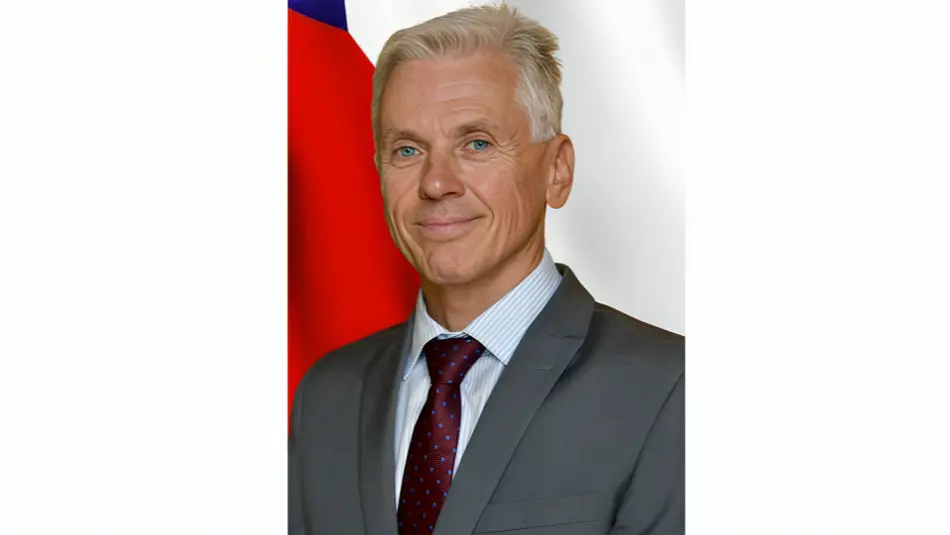
TASHKENT, April 30. /Dunyo IA/. On the eve of the official visit of the Prime Minister of the Czech Republic Andrej Babiš to Uzbekistan a Dunyo IA correspondent interviewed the Ambassador of the Czech Republic, Lubomir Frebort.
– Uzbek–Czech bilateral relations have gained significant momentum in recent years and, as experts note, are rooted in a strong historical foundation. Let us begin with the origins of these ties.
– Thank you for the question. You are absolutely right to note that relations between our countries have deep historical roots. At the same time, I would like to recall that modern diplomatic relations were established in the early 1990s.
From the outset, they have been built on the principles of mutual respect, equal partnership, and consideration of the national interests of both sides. We consistently respect Uzbekistan’s choice of an independent path of development, support the ongoing reforms, and intend to contribute to the construction of a New Uzbekistan in line with the course pursued by the President of Uzbekistan, Shavkat Mirziyoyev.
If we look at history, it is certainly not limited to the period following independence. Cooperation between our peoples has a much longer tradition. As early as the 19th century, prominent Czech scholars and researchers visited the territory of present-day Uzbekistan.
Allow me to cite a few illustrative examples. In 1878, the first director of the men’s gymnasium in Tashkent — located on the site of today’s Amir Temur Square — was a Czech professor. The Czech Republic’s contribution is also evident in Uzbekistan’s modern infrastructure, including Škoda trolleybuses, which were operated, among other routes, between Urgench and Khiva, trams in Samarkand, as well as Let L-410 Turbolet aircraft used in the country’s aviation fleet. I would also like to highlight the fruitful cooperation between archaeologists, who are jointly conducting excavations in the Surkhandarya region.
– Mr. Ambassador, Prime Minister Andrej Babiš is visiting Uzbekistan on an official visit for the first time. What are the key objectives of this trip? What practical outcomes does the Czech side expect? Which issues will be prioritized during the negotiations and the signing of bilateral agreements?
– First of all, I would like to emphasize that the visit of Prime Minister Andrej Babiš is of fundamental importance for the development of bilateral relations. This is his first official trip outside Europe following the formation of the new government, which was appointed at the end of December last year.
It is noteworthy that the first destinations of this visit include countries of Central Asia and the South Caucasus, with Uzbekistan occupying a special place on this agenda. This choice clearly demonstrates that the Czech leadership attaches particular importance to relations with Uzbekistan. Moreover, Uzbekistan remains the only country in Central Asia with which the Czech Republic maintains a format of enhanced partnership.
Economic cooperation has traditionally been a key pillar of bilateral relations. This includes expanding investment interaction, increasing trade turnover, and deepening industrial cooperation. It is precisely with this agenda that Prime Minister Andrej Babiš has arrived, aiming to elevate cooperation to a qualitatively new level, particularly in the trade, economic, and investment spheres.
Priority sectors include transport, industry, aviation, the defence industry, and critical infrastructure. Significant potential also exists in energy, agriculture, and several other areas where a practical foundation for expanding partnership is already in place. It is expected that the negotiations during the visit will focus substantively on deepening cooperation in these sectors.
– In recent years, Uzbekistan and the Czech Republic have been discussing the development of cooperation in the field of labor migration. In particular, a visa quota has already been allocated, and the Czech side has expressed interest in attracting medical professionals from Uzbekistan. Is this issue expected to be included in the agenda of the upcoming talks in Tashkent?
– This is indeed an important topic. We are closely studying the experience of leading countries in developing cooperation in the field of labor migration of medical personnel. Of particular interest is Uzbekistan’s experience in training medical specialists in line with the requirements of foreign labour markets.
As far as I am aware, the program of the visit of the Prime Minister of the Czech Republic, Andrej Babiš, includes visits to specialized training centers where medical personnel are trained, including with a focus on foreign language acquisition and adaptation for employment abroad.
It should be noted frankly that demographic trends in the Czech Republic are generating sustained demand for qualified personnel in the healthcare and caregiving sectors. The growing share of the elderly population objectively requires an expansion of the healthcare workforce.
– How do you assess the current investment climate in Uzbekistan from the perspective of Czech companies? What support instruments, including through CzechInvest, are available to Uzbek entrepreneurs interested in entering the Czech market?
– This is also one of the key areas of our bilateral cooperation. Czech companies are showing increasing interest in investment opportunities in Uzbekistan. This trend is natural: the country’s investment climate continues to improve, and ongoing economic reforms are creating more transparent and predictable conditions for foreign investors, including Czech businesses.
Among the factors that particularly attract Czech companies are macroeconomic stability, steady growth rates, and Uzbekistan’s advantageous geostrategic location, providing access to neighbouring markets. At the same time, it should be noted that for many Czech companies, the Uzbek market remains relatively new.
An important element of the upcoming visit of Prime Minister Andrej Babiš will be familiarization with industrial infrastructure, including a visit to a technopark.
As for investments by Uzbek companies in the Czech Republic, they are certainly welcomed. Additional momentum in this direction is expected from the opening of the Embassy of Uzbekistan in the Czech Republic with an enhanced trade and economic section, which will facilitate Uzbek businesses’ entry into Czech and broader European markets.
It is noteworthy that Uzbek companies are already actively participating in major industry events. In particular, the city of Brno annually hosts one of the largest international engineering exhibitions, where Uzbekistan has been widely represented in recent years, including with a national pavilion.
It is also worth highlighting the development of cooperation in standardization and metrology. Interaction between relevant agencies is contributing to the establishment of modern laboratories and the implementation of advanced technical regulations. This has practical significance: alignment with European quality standards significantly facilitates access of Uzbek products to EU markets, including the Czech market.
Overall, a wide range of business support instruments is already in place — both for Czech companies entering the Uzbek market and for Uzbek enterprises seeking to operate in the Czech Republic.
I would also like to emphasize that an important and integral part of the visit of Prime Minister Andrej Babiš will be the Uzbek–Czech business forum, which will effectively open the program of the delegation’s visit. It will serve as the starting point for substantive dialogue between the business communities of the two countries.
A high-level delegation of executives from leading Czech companies operating in key sectors — energy, transport, defence industry, agriculture, and others will accompany the Prime Minister. A comprehensive program of bilateral meetings with Uzbek partners is planned for them.
From an investment perspective, particular attention is drawn to one of the largest projects currently under consideration. This involves Škoda Transportation, which is exploring not only the supply of electric trains for Uzbekistan’s railways but also the establishment of joint production facilities within Uzbekistan. It is envisaged that, at the initial stage, assembly of rolling stock will be organized, followed by localization of production and expansion into exports to neighbouring countries.
In parallel, work is underway to modernize the mechanism of the Intergovernmental Commission on Trade, Economic and Investment Cooperation.
In addition, the Czech side plans active business participation in the Tashkent International Investment Forum, traditionally held in June.
– Taking into account the importance of agriculture for Uzbekistan, what is the potential for cooperation in the introduction of Czech technologies—particularly in water-saving, water purification, and agro-processing?
– Thank you for the question. Indeed, cooperation in the agricultural sector occupies an important place on the agenda of relations with Uzbekistan and is considered one of the priority areas.
The Czech side possesses significant experience and technological solutions, particularly in the field of deep processing of agricultural products.
Special attention is given to energy-efficient and resource-saving technologies. In particular, this includes cogeneration units that enable the simultaneous production of electricity and heat. Such systems can operate on biogas derived from agricultural and livestock waste, making them an environmentally sustainable solution. They are especially relevant for greenhouse farming, where they ensure year-round production while optimizing costs.
Equally important are irrigation and water-saving systems. For the Central Asian region, the rational use of water resources is of strategic importance.
Additional prospects are linked to the introduction of small hydropower plants aimed at supplying energy to rural and remote areas.
Overall, the agricultural sector offers a wide range of opportunities for mutually beneficial cooperation — from technology transfer to the implementation of joint projects.
– The resumption of direct flights between Tashkent, Prague, and Karlovy Vary opens new opportunities for tourism development. How do you assess the prospects for tourist exchanges?
– We welcome the fact that seasonal flights on the routes Tashkent–Prague–Tashkent and Tashkent–Karlovy Vary–Tashkent have been launched for the third consecutive year. Experience from recent years shows that these flights significantly contribute to the growth of mutual tourism and business flows, creating a stable dynamic of contacts between the countries.
Czech Republic has traditionally remained an attractive destination for citizens of Uzbekistan. At the same time, we are pleased to note that Uzbekistan is also steadily strengthening its position as a promising destination for Czech tourists. This now includes not only classical routes covering Samarkand, Bukhara, and Khiva, but also a growing interest in the country’s natural landscapes.
Ecotourism is gaining particular importance. For Czech travelers, traditionally oriented toward active recreation and nature-based tourism, the new opportunities offered by Uzbekistan in this area are of significant interest.
To support tourism exchanges, the Czech side regularly participates in specialized exhibitions and fairs held in Uzbekistan. In addition, a Czech travel company representative office has already been opened in the country, contributing to more active promotion of the Czech Republic as a destination.
At the same time, we would be interested in reciprocal steps—the opening of representative offices of Uzbek tour operators in the Czech Republic. This would allow for a systematic promotion of Uzbekistan’s tourism potential in the Czech market and further stimulate tourist inflows.

Latest News

See all
Read also
Kairat Sarybay: Concept of New Uzbekistan aligns closely with the Philosophy of the Conference on Interaction and Confidence-Building Measures in Asia

Edgars Rinkēvičs: Uzbekistan is a reliable partner of Latvia in Central Asia
Won Do Yeon: The state visit of the President of Uzbekistan to the Republic of Korea is of special significance