“Kabar” IA: Uzbekistan and Kyrgyzstan transition from product supplies to joint value chains
July 26, 2026. 15:30 • 2 min
• 88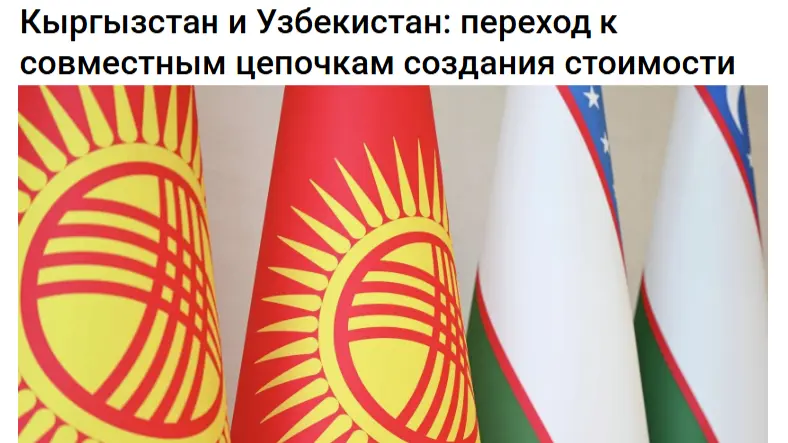
BISHKEK, July 26 /Dunyo IA/. Kyrgyz National Information Agency “Kabar” has published an article on trade and economic cooperation between Uzbekistan and Kyrgyzstan, reports Dunyo IA correspondent.
Publication notes that the two countries are gradually forming a common economic space based on mutual trade, industrial cooperation and direct ties between entrepreneurs and regions.
According to the publication, mutual trade between the two countries has increased more than sevenfold since 2016, reaching nearly $1.2 billion in 2025, with a 37 percent year-on-year growth. This upward trend continued in 2026, as trade turnover increased by 45.5 percent during January–May, reaching $469 million.
Article also highlights qualitative changes in the structure of Uzbekistan’s exports. The share of light industry products declined from more than 50 percent in 2021–2022 to 19 percent in 2025, while the share of raw materials decreased from 56 percent in 2019 to 8.2 percent in 2025.
At the same time, Kyrgyzstan’s share in Uzbekistan’s total foreign trade turnover currently stands at around 1.5 percent. Achieving the target of increasing bilateral trade to $2 billion by 2030 requires systematic diversification of the range of traded goods.
Publication identifies investment and industrial cooperation as the second key driver of bilateral cooperation. The number of enterprises with Kyrgyz capital operating in Uzbekistan has increased sevenfold since 2016, reaching 374 as of July 2026. The Uzbekistan–Kyrgyzstan Development Fund, established in 2021, supports joint projects through investment lending, leasing and project financing mechanisms.
According to the assessment of the Center for Economic Research and Reforms (CERR), promising areas of industrial cooperation include the establishment of joint production facilities in light industry, construction materials, food processing, and the mining sector along the route of the railway currently under construction, as well as the production of goods meeting EAEU standards, - “Kabar” concludes.
According to the publication, the next stage in the relations between the two countries lies in transitioning from quantitative growth in trade turnover to qualitative industrial integration and the formation of a unified production and logistics space.

Latest News




See all
Read also
“The Nation”: Uzbekistan–Kyrgyzstan relations transition to a mature model of economic cooperation