Popular Spanish newspaper describes Bukhara and Tashkent as symbols of Uzbekistan’s past and future
May 16, 2026. 11:30 • 3 min
• 534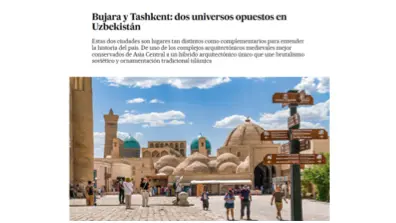
MADRID, May 16. /Dunyo IA/. Spanish newspaper “El País” has published an article dedicated to the Uzbek cities of Bukhara and Tashkent, reports Dunyo IA correspondent.
The article notes that, despite being part of the same country, Bukhara and Tashkent represent two distinct worlds in terms of history, architecture, and cultural identity. While one city has preserved the millennia-old heritage of Islamic architecture and the era of the Great Silk Road, the other has evolved into a modern metropolis combining Soviet modernism with contemporary urban development.
“El País” describes Bukhara as one of the best-preserved medieval cities in Central Asia. The publication emphasizes that the city, with more than 2,000 years of history, is renowned for its madrasahs, mosques, domes, and architectural monuments adorned with distinctive blue glazed tiles. Since 1993, Bukhara has been included on the UNESCO World Heritage List.
Special attention is given to the Lyabi-Hauz architectural ensemble, as well as the covered bazaars Toki Sarrafon and Toki Zargaron, the Khoja Kalon Mosque, the Khoja Gaukushan Madrasah, and the Bolo-Hauz Mosque. The Ark Fortress is described as the former political and cultural center of the city. The Samanid Mausoleum is also highlighted as one of the oldest examples of dynastic Islamic architecture.
The Spanish publication further underscores the significance of the Poi-Kalon complex, referring to it as “the face of Bukhara”. The city is portrayed as a center of traditional craftsmanship, including ceramics, weaving, and carpet-making, all of which continue to be preserved and developed today. The article also notes that contemporary cultural initiatives, such as the Bukhara Biennale, are giving new meaning to the city’s historical environment.
The second part of the article focuses on Tashkent, which is described as a “unique architectural hybrid” of Soviet modernism and Islamic traditions. The newspaper notes that the modern appearance of the capital was largely shaped following the devastating 1966 earthquake and the subsequent large-scale reconstruction of the city.
Particular mention is made of the Museum of Applied Arts of Uzbekistan, housed in a former diplomatic mansion and featuring more than 7,000 exhibits, as well as the Tashkent Metro, famous for its mosaic interiors, with the “Kosmonavtlar” station described as one of the most iconic.
In conclusion, “El País” states that, despite their differences, Bukhara and Tashkent together reflect Uzbekistan’s historical memory and modern development, simultaneously representing the country’s past and future.

Latest News
See all