“The Nation”: Multifaceted cooperation with Uzbekistan opens path for Pakistan to revive historical ties with Central Asia
February 05, 2026. 15:12 • 3 min
• 438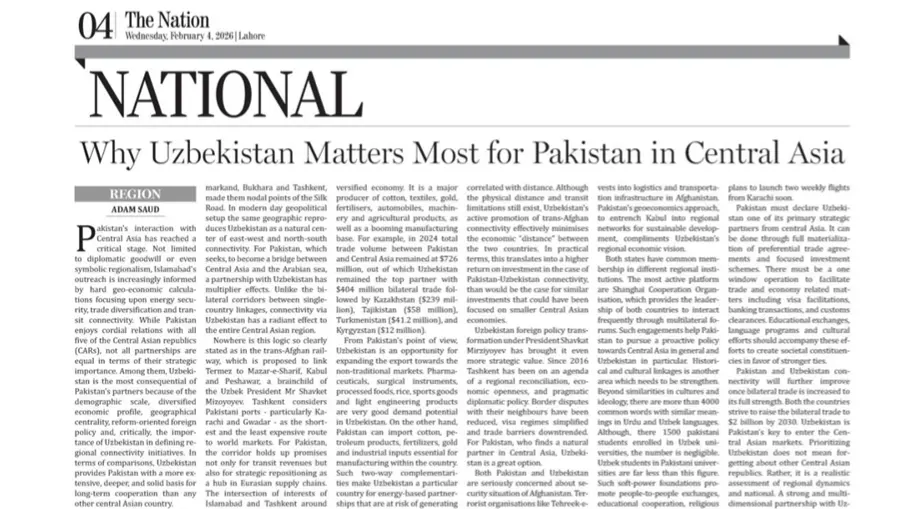
ISLAMABAD, February 6. /Dunyo IA/. An article titled “Why Uzbekistan Matters Most for Pakistan in Central Asia” has been published in one of Pakistan’s leading newspapers, “The Nation”, reports Dunyo IA correspondent.
The author of the article, Professor Adam Saud of Bahria University, notes in the introduction that Pakistan’s relations with Central Asian states have entered a decisive phase. According to him, among the countries of the region, Uzbekistan is viewed as Islamabad’s most important partner due to its demographic potential, diversified economic structure, central geographic location, reform-oriented foreign policy and, crucially, its key role in shaping initiatives for regional connectivity.
Uzbekistan’s geographical location represents a distinct strategic advantage. It is the only country in the region that shares borders with all other Central Asian republics, while simultaneously lying at the heart of internal Eurasian transit routes. Historically, cities such as Samarkand, Bukhara and Tashkent were major hubs along the Great Silk Road. In the contemporary geopolitical context, Uzbekistan is once again positioning itself as a natural connectivity hub along East - West and North - South corridors.
“For Pakistan, which aims to become a bridge between Central Asia and the Arabian Sea, cooperation with Uzbekistan is of fundamental importance. The developing partnership with Tashkent has an impact across the entire Central Asian region. This logic is particularly evident in the Trans-Afghan Railway project, initiated by Uzbekistan’s President Shavkat Mirziyoyev. Tashkent views this corridor as the shortest and most economically advantageous route to access global markets through Pakistani ports”, - article emphasizes.
A Pakistani analyst has pointed out that the alignment of interests between Islamabad and Tashkent around a key transport corridor underscores Uzbekistan’s distinctive and strategic role in Central Asia, setting it apart from its regional neighbors.
The expert further emphasizes that Uzbekistan’s considerable economic potential reinforces its unique standing in the region. With a relatively diversified economy, the country is a major producer of cotton, textiles, gold, chemical products, automobiles, machinery, and agricultural goods. This broad industrial and agricultural base not only strengthens Uzbekistan’s domestic market but also positions it as an increasingly influential economic and trade hub in Central Asia.
From Pakistan’s perspective, Uzbekistan represents a significant opportunity to expand exports to non-traditional markets. Analysts note particularly strong demand in Uzbekistan for pharmaceuticals, medical equipment, rice and sports goods.
At the same time, Pakistan could increase imports from Uzbekistan, including cotton, petroleum products, fertilizers, gold and other industrial commodities crucial for its manufacturing sector.
Experts highlight the substantial potential for both countries to deepen bilateral trade. Islamabad and Tashkent have set a target to raise their two-way trade volume to USD 2 billion by 2030, reflecting a shared commitment to strengthening economic ties and regional connectivity.
In conclusion, Adam Saud emphasizes that Uzbekistan serves as a key gateway for Pakistan into the Central Asian markets. Strong and multifaceted cooperation with Tashkent offers Islamabad the opportunity to deepen comprehensive regional connectivity and revive historical ties. Such connectivity, in turn, reinforces Pakistan’s role as a strategic bridge linking Central, South, Southeast and Western Asia.

See all