“The New York Times”: Bukhara - Ancient cultural cradle of Uzbekistan, that’s new again experiencing a new revival
June 30, 2026. 13:00 • 4 min
• 54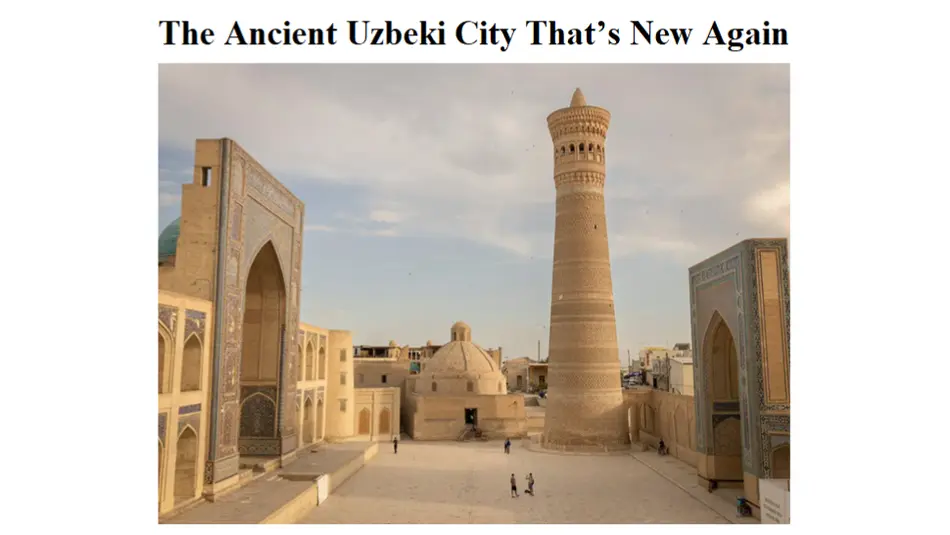
WASHINGTON, June 30. /Dunyo IA/. Highly authoritative American newspaper “The New York Times” has published an extensive feature article titled “Bukhara: Ancient city, that’s new again”, reports Dunyo IA correspondent.
Author of the publication Gisela Williams, presents Bukhara as one of the most prominent historic centers of Central Asia, which is currently undergoing a profound cultural and tourism renaissance. The publication emphasizes that for over a millennium, Bukhara stood as a paramount nexus of the Great Silk Road, serving as a global epicenter of international commerce, scientific advancement, cultural enlightenment and artisan craftsmanship.
Particular emphasis within “The New York Times” feature is directed toward the rich historical and architectural heritage of Bukhara. The publication underscores that the city currently preserves over 140 monuments inscribed on the UNESCO World Heritage List - including majestic mosques adorned with turquoise domes, ancient mausoleums, madrasahs, and the monumental Ark Citadel which collectively cultivate the incomparable atmosphere of one of the most meticulously preserved historic cities of the East.
Author observes that Bukhara is once again emerging as a prominent international cultural hub. According to Gisela Williams, a landmark milestone in this trajectory was the inauguration of the first Bukhara Biennial, which successfully convened acclaimed artists from across the globe and Uzbekistan. These site-specific art installations were custom-tailored for the city’s historical monuments, effectively elevating the profile of Bukhara’s rich cultural heritage among the international creative community.
As underscored in the publication, Gayane Umerova, Chairperson of the Art and Culture Development Foundation under the Cabinet of Ministers of Uzbekistan, identified the primary objectives of this initiative as the revitalization of historical landmarks, the sustainable empowerment of local artisans, and the comprehensive restoration of the city's traditional architectural tapestry.
Newspaper further cites the perspective of Suna Abdullaeva-Park, Co-Founder of the “Pavillon Kalon” cultural space, who notes that an exceptional creative energy permeates Bukhara today, as the city successfully reclaims its historical status as one of the preeminent cultural epicenters of the region.
A dedicated section of the publication is formulated to provide recommendations for international travelers. The author highly advises staying at the “Mercure Bukhara Old Town”, “Komil Bukhara Boutique Hotel” and “Lyabi House Hotel” - establishments that masterfully converge premium hospitality standards with a uniquely authentic historical atmosphere.
Particular distinction is accorded to the rich culinary heritage of Bukhara. Among the city's premier dining venues, “The New York Times” highlights the “Osh Joy” restaurant, which meticulously prepares the celebrated Bukhara Osh-Sofi pilaf utilizing authentic historical recipes, the “Joy Gastro Restaurant”, uniquely situated within a historic caravanserai, as well as the “Palmira”, “Dilkor Lagman” and “Old Bukhara” establishments, each offering international guests a premier selection of traditional Uzbek national cuisine.
For aficionados of national craftsmanship, the publication highly recommends visiting the “Akbar House Collection” gallery, atelier of the renowned master artisan Zakhir Kamalov, fine art workshop of Davlat Toshev, “Ustoz-Shogird” Applied Arts Center, “Pavillon Kalon” concept store, as well as the Central Bazaar of Bukhara, where visitors can acquire exceptional works by folk artisans, organic honey, heritage textiles, ceramics and other traditional authentic souvenirs.
Among the primary historical sites, the American newspaper highlights Sitorai Mokhi-Khosa - summer residence of the Amirs of Bukhara - Baland Mosque, Khodja Zaynuddin Sufi Complex, Chor-Bakr Memorial Ensemble, Ark Citadel, Samanid Mausoleum and Kyz-Bibi Sanctuary, characterizing them as vivid testaments to the centuries-old history, profound spiritual heritage and masterful architectural artistry of Uzbekistan.
According to the author of the publication, contemporary Bukhara harmoniously converges its rich historical legacy, a dynamically expanding cultural landscape, traditional craftsmanship, national cuisine and state-of-the-art tourism infrastructure, thereby reclaiming its status as one of the most compelling destinations for travelers from across the globe.

Latest News


See all
Read also
Egyptian Media: Environmental cooperation between Uzbekistan and the United States advances to a new horizon

“The Conversation”: Uzbekistan’s FIFA World Cup 2026 Qualification marks a landmark symbolic milestone for Central Asia