
“Kazinform” Agency: According to Census Outcomes, Uzbekistan maintains its multinational population composition
July 06, 2026. 14:30 • 2 min
• 2319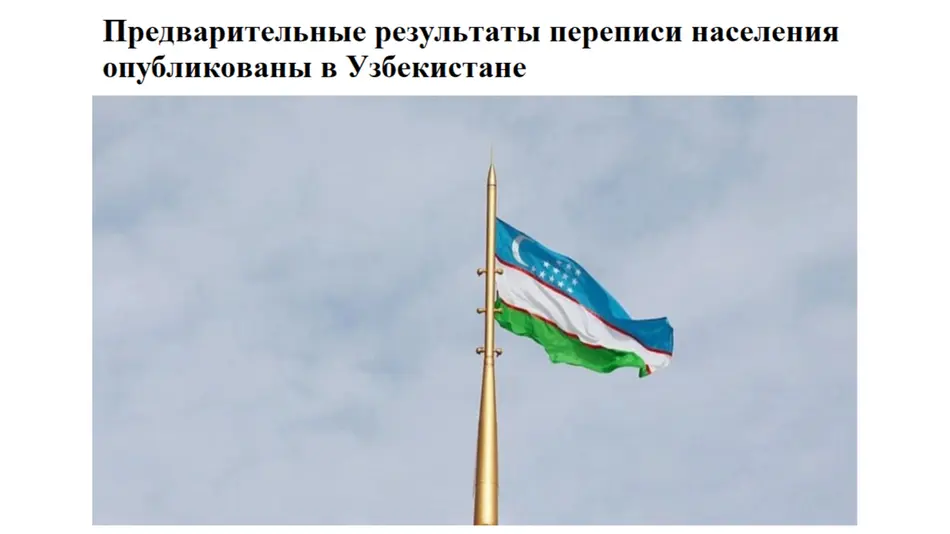
ASTANA, July 6. /Dunyo IA/. Statistics Committee of Uzbekistan has published the preliminary results of the first population census in 37 years, according to which the country's population has reached 39.05 million people, reports Dunyo IA correspondent, citing with reference to the “Kazinform” International Information Agency.
It is noted that this is the country's first population census since 1989, designed to provide government agencies with reliable and up-to-date information on the demographic and socio-economic situation.
According to official data, as of today, the population of the republic stands at 39 million 47 thousand 321 people, which is almost twice the figure of the last census conducted in 1989.
According to the published data, the ethnic composition of Uzbekistan's population is characterized by the predominance of Uzbeks, whose share accounts for 89.4% of the total population. In addition, representatives of other nationalities reside in the country: Tajiks – 3.3%, Karakalpaks – 2.2%, Kazakhs – 1.8%, Russians – 1.6%, Kyrgyz – 0.6% and Turkmen – 0.5%. Thus, Uzbekistan maintains its multinational population composition.
At the same time, 91.3% of the country's residents indicated Uzbek as their native language, reflecting its key role as the primary means of interpersonal communication and social integration.
Population census was conducted in two stages using modern methods of information collection. The first stage took place from January 15 to 31, and the second from February 4 to 28 of this year. Data collection was carried out both through online questionnaires and by door-to-door survey of the population.
The census was repeatedly postponed due to the COVID-19 pandemic. Initially, the event was planned for 2022, then the deadlines were moved to November 2023, after which they were definitively adjusted to the 2026–2027 period.
Published preliminary results will become the foundation for preparing the final census outcomes and will be used in developing long-term programs for socio-economic development, improving the public administration system, as well as planning measures in the fields of education, healthcare, employment, housing policy and regional development.

Latest News





See all
Read also


Pakistani Media: Uzbekistan welcomed more than 6.15 million tourists from OTS countries in 2025
Uzbekistan and the United States embark on a new stage of strategic and economic partnership