Under the chairmanship of the President of Uzbekistan, current situation in the oil and gas industry reviewed
August 03, 2026. 17:10 • 3 min
• 128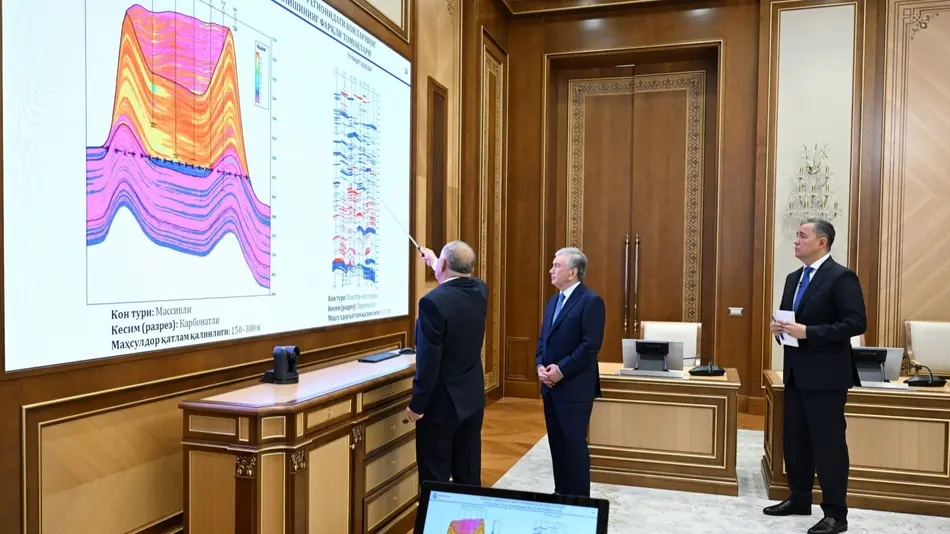
ТАSHKENT, August 3. /Dunyo IA/. Today, President Shavkat Mirziyoyev was presented with a report on Uzbekneftegaz Joint-Stock Company’s activities in the first half of this year and its priority tasks for the rest of the year, reports Dunyo IA correspondent.
According to the press service of the Head of our State, in the first half of this year, the company produced 11.5 billion cubic meters of natural gas. Simultaneously, crude oil, diesel, aviation kerosene, and liquefied gas output surpassed initial projections.
By year’s end, production is scheduled to reach 1.1 million tons of motor gasoline, 983,000 tons of diesel fuel, 310,000 tons of aviation kerosene, 606,000 tons of liquefied gas, and around 1.18 million tons of synthetic products.
As geopolitical tensions escalate, flights through Central Asian routes are rising, especially to Uzbekistan, which sees increased traffic compared to 2025. From July to December, aviation kerosene demand is projected to hit 375,000 tons, up 27 percent from the same period last year. Domestic oil refineries will supply most of this demand.
At the same time, following the introduction of restrictions on petroleum product exports in certain partner countries, imports of aviation kerosene from alternative sources, including Georgia, Iraq, and other countries, have been secured.
Information was also provided on plans to modernize Uzbekgeofizika Joint-Stock Company to improve the quality and increase the volume of geological exploration. A total of $38.8 million is planned to be allocated to upgrade geophysical well-logging equipment and to purchase a modern field system for 3D seismic exploration.
It was also reported that work is underway in collaboration with foreign companies, particularly the American company Schlumberger, to establish a seismic data processing center. The center will be equipped with a modern supercomputer system, new software will be acquired, and artificial intelligence will be widely applied to seismic surveys.
These measures will expand the area of annual 3D seismic surveys from 1,800 to 5,000 square kilometers and increase exploration depth from 4,500 to 8,000 meters. Additionally, the number of promising geological structures ready for further development will grow from 19 to 30.
Strategies have been identified to incorporate high-temperature and high-pressure-resistant materials in well construction, ultrasonic well-logging, real-time geophysical monitoring, and horizontal drilling. This will enhance well reliability in challenging geological settings, facilitate the efficient development of productive formations, and increase production rates.
Head of State instructed the responsible officials to take measures to ensure a stable, uninterrupted supply of petroleum products to the population and to the sectors of the economy.
In addition, tasks were set to modernize industry enterprises, improve energy efficiency, reduce production costs and ensure strict oversight of the implementation of the planned measures.

Latest News



See all
Read also

President of Uzbekistan attends opening ceremony of powerboat racing championship on Lake Issyk-Kul

Presidents of Central Asia and Azerbaijan attend opening of the “Baku” Hotel on the shores of Lake Issyk-Kul