President of Uzbekistan reviews proposals for developing the transportation and logistics system
July 01, 2026. 17:05 • 5 min
• 60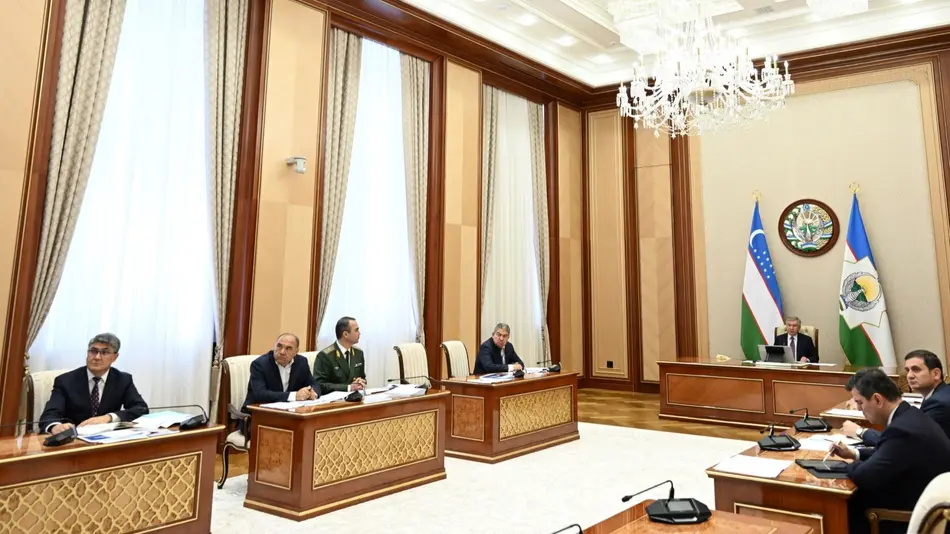
ТАSHKENT, July 1. /Dunyo IA/. President Shavkat Mirziyoyev reviewed a presentation outlining proposals to develop the transport and logistics system and to use the country’s transit potential effectively, reports Dunyo IA correspondent.
According to the press service of the Head of our State, today, Uzbekistan has broad opportunities to become a major land transport hub linking East and West. Four thousand kilometers of international transit corridors pass through the country, and the country also has a railway network spanning 4,700 kilometers.
Modern transport and logistics centers and dry ports are being developed in Tashkent, Navoi, and Namangan. Navoi Airport serves as an important cargo hub along Eurasian air routes.
Moreover, the construction of the China – Kyrgyzstan – Uzbekistan railway and the accelerated implementation of the Trans-Afghan Railway project will strengthen the country’s position in the regional and international transport system.
As a result of these major projects, Uzbekistan will become a key link in the shortest overland route from the Pacific Ocean to Europe. This corridor will cut cargo delivery times to eight days, three times shorter than on traditional routes. In addition, access to the Indian Ocean will be provided through the Pakistani ports of Karachi and Gwadar, offering the fastest route to South Asian markets, home to about 2 billion people.
It was noted that the country’s potential in this area has not yet been fully realized.
Annual trade turnover between China and Europe totals $800 billion, while freight traffic reaches 120-150 million tons. If Uzbekistan can handle an additional 15-20 million tons of international transit cargo annually, it could generate $400-600 million in additional revenue, attract $3 billion in foreign investment to construct logistics centers and terminals, and create 50,000 sustainable jobs. This could accelerate economic growth by 1.5-2 percentage points.
However, Uzbekistan’s share of this transit traffic currently does not exceed 1-2 percent. Although the volume of transit freight reached 15.3 million tons in 2025, a 54 percent increase compared with 2021, the country’s existing potential allows it to achieve much higher results.
According to estimates, despite the large number of border checkpoints, most lack sufficient capacity to receive and process international cargo promptly. The country has 27 logistics centers that meet international standards, with a combined capacity of 27.2 million tons. However, only one belongs to the highest category. Category A automated warehouse complexes cover only 10-15 percent of existing demand. There is also a shortage of modern refrigerated and customs warehouses.
It was also noted that logistics centers are mainly concentrated in Tashkent and its surrounding areas. The share of containerization remains low, the information systems of government agencies and private logistics centers are not fully integrated, and the level of digitalization in the sector remains insufficient.
The presentation proposed specializing the cities of Khanabad and Angren, as well as Yangiyul, Akhangaran, Alat, and Termez districts, in developing the transport and logistics sector.
The city of Khanabad, serving as the “gateway to the China route”, will handle the China – Central Asia – Caspian Sea – Caucasus – Europe, China – Central Asia – Trans-Afghan, and China – Central Asia – Iran transit corridors. The city of Angren, along with the Yangiyul and Akhangaran districts, will be developed as intermediate distribution centers for transit and foreign trade cargo.
Alat district will become the “gateway to the Middle Corridor” and specialize in the China – Central Asia – Caspian Sea – Caucasus – Europe and China – Central Asia – Iran routes. Termez district, in turn, will serve as the “gateway to the Trans-Afghan Corridor” and focus on the China – Central Asia – Trans-Afghan Corridor – Pakistan transport route.
Entrepreneurs planning to establish logistics centers in these areas will be offered 50 hectares of land in each district, totalling 300 hectares. Concessional and low-interest credit lines totalling $200 million are planned for annual allocation for these purposes. External infrastructure for the logistics centers will be developed using state budget funds.
Proposals were also reviewed for the construction of customs terminals and parking facilities in Qibray and Termez districts, the establishment of an international railway border checkpoint in the city of Khanabad, the expansion of the railway station in Yangiyul district, and the construction of a major Category A logistics center in Akhangaran district.
Particular attention during the presentation was given to digitalization and the introduction of modern management systems. It was proposed to introduce terminal and warehouse management systems at logistics centers, integrate them with the E-logistika platform, and establish systems for online monitoring, license plate recognition, and electronic vehicle registration.
The need to accelerate cargo clearance procedures at border checkpoints by introducing the one-stop principle was emphasized.
To attract more private investment in the sector, it was proposed to simplify customs duties and mandatory certification requirements for imports of modern equipment for logistics centers, warehouses, and cargo-handling machinery, units, and spare parts.
President emphasized that the transportation and logistics system is strategically important for expanding the country’s export potential, enhancing its investment attractiveness, and developing the regions.
The responsible officials were instructed to ensure the effective use of international transport corridors, expand the logistics center network, digitalize the sector, and create favourable conditions for the private sector.

Latest News




See all
Read also