Berlin hosts the First Uzbekistan–Germany Universities Forum
November 23, 2025. 13:54 • 6 min
• 1235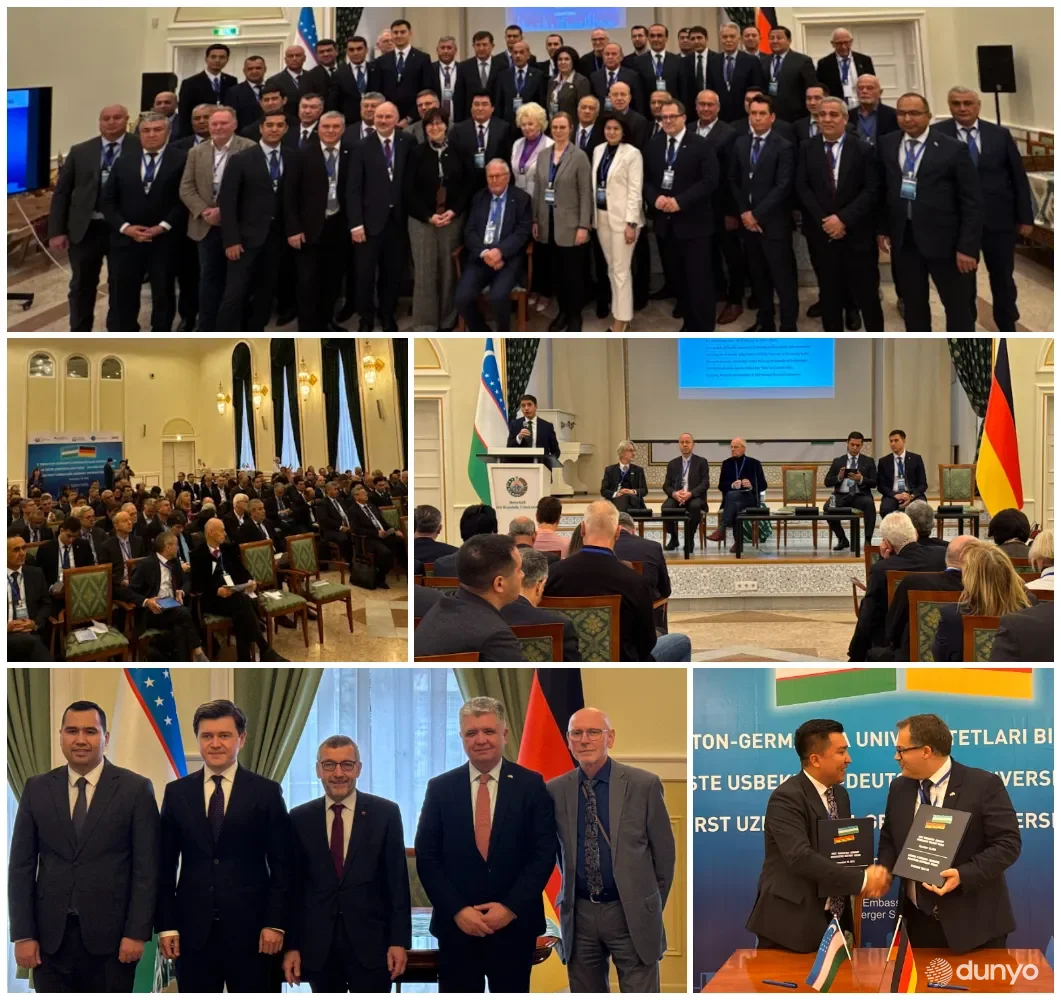
BERLIN, November 24. /Dunyo IA/. The Embassy of Uzbekistan in Germany, in cooperation with the Ministry of Higher Education, Science and Innovation of Uzbekistan, the Federal Ministry of Education and Research of Germany, the German Academic Exchange Service (DAAD), and the German Research Foundation (DFG), convened the First Uzbekistan–Germany Universities Forum in Berlin, reports Dunyo IA correspondent.

In a major event dedicated to advancing cooperation in higher education and scientific research, senior representatives of Germany’s Federal Ministry of Education and Research, the leadership and members of the German Rectors’ Conference (HRK), heads of universities, research institutes and academic centers, as well as representatives of scholarship foundations, participated alongside a delegation led by Sardor Radjabov, First Deputy Minister of Higher Education, Science and Innovation of Uzbekistan. In total, the forum brought together leaders of nearly 200 universities and research institutions from both countries.
During the opening ceremony, Ambassador Dilshod Akhatov welcomed the participants, noting that—thanks to the consistent reforms underway in Uzbekistan, including in the field of education—international cooperation is steadily expanding, particularly with Germany. He emphasized that the recent joint projects, forums and high-level conferences are clear evidence of this growing partnership. The Ambassador stressed that the forum holds historic significance, as it is being convened for the first time in Uzbekistan–Germany relations at a time when cooperation in politics, the economy, education, science and technology is advancing at an unprecedented pace. He also recalled that during the Fifth Meeting of the Uzbekistan–Germany Joint Commission on Cultural Cooperation, held on 28 October this year in Tashkent, the two sides reached important agreements aimed at expanding joint projects between universities, academic mobility programmes, cooperation among research institutes, and advancing new initiatives among young scholars.
The First Deputy Minister, in his remarks, underlined that cooperation between Uzbekistan and Germany in the field of education is entering a new stage. He highlighted the importance of further expanding joint academic programmes, collaborative research projects, and exchanges of faculty members and students between the universities and scientific institutions of the two countries. He stressed that the ongoing reforms in Uzbekistan’s higher education system are grounded in international best practices and innovation, adding that forums of this nature play a crucial role in advancing joint initiatives and deepening academic partnership.
In their remarks, Walter Rosenthal, President of the German Rectors’ Conference (HRK), and Karin Jacobs, Vice President of the German Research Foundation (DFG), expressed their strong interest in further expanding cooperation with Uzbekistan in the fields of science and education. They conveyed their readiness to advance joint research projects and deepen academic collaboration with Uzbek institutions.
Within the framework of the Forum, panel sessions were held on "Education and Academic Cooperation" and "Scientific Research and Innovations". Rectors of universities from Uzbekistan and Germany delivered presentations on key thematic areas and responded to participants’ questions regarding prospects for deeper collaboration.
In addition, during bilateral meetings, rectors of the two countries’ universities reached agreements on new areas of cooperation, and more than 60 memoranda and cooperation agreements were signed.
At the conclusion of the event, several German professors who have made notable contributions to advancing cooperation in education and science with Uzbekistan were awarded the title of "Honorary Professor" by the rectors of Uzbek universities.
The forum served as a vital and effective platform for deepening contemporary cooperation in the fields of science and education.
Prof. Dr. Walter Rosenthal, President of the German Rectors’ Conference:
- Today, our countries have established very strong collaborative relations in the field of science, and academic exchange between universities is developing dynamically. The high level of participation in this forum reflects the strong interest in mutual cooperation. I had an excellent discussion with the Deputy Minister of Uzbekistan. During our conversation, we focused on four key areas: accreditation, the establishment of universities in both countries, the creation of a high-level scientific research cluster, and student exchange programs. We are now committed to continuing close cooperation in these four specific directions.
Prof. Dr. Karin Jakobs, Vice-President of the German Research Foundation (Deutsche Forschungsgemeinschaft, DFG), stated:
- I am very pleased to participate in today’s forum. I am representing the President of the DFG, Prof. Katja Becker. Here, we had the opportunity to meet numerous Uzbek and German scientists, university rectors, and representatives of institutions interested in collaborating with Uzbekistan. Understanding the potential of the Uzbek side for implementing joint scientific projects is very important for us. Next spring, we plan to visit Uzbekistan with a large delegation from German universities of applied sciences and technical colleges to explore cooperation opportunities with relevant educational institutions within the framework of three major scientific projects. We have received nearly 100 project applications from Uzbekistan and approximately 60–70 from Germany. During our visit, we will establish direct contacts between both sides, and I am confident that this will result in numerous high-level scientific collaborations. The German Research Foundation is the largest financer of scientific projects in Germany. Each year, we support over 30,000 projects, with about 20% involving international collaboration. Approximately €3 million is allocated annually to support these international joint projects.
Bahrom Tulaganov, Rector of Tashkent State University of Architecture and Construction, stated:
- This forum marked the first-ever Uzbekistan–Germany Universities Forum and served as a platform for multifaceted agreements between higher education institutions of both countries. Key outcomes included agreements on the implementation of dual education programs, integration of industry with higher education, and the alignment of industrial development with scientific research initiatives. Additionally, long-term educational grants were discussed in collaboration with German research and academic exchange foundations. The German delegation highlighted, on multiple occasions, the multi-vector and comprehensive nature of Uzbekistan’s international cooperation, noting the country’s growing openness. Throughout the forum, strong interest and confidence in cooperation with Uzbekistan were expressed. The recognition and long-term commitment demonstrated by our German partners reflect the successful results of the extensive reforms being carried out across all sectors in our country, particularly in higher education, under the leadership of our President."
According to Presidential Decree No. 209, signed on 19 May this year, the ongoing modernization and transformation of Tashkent State University of Architecture and Construction includes cooperation with Germany’s Bauhaus University, as well as the Technical Universities of Dresden, Aachen, Potsdam, and Munich. This collaboration focuses on dual education programs, student and researcher exchanges, and research in areas such as green construction, seismic safety, sustainable building, construction material innovations, and export development. Currently, over 20 Uzbek students are pursuing studies in Germany as part of these academic exchange programs.


See all