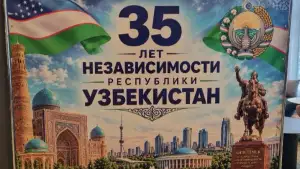
Abdusamat Khaydarov: Independence has become a resource for the national development and international influence of Uzbekistan
September 09, 2026. 13:00 • 5 min
• 134
TASHKENT, September 9. /Dunyo IA/. Director of the Diplomatic Academy under the University of World Economy and Diplomacy of the Ministry of Foreign Affairs of Uzbekistan, former Ambassador to Iran, Professor Abdusamat Khaydarov, in a comprehensive interview with the “Pravda Vostoka” newspaper, shared his assessments of the key outcomes of the country's 35-year period of independence, emphasizing the shifts in foreign policy course, the strengthening of regional cooperation in Central Asia, and the growth of Uzbekistan's international subjectivity, reports Dunyo IA correspondent.
According to him, over the years of independence, a solid institutional foundation of statehood has been formed in the country, national systems of administration, finance, and banking have been established, the framework of a socially oriented market economy has been laid, and defense capability and national security have been strengthened. Furthermore, after 2016, Uzbekistan transitioned to a more dynamic and open model of development based on large-scale systemic reforms, economic liberalization, enhancement of public administration efficiency and an intensification of foreign policy.
It was noted that one of the most significant outcomes of the transformations has been the shift in the character of the foreign policy course. The foreign policy of Uzbekistan has become more open, pragmatic, constructive and proactive. At its core are political dialogue, mutually beneficial cooperation, good-neighborliness, and the advancement of the country's economic interests.
Furthermore, foreign policy is viewed not only from the perspective of ensuring security but also as a vital resource for implementing domestic reforms, attracting investment and technology, expanding trade and developing transport links and regional connectivity. Among the key tasks of diplomacy are the strengthening of sovereignty, maintaining peace and stability in Central Asia, developing a balanced system of strategic partnerships, and promoting Uzbekistan's international initiatives.
Particular attention in the interview is paid to Central Asia, which is defined as Uzbekistan's primary foreign policy priority. As the Professor emphasized, relations with Kazakhstan, Kyrgyzstan, Tajikistan and Turkmenistan have significantly strengthened in recent years, with an intensification of political contacts, trade, investment, transport and border cooperation, as well as cultural and humanitarian exchanges.
According to his assessment, substantial progress has been achieved in matters concerning state borders, border-crossing regimes, and water-energy cooperation. Central Asia is becoming a more open, interconnected and predictable space.
Special emphasis was placed on the role of the Consultative Meetings of the Heads of State of Central Asia, which established a mechanism for regular direct dialogue among the countries of the region. According to Abdusamat Khaydarov, these summits facilitated the transition from predominantly bilateral contacts to systemic regional engagement, fostering a shared understanding of responsibility for the security, stability and sustainable development of Central Asia.
Speaking on Afghanistan, the expert highlighted the comprehensive nature of Uzbekistan's approach, which encompasses security matters, political and diplomatic settlement, humanitarian support, economic recovery and the integration of the country into regional cooperation.
In his view, Afghanistan should be considered not only as a security factor but also as a potential transit link between Central and South Asia. In this context, projects in energy, transport, and communications hold particular significance, including the Trans-Afghan Railway project along the Termez – Mazar-i-Sharif – Kabul – Peshawar route. The implementation of such initiatives is capable of strengthening regional connectivity and opening up a shorter access route to Indian Ocean ports for Central Asia.
A separate section of the interview is dedicated to expanding the geography of Uzbekistan's external ties. As Abdusamat Khaydarov noted, this does not imply a reorientation toward individual partners, but rather the formation of a balanced system of strategic partnerships.
According to him, along with the development of political, trade, economic, investment, energy, and transport cooperation with Russia and China, partnership with the United States and the European Union is expanding. Ties with the Republic of Korea, Japan, Türkiye, India and the states of the Arab-Muslim world are actively developing.
At the same time, economic diplomacy is playing an increasingly vital role. The expansion of external relations allows Uzbekistan to diversify trade and investment flows, attract technologies, access new markets and develop transport and logistics capabilities. Cooperation with the Saudi company ACWA Power is cited as one example, with its total project portfolio in the renewable energy sector in Uzbekistan exceeding $12 billion by 2026.
Emphasizing the increased role of Uzbekistan on the international stage, Professor noted the country’s transition to a more proactive multilateral diplomacy. The Republic actively promotes its own initiatives within the UN and other international and regional organizations, paying special attention to the issues of Central Asia, Afghanistan, environmental security, sustainable development, education, and tolerance.
In this context, the significance of the first “Central Asia – European Union” summit, held in April 2025 in Samarkand under the chairmanship of the President of Uzbekistan, was highlighted. Following the meeting, relations between Central Asia and the European Union were elevated to the level of a strategic partnership.
Theme of diplomatic training was also separately addressed. According to Abdusamat Khaydarov, a modern diplomat must possess not only knowledge in protocol and international law, but also a deep understanding of world politics and economics, analytical capabilities, foreign language proficiency and negotiation skills.
In this regard, the formation of a system of continuous diplomatic education, combining fundamental training, retraining and advanced professional development of specialists, is of paramount importance.
Summing up the 35-year period of Independence, Abdusamat Khaydarov named the consistent strengthening of state sovereignty and the qualitative growth of Uzbekistan's international subjectivity as the main achievements.
He emphasized that independence has become not only a political and legal reality but also a resource for national development, which has allowed the country to implement its own model of reforms, strengthen its economic potential, modernize production, develop entrepreneurship and expand international economic ties.
According to his assessment, today Uzbekistan not only participates in regional and global processes but also acts as an initiator of international initiatives, gaining the opportunity not merely to react to unfolding changes but to actively participate in shaping the international agenda on security, sustainable development, connectivity and cooperation.

Latest News


See all
Read also
Johann Saathoff: Uzbekistan has become an important partner for Germany and Europe in Central Asia
“China Daily”: Uzbekistan-China Partnership enters a more mature and strategically important stage
Meetings with Citizens of Uzbekistan held in Istanbul on the occasion of the 35th Anniversary of Independence

35th Anniversary of Independence of Uzbekistan broadly celebrated in Hamburg