Uzbekistan elected Chair of the 25th General Assembly of the States Parties to the UNESCO World Heritage Convention
November 12, 2025. 10:02 • 5 min
• 1793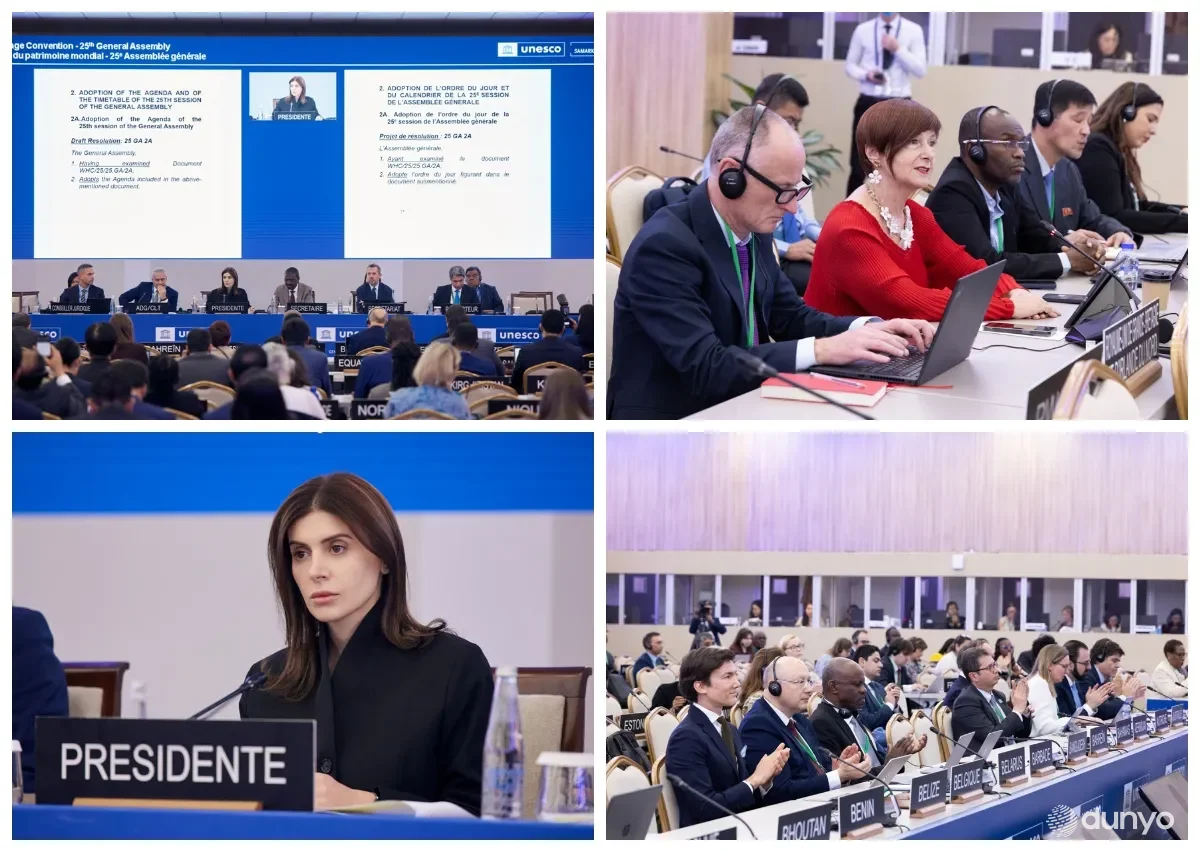
SAMARKAND, November 12. /Dunyo IA/. Gayane Umerova has been elected as Chairperson of the 25th Session of the General Assembly of the States Parties to the UNESCO World Heritage Convention, reports Dunyo IA correspondent.

On 11 November, at the 43rd Session of the General Conference of UNESCO in Samarkand, the States Parties to the Convention Concerning the Protection of the World Cultural and Natural Heritage unanimously endorsed the candidacy of Uzbekistan’s representative for the position of Chair of the 25th General Assembly of the States Parties to the Convention.
The World Heritage Convention serves as a key international instrument for the preservation of sites of Outstanding Universal Value. The General Assembly of the States Parties defines the Convention’s strategic priorities — ranging from the inscription of new properties on the World Heritage List to the adoption of decisions aimed at their conservation, promotion, and the strengthening of international cooperation.
The Chairperson of the General Assembly is elected for the duration of a single session, which is convened once every two years. The Chairperson’s mandate includes presiding over the meetings, ensuring compliance with the Rules of Procedure, coordinating the interaction between the General Assembly, the World Heritage Committee and the UNESCO Secretariat, representing the Assembly at international events, and facilitating consensus in the decision-making process.
Gayane Umerova is an Uzbek art historian, curator, and cultural leader. She holds master’s degrees in Contemporary Art and Art Business. Since 2017, she has headed the Art and Culture Development Foundation of Uzbekistan, overseeing major national and international projects, including the establishment of the Center for Contemporary Art in Tashkent, the construction of the new National Museum, and the organization of large-scale international cultural events.
Since 2020, Ms. Umerova has served as Secretary-General of the National Commission of the Republic of Uzbekistan for UNESCO under the Cabinet of Ministers. In 2025, she was appointed Head of the Department for Creative Economy and Tourism within the Presidential Administration of the Republic of Uzbekistan.
She is a recipient of the French Order of Arts and Letters (Ordre des Arts et des Lettres) and has been featured among international rankings of the most influential women in the arts. Under her leadership, Uzbekistan has implemented a number of prominent international cultural initiatives — among them, the country’s participation in the Venice Biennale stands out as a landmark achievement.
At the 25th Session of the General Assembly of the States Parties to the UNESCO World Heritage Convention, delegates will address a number of key issues, including the election of new members to the World Heritage Committee, the adoption of strategic decisions on the preservation of World Heritage properties, the development of international partnerships, and the integration of digital technologies. The session will also explore new approaches to museum and cultural activities, with special emphasis on youth engagement, sustainable development, and the promotion of cultural tourism.
The Bureau of the General Assembly has been formed with due regard to geographical balance, comprising a Chairperson, four Vice-Chairs, and a Rapporteur. The Vice-Chairs represent Belgium, Mexico, Kazakhstan, and Senegal, while the Rapporteur’s functions are performed by Naufel El Majdoub of Morocco. This inclusive approach ensures a broad representation of perspectives in discussions on the preservation and promotion of World Heritage. The remaining agenda items, including the election of new members to the World Heritage Committee, will be considered in November 2025 at UNESCO Headquarters in Paris
Uzbekistan continues to strengthen its cooperation with UNESCO, advancing initiatives in museum digitalization, restoration projects, and international research programs. The country’s new initiatives are aimed at enhancing the role of culture in education, and at fostering interregional cooperation and intercultural dialogue as key drivers of sustainable development and mutual understanding.
The election of Gayane Umerova represents a significant achievement for Uzbekistan and the wider Central Asian region. Central Asia is increasingly seen not merely as a custodian of great heritage, but as an active participant in global cultural process.
Experts note that for Uzbekistan, this represents a new opportunity to showcase the country’s contemporary transformations through art, heritage, and international cooperation. The decision underscores that culture is not only a reflection of the past, but also a resource for the future, capable of strengthening mutual understanding and fostering cooperation between states.
It can confidently be said that the 43rd Session of the UNESCO General Conference in Samarkand was truly historic for Uzbekistan.
As part of the session, an international scientific conference titled "Samarkand: 3,000 Years of Heritage" was held, organized by the Uzbekistan Fund for the Development of Culture and Arts in collaboration with the Academy of Sciences, the Samarkand Institute of Archaeology, and the Samarkand Regional Administration, with the support of UNESCO. Participants — leading archaeologists and experts, including Lazare Elundu Assomo, Director of the UNESCO World Heritage Centre, Professor Temur Shirinov, and Dr. Claude Rapin — presented the results of international research, which led to a scientific conclusion: the history of Samarkand spans at least 3,000 years, revising the previous estimate of 2,750 years.
In addition, the conference saw the inaugural presentation of the UNESCO - Uzbekistan International Prize in the Name of Abu Rayhan Beruni - the first United Nations award dedicated to the ethics of artificial intelligence. Established at the initiative of President Shavkat Mirziyoyev, the prize recognizes scientific achievements and international cooperation in AI ethics. The 2025 laureates include Professor Virgilio Almeida (Brazil), Professors Susan Perry and Claudia Roda (USA–Italy), and the Tsinghua University Institute for International AI Governance (China). Another significant outcome was the election of Khaled El-Enany of Egypt as the new Director-General of UNESCO. A renowned Egyptologist and former Minister of Antiquities and Tourism, he becomes the first leader of the organization from the Arab world and only the second representative of Africa to hold this post.
These milestones underscore Samarkand’s role as a strategic platform shaping the global cultural agenda: the city’s 3,000-year heritage was confirmed, the first international AI ethics prize was established, and a new UNESCO Director-General was appointed - all consolidating Uzbekistan’s position as an active participant in global cultural processes.
See all